
The utilization of exterior commercial square footage—ranging from corporate campus courtyards and corporate dining patios to hospitality rooftop terraces—has become a critical component of modern facility planning. Converting these outdoor areas into functional, revenue-generating, or collaborative spaces requires capital investment in exterior furnishings. However, deploying furniture in uncontrolled environments exposes these assets to severe environmental stressors: constant ultraviolet (UV) radiation, drastic thermal cycling, saline moisture in coastal areas, and high-velocity wind loads.
For facility managers and corporate procurement officers, specifying outdoor furniture is a strict exercise in material science and structural engineering. Residential-grade patio sets fail rapidly under commercial use, resulting in structural collapse, severe color fading, and exorbitant replacement costs. This technical guide outlines the rigorous environmental tolerances, material specifications, and operational logistics required to successfully source and deploy weatherproof outdoor furniture for commercial applications.
Material Science: The Failure Points of Traditional Outdoor Seating
Understanding what materials to avoid is the first step in commercial exterior procurement. Traditional materials that dominate residential markets exhibit critical failure points when subjected to the high-traffic, low-maintenance realities of a corporate facility.
Corrosion and Oxidation in Ferrous Metals
Steel and wrought iron are historically popular for outdoor applications due to their immense static load capacity. However, ferrous metals are highly susceptible to oxidation (rust). While manufacturers apply powder-coated finishes to seal the metal, this barrier is easily compromised in commercial settings by chairs scraping against concrete pavers or striking other metal frames. Once the coating is breached, moisture infiltrates the substrate, causing the steel to rust from the inside out. This not only destroys the structural integrity of the chair but also causes rust stains to bleed onto expensive commercial hardscaping, creating secondary damage for the facility.
Organic Degradation: Wood and Natural Fibers
Natural materials such as teak, acacia, and authentic rattan require intense, continuous maintenance. Wood is hygroscopic; it absorbs environmental moisture and swells, then contracts as it dries. This thermal and hygroscopic cycling causes the timber to check, splinter, and eventually rot unless treated with specialized penetrating oils on a quarterly basis. In a commercial environment, allocating janitorial labor hours for the constant sanding and oiling of outdoor furniture is fiscally inefficient. Natural rattan and wicker suffer from hydrolysis and UV embrittlement, snapping and unravelling within a single season of exposure.
The Polypropylene Mandate: Engineering the Commercial Standard
To mitigate the maintenance overhead and failure rates of metal and wood, commercial exterior procurement has pivoted heavily toward advanced thermoplastics, specifically high-density polypropylene (PP).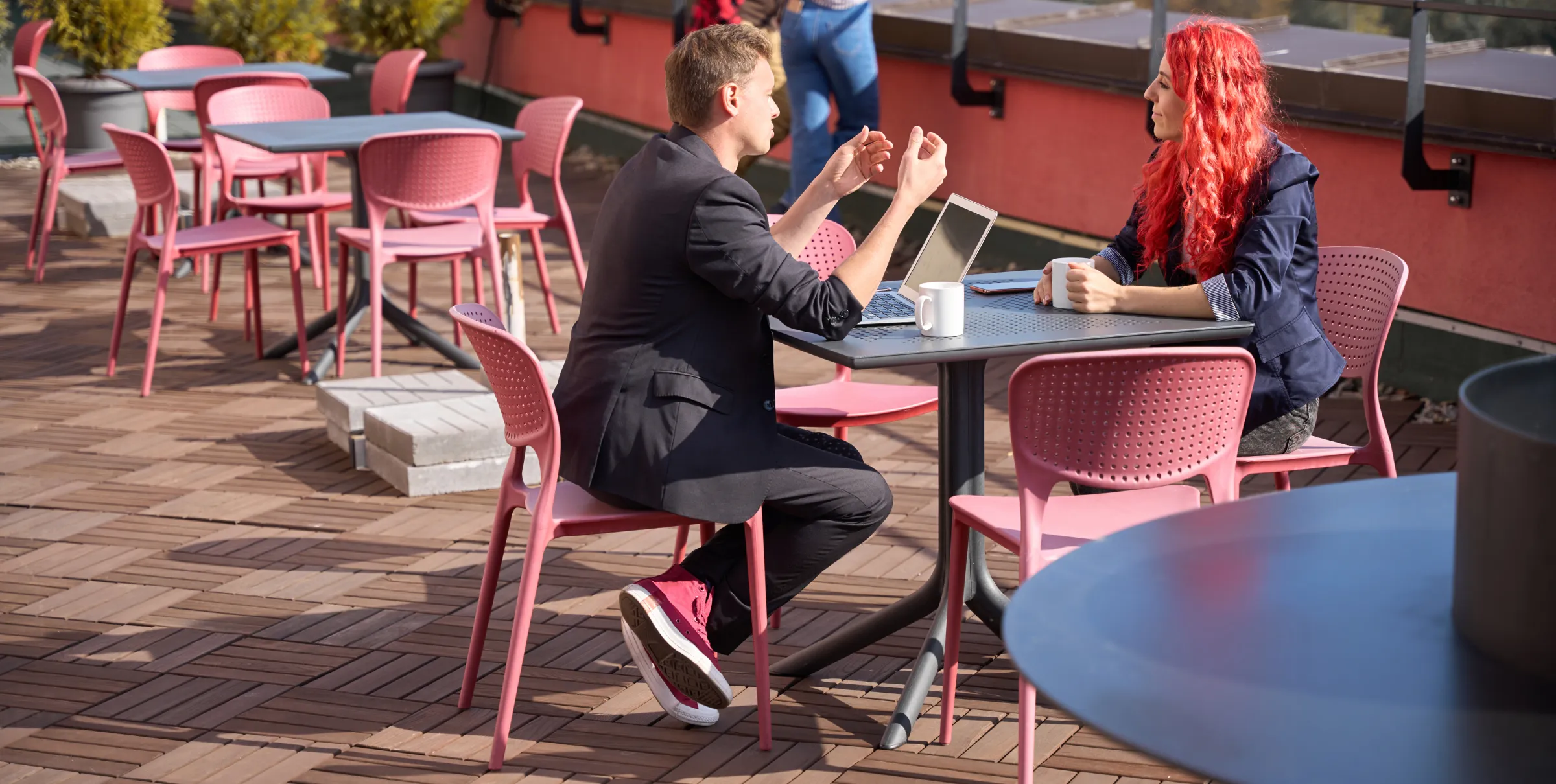
Hydrophobic Properties and Monolithic Construction
Polypropylene is an inherently hydrophobic polymer, meaning it completely repels water at a molecular level. It will never absorb moisture, rot, warp, or rust. Furthermore, moulded polypropylene chairs are manufactured using gas-assisted injection molding. This creates a monolithic, single-piece structure without mechanical joints, screws, or welds. Because mechanical fasteners (screws and bolts) are the primary points of failure and rust in outdoor furniture, eliminating them entirely via monolithic molding increases the lifecycle of the asset exponentially.
UV Stabilizers and Photochemical Resistance
The most destructive force for outdoor plastics is photochemical degradation caused by UV radiation. Unprotected plastics undergo chain scission when exposed to sunlight, causing the material to become brittle and the pigment to chalk and fade. When specifying polypropylene chairs outdoor for commercial use, buyers must demand documented evidence of UV stabilizers integrated into the polymer matrix. These chemical additives absorb or scatter UV energy, preventing it from breaking the polymer chains. High-grade commercial PP furniture retains its tensile strength and colorfastness for thousands of hours of direct sunlight exposure.
Structural Engineering for High-Wind Environments
Corporate patios, especially those elevated on rooftops or situated in urban wind tunnels, face unique aerodynamic challenges. Furniture that is too light will be displaced or thrown by heavy gusts, causing severe property damage and safety liabilities.
Aerodynamic Perforation and Weight Optimization
Solid-backed plastic or metal chairs act as sails, catching the wind and tipping over easily. To combat this, commercial polypropylene garden chairs are frequently engineered with perforated backrests or lattice structures. This design allows wind to pass directly through the chair, drastically reducing the aerodynamic drag coefficient. While PP is lightweight, manufacturers often inject fiberglass into the polypropylene matrix during the molding process. This fiberglass reinforcement adds necessary mass to anchor the chair in high winds while simultaneously doubling the flexural strength of the legs.
The Stackable Mandate for Severe Weather Protocols
Regardless of aerodynamic design, extreme weather events (such as hurricanes or winter blizzards) require facility teams to clear the exterior patio rapidly. The ability to dense-pack the furniture is a mandatory procurement specification. A commercial polypropylene stackable chair allows maintenance staff to stack seating vertically (often up to 8 or 10 chairs high) and move them via dolly into indoor storage or secure them tightly against structural walls. Non-stacking outdoor chairs consume massive amounts of off-season storage space and complicate severe weather lockdown procedures.
Facility Maintenance and Sanitization Protocols
Outdoor furniture is subjected to environmental soiling, including bird droppings, tree sap, urban smog particulate, and food spills in corporate dining areas. The specified materials must tolerate aggressive cleaning without degrading.
Drainage and Water Pooling Mitigation
Following a rainstorm, outdoor dining areas must be rapidly turned over for use. If a chair's seat pan is perfectly flat or concave without drainage, water will pool, requiring janitorial staff to manually wipe down every single seat before employees or guests can use them. Commercial polypropylene dining chairs are engineered with subtle convex seat sloping or integrated drainage channels (weep holes) that allow rainwater to sheet off immediately. This self-draining geometry drastically reduces the time required to reopen the patio after inclement weather.
Chemical Resistance in Cleaning
In high-turnover exterior dining spaces, sanitization is critical. PP exhibits phenomenal chemical resistance. Unlike wood varnishes or inferior plastics that cloud or melt when exposed to industrial degreasers, bleach solutions, or quaternary ammonium compounds, fiberglass-reinforced polypropylene can be power-washed and aggressively sanitized daily. This makes a complete polypropylene table and chairs setup the most hygienic option for outdoor corporate cafeterias and hospitality terraces.
Strategic Sourcing and Lifecycle Calculation
Procuring commercial exterior furniture should never be based on the lowest initial purchase price. Facility managers must calculate the Total Cost of Ownership (TCO), factoring in the anticipated lifecycle, the cost of off-season storage, and the janitorial labor required for daily maintenance.
As detailed in our specialized polypropylene shell chairs buyers guide, investing in fiberglass-reinforced, UV-stabilized, injection-molded PP furniture yields the highest ROI for outdoor spaces. It eliminates the need for painting, oiling, and rust remediation. By prioritizing monolithic construction, aerodynamic efficiency, and chemical resistance, corporations can deploy outdoor architectural spaces that remain durable, safe, and visually immaculate across all four seasons.
Frequently Asked Questions
Why shouldn't I buy standard metal chairs for a commercial outdoor patio?
Standard ferrous metals (like steel and iron) will inevitably rust when their powder-coated finish is scratched by heavy commercial use. This rust compromises the structural integrity of the chair and bleeds onto expensive concrete or stone hardscaping, causing permanent stains and requiring costly remediation.
How does UV radiation damage outdoor plastic furniture?
UV radiation causes a photochemical reaction known as chain scission in unprotected plastics. This breaks down the molecular bonds, leading to severe color fading (chalking) and making the plastic highly brittle, causing it to crack under the weight of a user. Commercial outdoor furniture must be manufactured with UV-stabilizing chemical additives to prevent this.
What is the advantage of injection-molded polypropylene over assembled furniture?
Injection-molded polypropylene chairs are created as a single, monolithic piece. They have no screws, bolts, or mechanical joints. Because mechanical fasteners are the most common points of failure, loosening, and rust in outdoor furniture, eliminating them exponentially increases the chair's lifespan and safety.
How do I prevent outdoor chairs from blowing away in high winds?
To mitigate wind displacement, specify chairs with perforated or lattice backrests that allow air to pass through, reducing aerodynamic drag. Additionally, look for polypropylene that is reinforced with fiberglass, which adds necessary mass and structural rigidity without making the chair impossible to move.
Why is stackability a crucial feature for commercial patio furniture?
Commercial facilities require stackable chairs to execute severe weather protocols rapidly. When storms approach or winter begins, maintenance staff must be able to dense-pack the furniture to move it indoors or secure it. Stackable chairs drastically reduce the square footage required for off-season storage.
Do I need to manually dry polypropylene chairs after it rains?
High-quality commercial polypropylene outdoor chairs are engineered with self-draining geometry. The seat pans feature slight convex sloping or integrated weep holes that allow rainwater to sheet off completely. This eliminates water pooling and allows the patio to be used almost immediately after a rainstorm without requiring manual wipe-downs.
