
Ask three furniture suppliers for a "laminate desk" and you will receive quotations for three materially different products at three different price points, all technically honest. Surface terminology in commercial desking is genuinely confusing—melamine, TFL, MFC, and laminate overlap and contradict each other across markets—and buyers who do not pin down the definitions end up comparing quotations that are not comparable. The desk surface determines scratch life, repairability, replacement matching, and a large share of unit cost, so it deserves the same specification discipline as frames and mechanisms.
This guide defines the three material families that cover nearly every commercial desk surface—melamine (thermally fused laminate), high-pressure laminate, and wood veneer—and maps them against the performance metrics and project conditions where each one earns its place. The zoning logic at the end is the same approach Aston Office applies when configuring executive office desk and workstation programs.
The Terminology Problem: What Suppliers Actually Mean by "Laminate"
Three definitions resolve most quotation confusion. Melamine, sold as TFL (thermally fused laminate) in North America and MFC (melamine-faced chipboard) in Europe, is a decorative paper saturated with melamine resin and fused directly onto a particleboard or MDF core in a single press cycle—no glue line, no separate sheet. HPL (high-pressure laminate) is a standalone sheet built from multiple phenolic kraft-paper layers under the decorative face, pressed above 1,000 psi, then bonded to a substrate as a second fabrication step. Wood veneer is a thin slice of real hardwood glued to a stable core and finished with lacquer. When a quotation says "laminate," the first question is always which of the first two it means, because the performance gap between them is not subtle.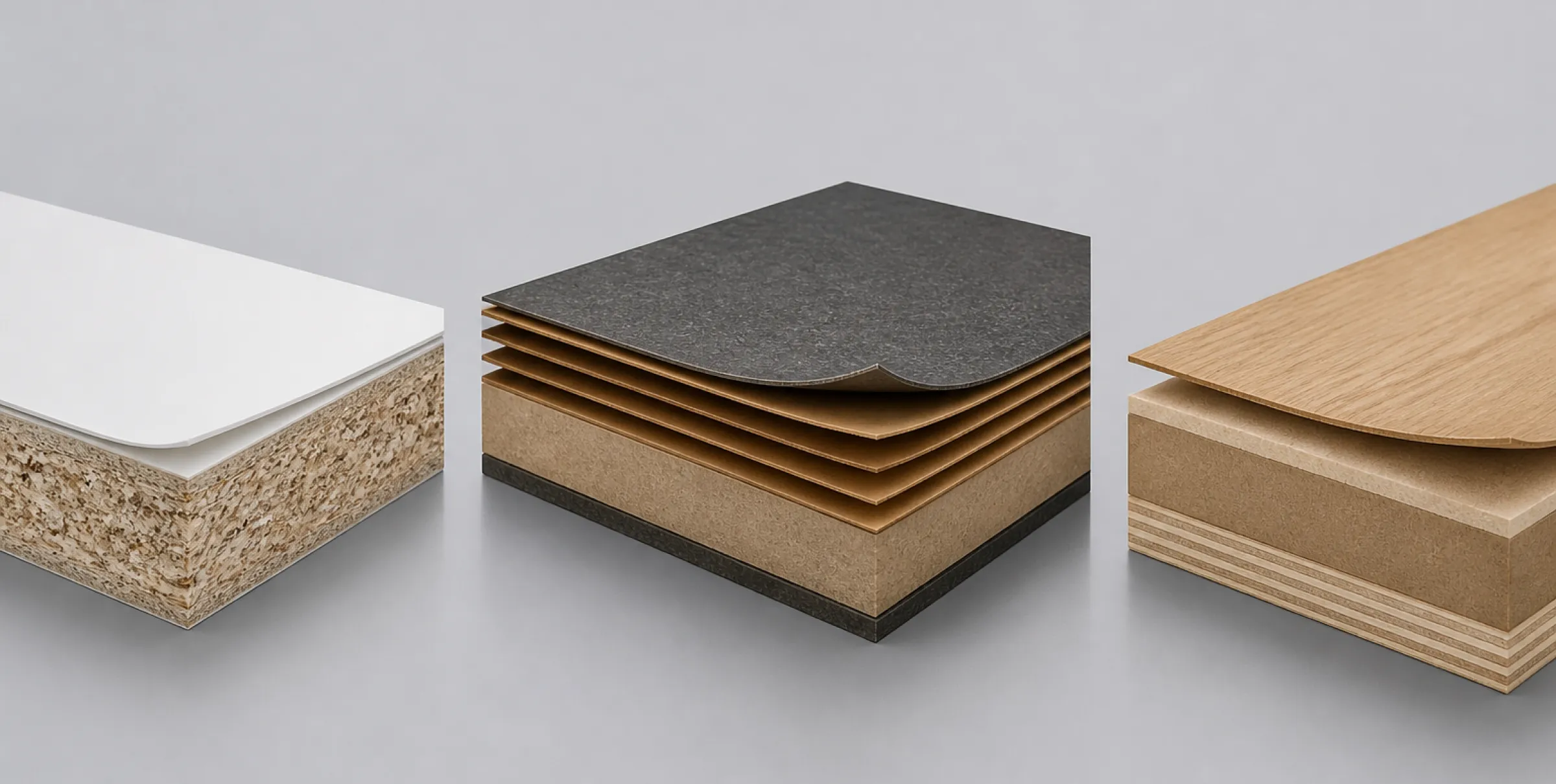
Melamine (TFL): The Volume Standard for Office Desking
Melamine-faced panels dominate commercial desking for sound economic reasons: the surface and the board are produced in one step, the panel arrives ready for cutting and edge banding, and the material cost sits well below the alternatives. European production is governed by EN 14322, where Class 3 commercial ratings specify scratch resistance of at least 2.0 N, stain resistance at Rating 5 (no visible mark after 16 hours of contact with coffee, wine, acetone, or common cleaning agents), and lightfastness of Blue Wool Scale 6 or better. A Class 3 melamine surface is a genuinely serviceable commercial material for general workstations, private offices, and storage furniture.
Its limits are equally well documented. Laminate manufacturers themselves—including the brands that sell both product lines—state directly that TFL carries significantly lower scratch, wear, and impact resistance than HPL. NEMA LD-3 wear testing puts melamine surfaces in the 200-to-400-cycle range against 400 to 1,000+ for general-purpose HPL. Melamine cannot be postformed around curved edges, chips at corners under impact, and is not field-repairable: a damaged panel is a replaced panel. For a volume run of wooden office desks in standard workstation use, those limits are acceptable. For a reception counter, they are not.
HPL: The Surface for High-Traffic Horizontal Work
HPL earns its 20-to-50 percent price premium on horizontal surfaces that take abuse: reception counters, conference tables, training-room worksurfaces, and any desk in a multi-shift or public-facing environment. The multi-layer kraft-paper construction produces a thicker wear surface (general-purpose grades run 0.028 to 0.048 inches), superior impact resistance, and better tolerance for heat and aggressive cleaning chemicals. It is also the only laminate that postforms—heating and wrapping around a radiused edge for a seamless, waterproof profile—which is why cafeteria counters and healthcare casework specify it by name.
Two procurement notes apply. First, many commercial specifications call out HPL explicitly, and substituting melamine may not be accepted at submittal review; the AWI casework standard, for example, permits low-pressure decorative laminate on exposed surfaces only at Economy grade. Second, HPL is a fabrication step, not a panel product: the sheet is bonded to a substrate with adhesive, adding three to five days of fabrication time versus roughly two for melamine panels, which matters on compressed project schedules.
Wood Veneer: The Executive Tier With a Maintenance Contract Attached
Veneer occupies a different category because it is a different value proposition. It delivers real grain, real depth, and the one property no printed surface can replicate: no two panels are identical. In boardrooms and executive suites, that authenticity is the point, which is why modern executive desks and director-level furniture anchor on veneer finishes. The distinction between desk tiers and their material expectations is covered in our comparison of director tables and executive desks.
The trade-offs are operational. Veneer measures around Mohs 2 for scratch resistance against melamine's Mohs 3 to 4, so it marks faster under daily abrasion. It demands sealed edges and disciplined care—our wooden desk maintenance guide covers the protocols—and it requires 4 to 6 weeks of lead time plus lacquer curing, the longest cycle of the three. Against that stand two decisive advantages: veneer is the only one of the three that can be sanded and recoated on site, and it can extend its service life indefinitely under proper maintenance. A veneered boardroom table can be refinished at year ten; a chipped melamine one cannot.
One caution applies to replacement planning: natural veneer varies by log and batch, so a replacement panel ordered five years later may not match the original. Buyers of large veneer programs should order attic stock—spare finished panels from the original batch—as part of the initial purchase.
Side-by-Side Specification Comparison
| Criterion | Melamine (TFL/MFC) | HPL | Wood Veneer |
|---|---|---|---|
| Construction | Decorative paper fused to board in one press cycle | Multi-layer kraft-paper sheet bonded to substrate | Sliced hardwood glued to MDF or plywood core |
| Wear resistance (NEMA LD-3) | 200–400 cycles | 400–1,000+ cycles | Lower; depends on lacquer system |
| Scratch resistance | ≥2.0 N (EN 14322 Class 3); Mohs 3–4 | Category-best | Mohs ~2 |
| Edge treatment | PVC/ABS banding, visible joint | Self-edge or postformed, seamless option | Solid wood edge, nearly invisible |
| Field repair | None; panel replacement | Difficult; specialist patching | Sand and recoat on site |
| Typical lead time | 2–3 weeks | 3–4 weeks + fabrication | 4–6 weeks + lacquer curing |
| Replacement matching | Exact reprint available years later | Exact reprint available years later | Batch-variable; order attic stock |
| Best-fit zones | Workstations, storage, private offices | Reception, conference, training, high-traffic | Boardrooms, executive suites |
Edge Banding and Core Boards: Where Surface Systems Actually Fail
Surface failures in the field concentrate at edges and penetrations, not in the middle of panels. Melamine systems depend on their edge banding: specify laser or hot-air banding for a near-invisible glue line on visible edges, and 2 mm PVC or ABS banding on impact-exposed edges rather than 0.4 mm. HPL's postformed edge removes the joint entirely on counters. Veneer uses solid wood edge profiles that protect the vulnerable veneer edge from chipping.
The core board matters as much as the face. European specification centers on EN 312 grades: P2 for dry interior use, P5 for load-bearing panels in humid conditions. Balanced construction—matching paper weights and resin content on both faces of the panel—prevents the hygroscopic warping that shows up as cupped desktops months after installation. For long office desks and extended conference surfaces, core grade and balance are the difference between a flat table at year five and a warranty claim.
Specifying by Zone: Matching Material to Use Intensity
Most commercial projects do not need one surface material; they need a zoning decision. The pattern that consistently performs: melamine across general workstations and storage, HPL on reception counters, conference tables, and training surfaces, and veneer reserved for boardrooms and executive suites where its maintenance cost is justified by its role. Mixed programs of this kind typically save 20 to 30 percent against an all-HPL specification with no visible compromise, because the premium material lands only where traffic justifies it. Reception counters in particular should default to HPL or veneer regardless of the workstation standard—the counter is the highest-contact surface in the building, and our reception desk procurement guide details the traffic and compliance geometry that drives that specification.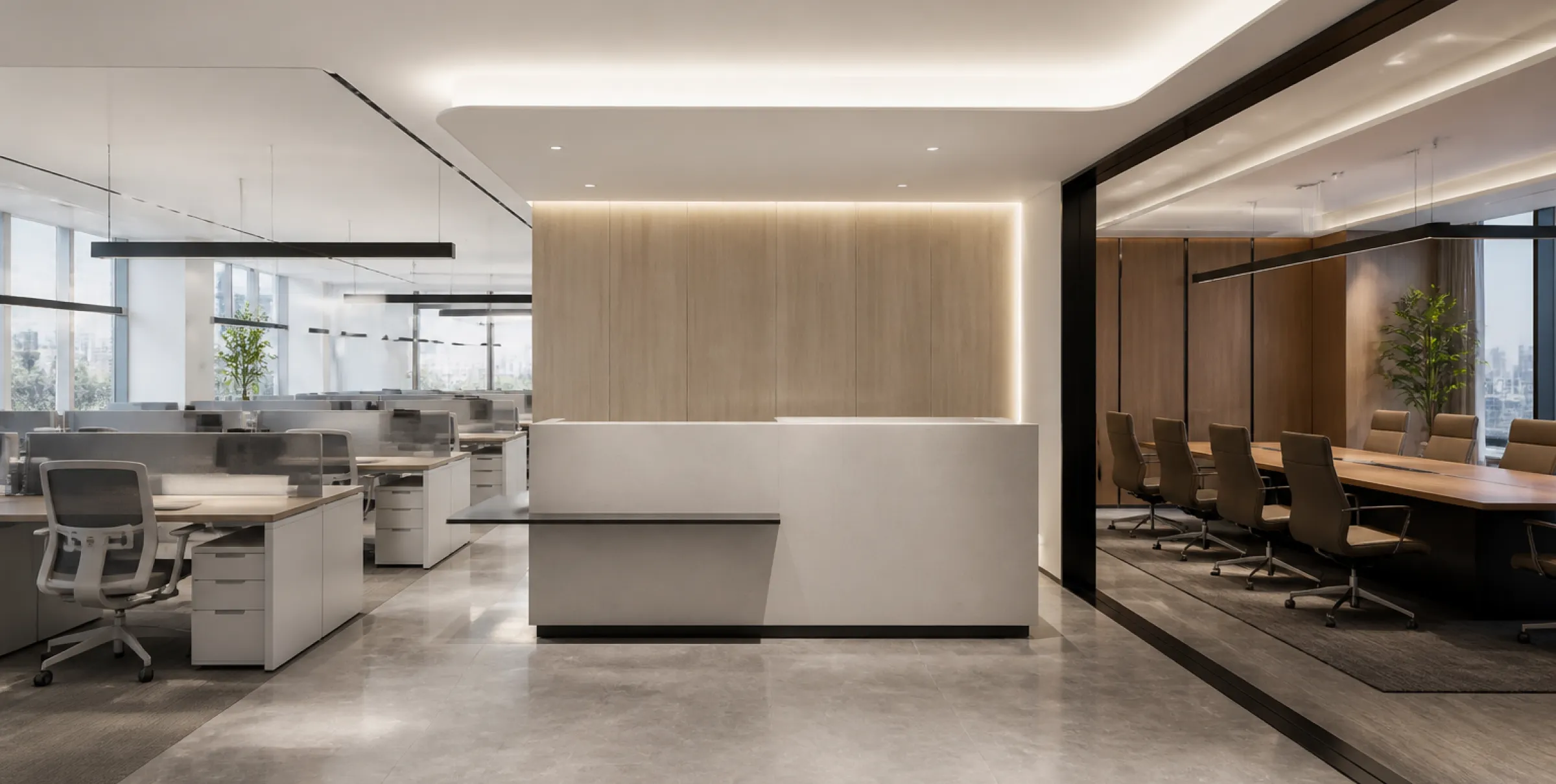
At Aston Office, desk programs are quoted with per-zone surface schedules: melamine, HPL, and veneer configurations priced side by side, with EN 14322 class ratings, core grades, and edge specifications stated line by line. Programs sourced through our wholesale office furniture channel include finish samples from production batches and attic-stock options on veneer lines. Send your floor plan and zone list, and our team will return a zoned material schedule with landed pricing.
Frequently Asked Questions
Is melamine the same as laminate?
No, though both are often sold under the word "laminate." Melamine (TFL) is a decorative paper fused directly onto the board in one press cycle. High-pressure laminate is a separate multi-layer sheet bonded to a substrate afterward. Laminate manufacturers state directly that TFL has significantly lower scratch, wear, and impact resistance than HPL, so the distinction changes both price and performance.
Which desk surface is most scratch-resistant?
HPL leads the category, with general-purpose grades testing at 400 to 1,000+ NEMA LD-3 wear cycles. Commercial melamine rated to EN 14322 Class 3 (scratch resistance of 2.0 N or higher) handles standard workstation use well. Wood veneer is the softest at roughly Mohs 2 and relies on its lacquer system and maintenance regime for surface life.
Can a damaged melamine desktop be repaired?
Not practically. A chipped or delaminated melamine panel is replaced rather than repaired, because the fused surface cannot be patched invisibly. This is why melamine suits zones where panel replacement is cheap and fast, while veneer—which can be sanded and recoated on site—suits high-visibility furniture expected to serve for decades.
What is MFC and how does it relate to melamine?
MFC (melamine-faced chipboard) is the European term for the same product family North America calls TFL: melamine-resin decorative paper fused to a particleboard core. European commercial panels are specified under EN 14322, with Class 3 covering commercial-use ratings for scratch, stain, and lightfastness performance.
When should a project pay for HPL instead of melamine?
Specify HPL on high-contact horizontal surfaces: reception counters, conference and training tables, multi-shift desking, and any surface exposed to impact or aggressive cleaning. HPL is also mandatory when the specification names it, when postformed curved edges are required, or when the project is submitted under standards such as AWI, which restricts low-pressure laminates on exposed surfaces to Economy grade.
How long do veneer desks take to produce, and how do I handle future replacements?
Veneer programs typically run 4 to 6 weeks plus lacquer curing time, the longest cycle of the three surface families. Because natural veneer varies by log and batch, order attic stock—spare finished panels from the original production batch—with the initial purchase so that replacements years later still match the installation.
What core board should sit under the surface material?
For European-style specification, EN 312 P2 particleboard covers standard dry interior use, while P5 covers load-bearing applications in humid conditions. Whatever the surface, require balanced panel construction—matched paper weights and resin content on both faces—to prevent the warping that appears on long desktops months after installation.
