
Seat cushions are the first component of an office chair to fail in the field, and they fail silently. A cushion does not break; it flattens, softens, and sags until users start reporting discomfort—usually 18 to 36 months into a five-year depreciation schedule, and usually after the warranty conversation has become difficult. The root cause is almost always traceable to the purchase order, where the foam was specified with an adjective instead of a number.
This guide covers the foam specifications that predict cushion lifespan in commercial seating: density, IFD firmness, support factor, molded versus cut construction, and market-specific fire compliance. These are the same parameters Aston Office locks into production specs for upholstered seating programs, from task chairs to ergonomic leather executive chairs.
Why "High-Density Foam" Is a Marketing Term, Not a Specification
Supplier quotations routinely describe seat foam as "high-density" or "premium high-resilience" without stating a measurable value. The phrase is meaningless on its own. Virgin cut foam runs from roughly 18 to 40 kg/m³; molded foams for commercial chairs typically run 30 to 60 kg/m³; and rebonded foam made from compressed scrap can read 60 to 120 kg/m³ while performing worse than either. A rebonded cushion can be the densest material in the room and the fastest to degrade, because density alone says nothing about cell structure or binder content.
The procurement fix is to treat "high-density" as a request for data. Any foam claim in a quotation should resolve into kg/m³, an IFD value, the production method, and a batch tolerance. A supplier who cannot produce those four numbers has not specified the foam; the foam supplier has.
The Two Numbers That Matter: Density and IFD
Density Predicts Durability
Density is mass per unit volume—how much polyurethane is in the block, measured in kg/m³ or pounds per cubic foot. It is a durability metric: higher polymer density means the foam retains its properties longer under cyclic loading. As a working reference for commercial task seating, cushions below 30 kg/m³ belong in light-duty or residential use; 40 to 55 kg/m³ is the contract-grade band for eight-hour daily use. Density also interacts with thickness and seat-board design, which is why density claims must be read against the whole cushion assembly rather than in isolation.
IFD Predicts Feel—and Support Factor Prevents Bottoming Out
IFD (indentation force deflection, tested per ASTM D3574 Method B1) measures the force needed to compress a foam sample by 25 percent of its height with a standardized indentor foot. It quantifies firmness, and the Polyurethane Foam Association is explicit on the point: firmness is independent of density. A dense foam can be engineered soft; a light foam can feel firm. Typical seat-cushion IFD values run 24 to 36 lbf at 25 percent deflection, with firmer specifications above that range.
The number most buyers never request is support factor—the ratio of 65 percent IFD to 25 percent IFD. It describes what happens after the first touch, when a full day's body weight settles into the cushion. Values run roughly 1.7 to 3.0, and higher is better: a cushion with a support factor of 2.4 retains far more resistance at deep compression than one at 1.7, which is the difference between "still supportive at hour six" and "feels dead after lunch." Showroom complaints about cushions that feel fine on day one and flat within months are usually support-factor failures wearing a density costume.
Molded vs. Cut Foam: Process Differences That Surface in Year Three
Molded Foam
Molded (cold-cure) foam is injected as liquid polyurethane into a shaped tool, where it expands and cures into a finished cushion in one piece. The process controls shape, thickness, and support zones precisely, produces consistent density across the cushion, and repeats reliably across production batches. It also enables true ergonomic geometry—the waterfall front edge that reduces pressure behind the thighs is a molded feature. The trade-offs are tooling cost and higher unit price, which is why molded cushions concentrate in premium task and executive seating.
Cut Foam
Cut foam is sliced from large poured slabs and shaped by CNC or die cutting. It is flexible, fast, and cost-effective, and modern cutting produces credible ergonomic contours. Its weaknesses are consistency—density varies across and between slabs—and the glued laminations used to build thickness, which introduce layer-separation risk. Industry guidance limits seat cushions to a single front-to-back adhesive seam and no more than 4 lbf of IFD difference between glued pieces.
The Rebonded Foam Warning
Rebonded foam—shredded scrap compressed with adhesive, usually dark gray with a visibly layered texture—appears in budget seating precisely because its density numbers look impressive. It is heavy, firm, and fast to break down. If a quotation's density figure seems too high for the price point, ask whether the foam is virgin. Requesting a foam cross-section or an unupholstered sample settles the question in one step. Where supplier consistency is uncertain at all, the batch-inspection discipline described in our factory vetting framework applies to foam suppliers exactly as it does to finished-goods factories.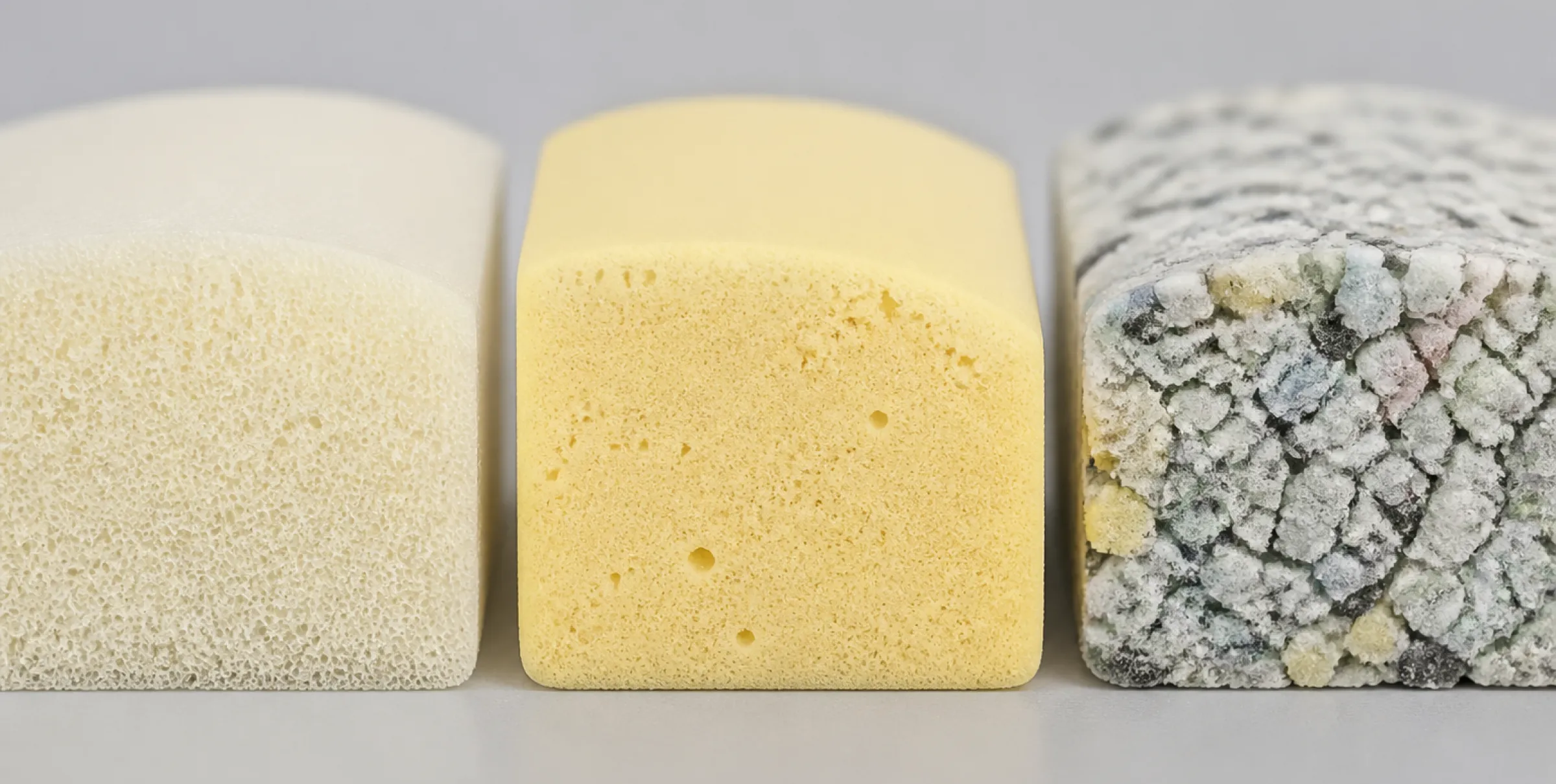
Cushion Architecture: Comfort Layers, Contours, and Seat Boards
Commercial cushions are rarely a single block. The common architecture is a high-resilience base layer carrying the structural load, with a softer comfort layer on top—memory foam in the 9 to 15 IFD range is used this way, as a pressure-relief surface rather than a support structure. Buyers should be skeptical of any chair marketed as "memory foam seating": viscoelastic foam as a primary support layer bottoms out and retains heat, which is why it belongs in a thin top layer at most.
The cushion also does not work alone. Seat-board material, thickness measurement conventions (bare foam versus finished upholstered seat), and contour geometry all change how the same foam performs. For heavy-use categories such as heavy-duty office chairs, cushion specifications should be evaluated together with the structural ratings in our heavy-duty chair specification guide, because a 55 kg/m³ cushion on a flexing seat board still fails early.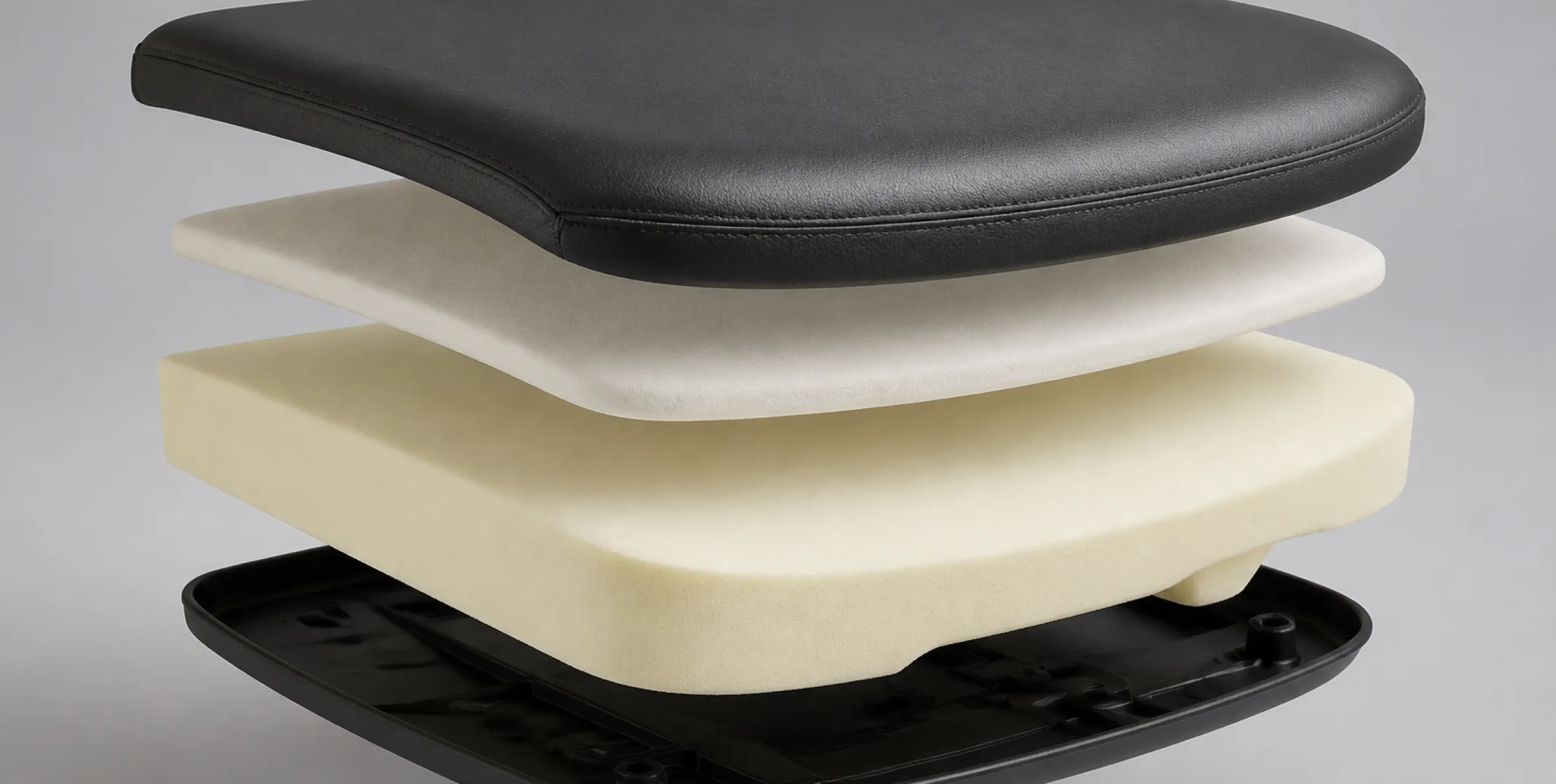
Fire Compliance by Market: TB 117-2013, BS 5852, and EN 1021
Foam flammability requirements are set by destination market, and the foam formulation—not a spray applied afterward—carries the compliance. The three regimes that dominate commercial projects:
| Market | Standard | Foam Requirement |
|---|---|---|
| United States | CAL TB 117-2013; NFPA 260; CAL 133 for high-hazard occupancies | Smolder-resistant components; documented per batch |
| United Kingdom | BS 5852, Crib 5 ignition source for contract use | CMHR (combustion-modified high-resilience) foam with FR fabric or interliner |
| European Union | EN 1021-1 (cigarette) and EN 1021-2 (match flame) | Ignitability-tested composite; public-assembly projects may stack Crib 5 |
Two procedural points matter. First, request certificates per production batch, because foam formulations vary by lot and a certificate from last year's supplier does not cover this year's order. Second, fire tests evaluate the composite—foam, fabric, and any interliner together—so substituting a cheaper cover fabric after certification invalidates the test. The connection between component test data and enforceable warranty language is detailed in our analysis of commercial furniture warranties and testing standards.
How to Specify and Verify Foam in a Purchase Order
A complete cushion specification fits in five lines: density in kg/m³ with a stated tolerance, 25 percent IFD with its test method, support factor, production method (molded or cut, virgin material), and the destination market's fire standard with batch certificates. Verification is equally procedural: request an unupholstered foam sample or cross-section before production, retain a signed golden sample, and include cushion checks in the pre-shipment inspection brief.
At Aston Office, upholstered seating programs are quoted with full cushion data sheets—density, IFD, support factor, and batch fire certificates—rather than adjectives. Programs sourcing through our wholesale office furniture channel receive foam cross-sections with physical samples and cushion aging data aligned to the usage intensity of the destination environment. Send your seating schedule and target markets, and our engineering team will return a cushion specification matched to your duty cycle.
Frequently Asked Questions
What foam density should a commercial office chair have?
For contract-grade seating in eight-hour daily use, specify molded or virgin cut foam in the 40 to 55 kg/m³ range. Cushions below roughly 30 kg/m³ suit light-duty or residential use. Density must be read together with cushion thickness, seat-board construction, and production method, because a rebonded foam can show a high density figure while degrading faster than lower-density virgin foam.
Is higher-density foam always firmer?
No. Density measures mass per volume and predicts durability; firmness is a separate property measured by IFD (indentation force deflection). The Polyurethane Foam Association states directly that firmness is independent of density—a high-density cushion can be formulated soft, and a low-density one can feel firm. Specify both numbers.
What is IFD and what value is right for office chairs?
IFD measures the force needed to compress a foam sample by 25 percent of its height under ASTM D3574 Method B1. Typical seat cushions run 24 to 36 lbf at 25 percent deflection. Pair the 25 percent IFD with the support factor (65 percent IFD divided by 25 percent IFD, ideally 2.0 or higher) to ensure the cushion stays supportive under full body weight rather than bottoming out.
Is molded foam better than cut foam?
Molded foam offers tighter dimensional consistency, one-piece construction without glue seams, and true ergonomic contours such as waterfall edges, at a higher unit cost. Cut foam is flexible and cost-effective but varies between slabs and relies on laminations for thickness. For long-lifecycle contract seating, molded construction reduces batch-to-batch warranty exposure.
What is rebonded foam and should I avoid it?
Rebonded foam is shredded foam scrap compressed with adhesive into blocks. It reads dense on a data sheet—often 60 to 120 kg/m³—but breaks down quickly in daily seating use. It has legitimate applications in carpet underlay and packaging, not in commercial seat cushions. Ask for virgin foam and verify with a cross-section sample.
What fire standards apply to office chair foam?
By market: the US requires CAL TB 117-2013 smolder resistance (with CAL 133 for high-hazard occupancies), the UK contract market requires BS 5852 Crib 5 performance typically achieved with CMHR foam, and the EU requires EN 1021-1 and 1021-2 ignitability testing. Certificates must cover the tested composite of foam, fabric, and interliner, per production batch.
Why do office chair cushions go flat, and when is replacement due?
Cushions flatten through compression set and fatigue softening—permanent loss of thickness and firmness from cyclic loading—which accelerates in low-density or rebonded foams. Visible sagging, a hard seat board feel, or a compressed waterfall edge are the field signals. Our guide on office chair replacement cycles covers inspection triggers and cost planning for fleet renewal.
