
The first container order is where most import programs fail, and it almost never fails at sea. It fails months earlier, at the vetting stage, when a buyer accepts a website gallery and a PDF certificate as evidence of manufacturing capability. The gap between what a supplier presents and what its production floor actually does is the central risk in furniture sourcing, and closing it does not require a plane ticket. It requires a structured sequence of evidence checks, each one cheap, ordered from least to most expensive.
This framework is the same five-layer process Aston Office recommends to distributors evaluating any manufacturer, including us: paper verification, live video audit, certification checks, sample and inspection gates, and payment structure. A supplier that passes all five is about as low-risk as cross-border sourcing gets.
Paper Verification: Registry Records and the Trading-Company Filter
Every legitimate Chinese manufacturer holds a business license registered with the State Administration for Market Regulation, identifiable by a unified social credit code that appears on every official document the company issues. Verify three fields against the public registry: the registered name against the name on your quotation and contract, the registered address against the factory address you were given, and the business scope, which must cover furniture manufacturing rather than trading alone. A company registered eighteen months ago is not a twenty-year-old manufacturer regardless of what its About page says.
This layer also performs the most valuable single filter in sourcing: separating factories from trading companies posing as factories. A trading company is not automatically a bad partner, but a trading company claiming to be a manufacturer is misrepresenting its quality controls, its pricing structure, and its ability to stand behind a warranty. Registration records resolve the question in minutes, before any sales relationship develops.
The Live Video Audit: Reading a Production Floor Remotely
A website gallery proves nothing; a live video call shows reality. Schedule a walkthrough and ask to see the production floor with machines running, raw material inventory, half-finished goods on the line, the warehouse, and the loading area. Then ask the host to walk to a specific machine or a specific pile of material. A genuine factory can show anything in real time; a front operation cannot fake a production line for long.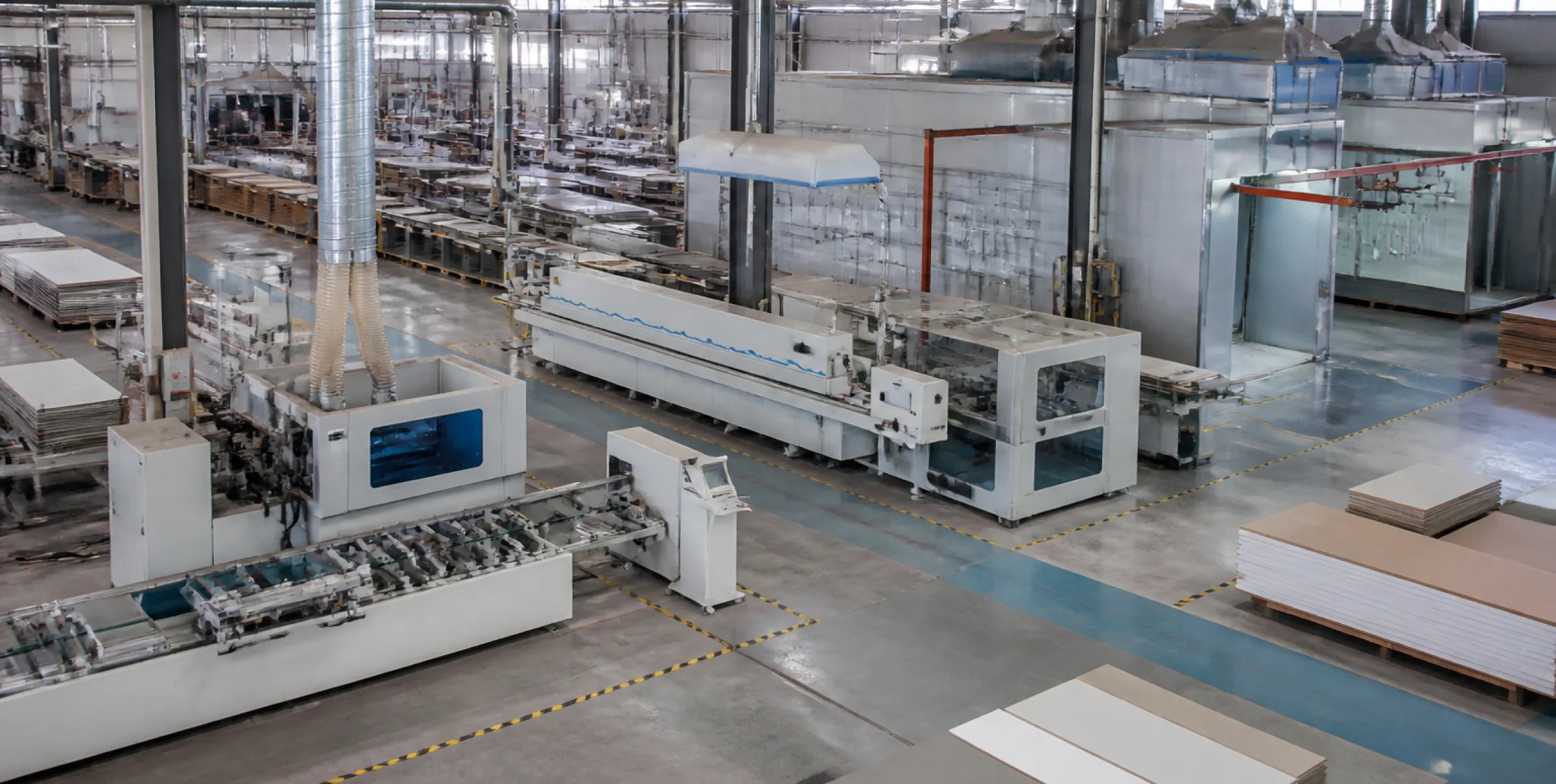
Capacity Math
During the walkthrough, document the equipment and do the arithmetic. Count CNC machining centers and note the brands—Homag, Biesse, and SCM indicate serious capital investment in panel processing—along with edge-banding lines, enclosed spray booths, and upholstery workstations. Multiply line count by reported units per line per day and compare the result against both the claimed capacity and your order volume. A facility running three lines at 40 chairs per line per day cannot deliver 2,000 chairs in 30 days without subcontracting or forced overtime, and both degrade quality.
The Subcontracting Signal
Capacity misrepresentation matters because of what fills the gap: subcontracting to lower-tier workshops that were never part of your audit. Ask directly which process steps happen in-house and which go outside, and ask for the Approved Supplier List covering panel suppliers, foam suppliers with density certificates, fabric suppliers with abrasion test data, and hardware suppliers by brand and model. A factory that cannot produce an ASL sources from the spot market and cannot guarantee material consistency between your sample and your container.
Certifications That Matter and How to Verify Them
Three frameworks dominate buyer requirements, and they answer different questions. ISO 9001 certifies that a quality management system exists and is maintained; certificates carry three-year validity with annual surveillance audits, and the certificate number and issuing body can be verified independently. BSCI (amfori) and Sedex SMETA audits assess labor conditions and workplace ethics, not product quality. BSCI issues graded reports from A to E with roughly twelve-month validity; SMETA reports run on a similar cycle in two-pillar or four-pillar scope.
Verification discipline matters more than the badge. Never accept a loose PDF. For BSCI, ask for the amfori DBID and confirm active status on the platform; for SMETA, request the factory's Sedex Z-number and have the report shared directly to your buyer account; for ISO, check the number with the certification body. Confirm in every case that the audited address is the facility producing your order, not a showcase sister site, and ask what corrective actions were raised and whether they closed. A factory that claims a perfect audit with zero findings deserves more scrutiny than one showing minor findings resolved on schedule. Product-level documentation—flammability, formaldehyde limits such as CARB/EPA for the US, REACH for the EU—sits on top of these frameworks and should be collected per market. The relationship between test data and enforceable warranty terms is covered in our analysis of commercial furniture warranties and testing standards.
Samples, Golden Samples, and the AQL Inspection Gate
Samples are the cheapest insurance in sourcing. Order representative samples per product group, test function and durability against your written specification, and compare shortlisted suppliers side by side. Keep the approved unit: once production begins, "same as approved sample" becomes your enforceable quality standard, and it is only enforceable if the golden sample physically exists and is signed by both parties.
Pre-shipment inspection then applies statistical discipline to the finished order. Third-party firms—SGS, Bureau Veritas, Intertek, TÜV, or specialist furniture inspectors—work to ISO 2859-1 / ANSI Z1.4 sampling at General Inspection Level II, with defect classes typically gated at AQL 0 for critical defects, 2.5 for major, and 4.0 for minor. On a 200-unit sample at AQL 2.5, the batch passes at ten major defects and fails at eleven. Understand what this means: AQL is a final gate, not a quality system, and a batch that fails is reworked and re-inspected at the factory's cost before loading, which is exactly the leverage the inspection exists to create. For orders touching moisture-sensitive panels, our guide to flat-pack engineering and packaging validation covers the ISTA and moisture-control checks that belong in the same inspection brief.
Payment Structure and Contract Controls
Payment terms are part of verification because they structure the supplier's incentives. The workable patterns:
- T/T 30/30/40: 30 percent deposit, 30 percent mid-production, 40 percent against inspection before shipment. The most common structure for custom furniture, tying payments to verified progress.
- L/C at sight: bank-guaranteed payment against shipping documents, appropriate for large orders and first-time relationships.
- Platform escrow: marketplace trade-protection programs for smaller trial orders with new suppliers.
A supplier demanding 100 percent prepayment from a new customer is a red flag; reputable factories finance production against deposits. Sequence the commercial documents before the deposit moves: manufacturing contract specifying materials, tolerances, QC terms, and penalty clauses; NNN agreement where designs are involved; and the quality agreement as a separate exhibit naming the golden sample and the AQL gate. Buyers building their first procurement process can pair this framework with our operational guide on sourcing office chairs in bulk.
What a Transparent Factory Looks Like From the Inside
The five layers above describe what buyers should demand, so it is fair to close with what we provide. Aston Office maintains its registration records, production capacity figures, and certification documentation for buyer verification on request, and our facility walkthroughs—live video or in person—cover the full production floor, not a showroom. Our factory profile, quality control process, and certification documentation are published for exactly this diligence process, and every wholesale program includes golden-sample sign-off and third-party pre-shipment inspection support before the balance payment is due.
If you are qualifying suppliers for a seating or casegoods program, send your specification and target volume through our wholesale channel. We will return capacity data, certification documents, and a sample plan within one business day—the same evidence this framework asks you to collect.
Frequently Asked Questions
How do I check if a Chinese furniture supplier is a real factory?
Verify the business license against the public registry using the company's unified social credit code. Compare the registered name, address, and business scope against your quotation documents; the scope must cover manufacturing, not just trading. Follow with a live video walkthrough of the production floor with machines running—trading companies posing as factories fail at one of these two steps.
What is an AQL inspection and what do the numbers mean?
AQL (Acceptable Quality Limit) is a statistical sampling rule from ISO 2859-1 / ANSI Z1.4 that tells an inspector how many units to check and how many defects trigger batch rejection. The common configuration is AQL 0 for critical defects, 2.5 for major, and 4.0 for minor. It does not mean 2.5 percent of your order may be defective; it sets the accept and reject thresholds on the inspected sample, with failure forcing rework before loading.
Is a BSCI or Sedex audit proof of product quality?
No. BSCI and SMETA are social-compliance audits covering labor conditions and workplace ethics; they say nothing about whether the furniture meets specification. Product quality is evidenced by ISO 9001 quality-system certification, batch test reports (abrasion, flammability, formaldehyde), golden samples, and pre-shipment inspection results. Serious buyers check both categories.
How do I verify a factory's certificates are genuine?
Never accept a PDF at face value. Verify BSCI through the amfori platform using the factory's DBID, have SMETA reports shared directly to your Sedex buyer account via the factory's Z-number, and confirm ISO certificate numbers with the issuing certification body. In every case, check that the audited address matches the facility producing your order and that the audit date is within the validity window.
What payment terms are safe for a first container order?
T/T 30/30/40 (deposit, mid-production, and balance against passed inspection) is the standard structure for custom furniture. Letters of credit at sight suit large first-time orders, and platform escrow works for small trial orders. Treat any demand for 100 percent prepayment from a new customer as a red flag.
What should a live video factory audit cover?
Ask to see the production floor with machines running, raw material inventory, half-finished goods, the warehouse, and the loading area. Count production lines and major equipment, note machinery brands, and ask the host to walk to specific locations on request. Finish by asking which process steps are subcontracted and requesting the Approved Supplier List for materials.
How long does proper factory qualification take?
A thorough qualification runs six to ten weeks: one to two weeks for document and registry verification, two to three for sampling and evaluation, one to two for the audit itself and reference checks, and the remainder for corrective actions and contract execution. Compressing the process to two or three weeks is possible under deadline pressure, but compensate with additional in-production inspection checkpoints.
