
Ocean freight for office furniture is billed on volume, and fully assembled furniture ships mostly air. A 40HQ container offers roughly 68 CBM of usable loading space, and the difference between an assembled chair carton and a flat-packed one can exceed 60 percent of that volume per unit. For distributors and project buyers importing at container scale, knock-down (KD) engineering is one of the few specification decisions that moves landed cost by double digits without touching the product itself.
This guide explains how KD design works across chairs, desks, and sofas, how to run the assembly-labor-versus-freight calculation honestly, and where flat-pack construction introduces quality risk that must be controlled at the specification stage. The examples reflect the container loading data Aston Office produces for wholesale office furniture programs.
The Freight Economics of Air: Why Assembled Furniture Loses Money
Furniture is a classic cube-out cargo: a container of seating reaches its volume limit long before its roughly 26-ton payload limit. That means every void inside a carton is freight you pay for and cannot sell. An assembled ergonomic task chair in export cartons typically occupies 0.25 to 0.38 CBM. The same chair engineered for flat-pack shipment—backrest, seat, mechanism, base, and armrests nested in a single carton—compresses to roughly 0.10 to 0.15 CBM.
The container math makes the gap concrete. At 68 usable CBM, a 40HQ holds approximately 180 to 270 assembled chairs, or 450 to 680 flat-packed ones. At a representative $4,500 per 40HQ on major Asia-to-Europe or Asia-to-Americas lanes, freight per unit falls from roughly $17 to $25 assembled down to $7 to $10 knock-down. On a 2,000-chair annual program, that is a five-figure freight difference before any factory price advantage. Factories increasingly price to reflect this: dual-track quotations offering 12 to 18 percent FOB discounts on KD versions of identical designs appeared across major Chinese furniture fairs in 2026.
Carton dimensions are themselves a design variable. Trimming 5 cm from a carton width can add 8 to 12 units to a 40HQ load, and mixing flat-pack casegoods into the voids between upholstered cartons can push utilization from roughly 58 CBM toward 66 CBM. This is why packed CBM must be measured on final export cartons—protective corners, foam inserts, and palletization all inflate billable volume beyond showroom dimensions.
The same logic scales with order size and shipping method, which is why KD specification decisions should be made together with the FCL-versus-LCL analysis covered in our guide to importing wholesale office furniture.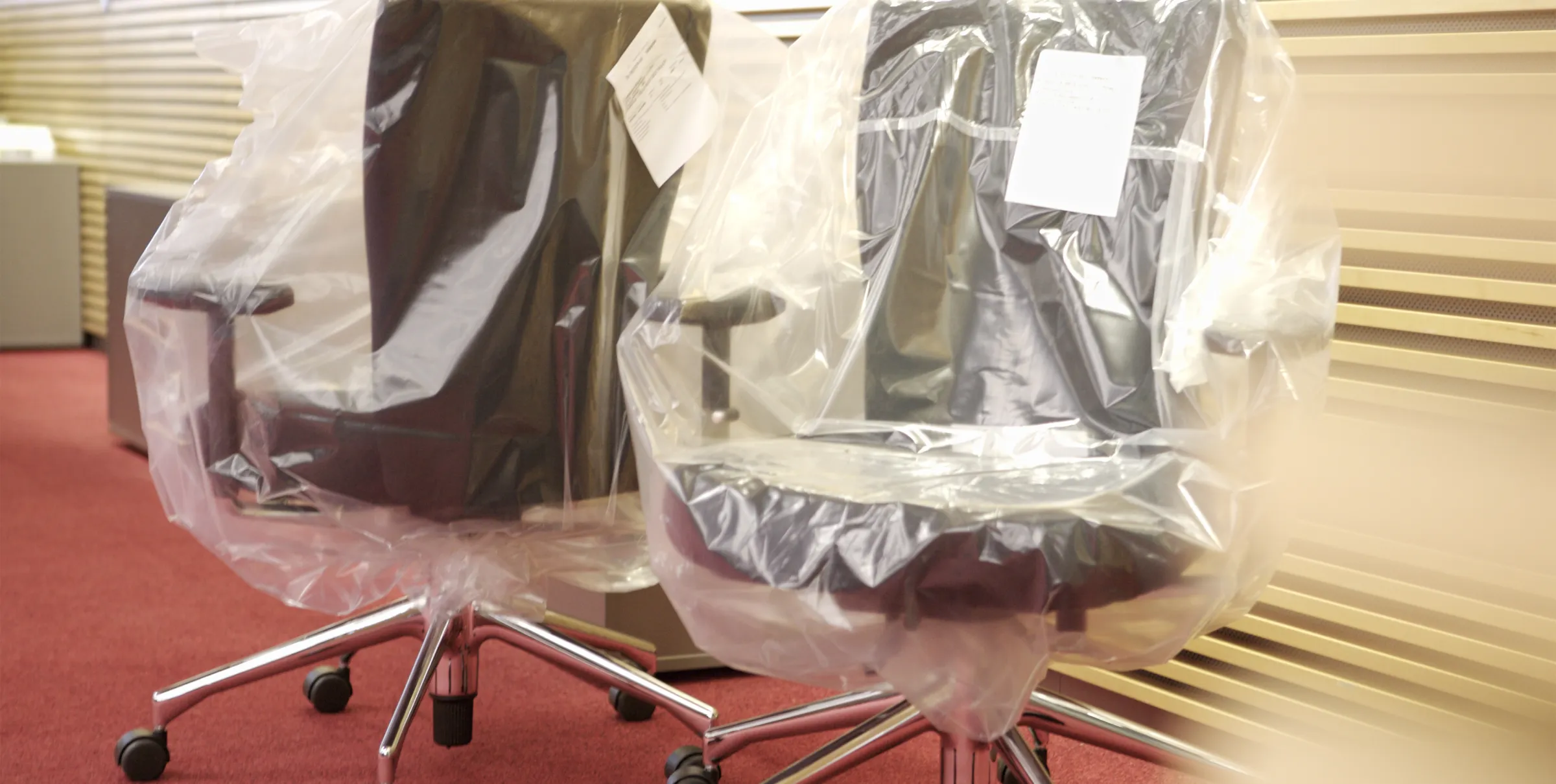
How Knock-Down Design Works Across Product Categories
Task and Executive Chairs
Chairs are the easiest category to knock down because they already consist of bolted subassemblies. A KD mesh office chair ships as backrest, upholstered seat, synchro mechanism, gas lift, five-star base, casters, and armrests, separated by molded EPE foam or pulp trays inside one carton. The critical engineering requirement is that separation points sit at joints the product was designed around—mechanism-to-seat and backrest-to-mechanism interfaces—rather than at welded or bonded structures that were never meant to come apart.
Desks, Workstations, and Storage
Panel-based furniture is natively flat-pack. Tops, modesty panels, legs, and side cabinets pack as flat components joined by cam-lock fittings, dowels, or bolted metal brackets. The specification risk here is hardware grade: entry-level cam locks loosen under repeated assembly cycles, while die-cast zinc or steel fittings with metal threaded inserts survive reassembly. For height-adjustable and executive office desk programs, confirm that the frame—rather than the desktop—carries the structural load, so top panels can ship flat without warping risk.
Sofas and Lounge Seating
Upholstered seating is the hardest category to flatten, but also the most wasteful when shipped assembled. Detachable legs, bolt-on armrests, and separate backrest modules cut a three-seat sofa from roughly 1.4 CBM assembled to under 0.9 CBM. Some designs go further with compression or roll-pack cushions. The trade-off is joint visibility and rigidity, which is why lounge KD specifications should always be validated on a physical sample before the container order is placed.
Assembly Labor vs. Freight Savings: Running the TCO Calculation
Knock-down savings are real only if assembly cost stays below freight savings. The honest calculation has four inputs: freight delta per unit, assembly minutes per unit, local fully-loaded labor rate, and damage or return exposure. A well-engineered KD task chair assembles in 8 to 15 minutes with a single hex key; a poorly engineered one with misaligned inserts can take 40 minutes and generate stripped threads and returns.
| Cost Factor | Assembled Import | Knock-Down Import |
|---|---|---|
| Packed volume per task chair | 0.25–0.38 CBM | 0.10–0.15 CBM |
| Units per 40HQ (68 usable CBM) | 180–270 | 450–680 |
| Freight per unit (at $4,500/40HQ) | $17–$25 | $7–$10 |
| FOB price | List | Typically 12–18% lower |
| Assembly labor per unit | None | 8–15 min at destination labor rate |
| Last-mile parcel profile | Often oversize surcharges | Usually standard parcel dimensions |
At a $20 per hour warehouse labor rate, 12 minutes of assembly costs about $4 per chair—well under the $10 to $18 freight delta. KD loses this calculation mainly in two scenarios: very high labor markets combined with low freight rates, and project installations where assembly must happen in occupied offices at premium labor cost. Distributors reselling through e-commerce channels gain an additional advantage, because flat-pack cartons avoid the dimensional oversize surcharges that carriers apply to assembled chair boxes. Buyers weighing these options at order level can apply the same framework in our guide on buying office chairs in bulk.
Quality Risks in KD Furniture and How to Specify Against Them
Fastener Engineering and Reassembly Cycles
The failure mode of cheap KD furniture is not the first assembly but the third. Specify metal threaded inserts rather than screws driven directly into particleboard, die-cast or steel cam fittings rather than plastic, and hardware sorted into labeled, heat-sealed blister packs with a 2 percent spare-parts allowance per carton. Missing hardware is the single most common cause of KD-related returns, and it is entirely preventable at the packing line.
Packaging Validation: ISTA Standards
Flat-pack cartons travel harder than assembled crates because they move through parcel networks. Require packaging validated to ISTA 3A for individually cartoned products under 150 lbs—the standard covering drop, vibration, and compression testing for parcel shipment—and ISTA 3E for unitized pallet loads on full-container programs. Test reports should reference the exact carton and product revision being ordered. Ocean transit adds a second requirement: wood-based components should ship below 12 percent moisture content with desiccant packs in each carton, because container condensation over a 30-to-45-day voyage warps panels and weakens corrugated board. For how these test regimes connect to warranty language, see our analysis of commercial furniture warranties and testing standards.
Sourcing KD Furniture from an OEM Factory
Knock-down performance is decided at the factory, not the freight forwarder. When briefing a manufacturer, request three documents before the purchase order: packed CBM per SKU measured on final export cartons, a container loading diagram showing carton orientation and total unit count per 40HQ, and the ISTA test report matching the shipping method. A supplier who cannot produce a loading diagram has not engineered the packaging.
At Aston Office, KD versions of chair, desk, and sofa lines are quoted with locked carton dimensions, hardware kits with spare allowances, and loading plans calculated against 68 usable CBM per 40HQ. Every KD configuration is validated on a physical golden sample before production: we assemble it, disassemble it, and assemble it again, because the second assembly exposes tolerance problems that the first one hides. Distributors sourcing office chairs at wholesale volume receive per-SKU landed-cost worksheets covering freight per unit, assembly time, and carton specifications for both KD and assembled configurations. Send your target SKUs and destination port, and our team will return the full comparison within one business day.
Frequently Asked Questions
What is knock-down (KD) furniture?
Knock-down furniture is designed to ship as disassembled flat-packed components and be assembled at the destination. For office chairs this typically means the backrest, seat, mechanism, base, and armrests ship nested in one compact carton. KD design reduces packed volume by 50 to 70 percent compared with fully assembled units, which directly lowers ocean freight cost per unit.
How much can KD packaging reduce freight costs?
On a representative $4,500 40HQ lane, freight per task chair falls from roughly $17 to $25 assembled to $7 to $10 knock-down, because container yield rises from 180–270 units to 450–680 units. Factories commonly add a 12 to 18 percent FOB discount for KD versions of identical designs, since flat-pack cartons also reduce factory-side packing labor and storage.
Does knock-down furniture compromise structural strength?
Correctly engineered KD furniture does not. Separation points must sit at bolted interfaces the product was designed around, such as the mechanism-to-seat joint on a chair. Strength problems come from poor hardware: screws driven into particleboard, plastic cam fittings, and missing threaded inserts. Specify metal inserts, steel or die-cast zinc fittings, and validate on a physical sample before ordering.
What is ISTA 3A testing and when is it required?
ISTA 3A is the International Safe Transit Association performance test for individually packaged products under 150 lbs moving through parcel delivery networks. It simulates drops, random vibration, and compression. Require it whenever flat-pack cartons will ship via courier or e-commerce fulfillment. For palletized full-container shipments, ISTA 3E covering unitized loads is the appropriate standard.
How long does it take to assemble a KD office chair?
A well-engineered KD task chair assembles in 8 to 15 minutes using a single hex key included in the hardware kit. Desks and workstations typically require 20 to 40 minutes. When evaluating suppliers, ask for the verified assembly time from their instruction video rather than a marketing estimate, because misaligned inserts or poor hardware can triple real-world assembly time.
Should distributors order KD or fully assembled furniture?
Choose KD when you have low-cost assembly labor, sell through e-commerce channels, or import at multi-container volumes. Choose assembled when installation happens in occupied client offices at premium labor rates, when your customers have no assembly capability, or when freight rates are unusually low relative to labor. Many distributors run a mixed program: KD for volume SKUs, assembled for executive and showroom lines.
What is a container loading diagram?
A container loading diagram is a supplier-produced plan showing each carton's dimensions, orientation, and position inside a specific container type, with the total unit count per 40HQ or 40GP. Request it before signing a purchase order. It is the only reliable way to verify packed CBM claims, and a factory that cannot produce one has not engineered its export packaging.
