
"Heavy duty office chair" gets used loosely. To some buyers it means a chair that holds a larger user. To others it means a chair that survives three 8-hour shifts a day in a 911 dispatch room. To others still it means a chair that doesn't fail when fifty people in an open office abuse it daily for five years. These are three different products. They share some specs, but diverge sharply on others — and confusing them at procurement time is one of the most common reasons buyers end up replacing furniture inside two years.
This guide separates the three categories — big and tall, 24/7 multi-shift, and high-traffic commercial — and walks through the technical specifications that matter when sourcing any of them in volume. The numbers and standards below come from our factory floor in Foshan, where we run BIFMA-compliant testing on every chair series before production release.
1. What Counts as a Heavy Duty Office Chair (Definitions and Use Cases)
The term covers three overlapping but distinct categories. Treating them as one product is where most procurement errors start.
Big and Tall office chairs
Engineered to seat users above the standard size envelope — typically 180 kg (400 lb) and above, with wider seat pans (50–65 cm vs the 45–48 cm of standard chairs) and reinforced lumbar/back zones. Used when the user population includes people outside the median size range. ANSI/BIFMA X5.11 is the relevant testing standard.
24/7 multi-shift chairs
Built for continuous occupancy — environments where one chair is used by multiple operators across rotating shifts, with effectively no downtime. The chair is engineered to handle 24-hour daily mechanical cycling rather than the 8-hour assumption built into standard BIFMA testing. Used in 911 dispatch, control rooms, hospitals, military operations, and surveillance centers. BS 5459-2:2000 is the historical UK reference; ANSI/BIFMA introduced 24/7-specific testing more recently.
High-traffic commercial chairs
Standard-sized chairs built with reinforced components for environments where the chair sees high turnover and abuse — open-plan offices with 50+ stations, education campuses, public-sector workplaces. Not big-and-tall, not 24/7, but engineered above the baseline for component longevity. Most premium commercial mesh chairs fall here.
A chair can be more than one of these. A big-and-tall 24/7 dispatch chair exists. So does a standard-sized 24/7 chair. So does a big-and-tall chair for a 9-to-5 office. The categories combine, but each adds cost and procurement constraints.
Aston's full office chair wholesale catalog covers all three categories with mesh, fabric, and leather upholstery options.
2. Weight Capacity Ratings for Big and Tall Office Chairs Explained
Weight capacity numbers on office chairs aren't standardized informally — they reference specific testing protocols. The number matters less than the standard it's tested against.
| Rated Capacity | Typical Use Case | Required Spec |
| 120–135 kg (265–300 lb) | Standard commercial office | BIFMA X5.1 baseline |
| 150–180 kg (330–400 lb) | Light big & tall, premium commercial | BIFMA X5.11 entry |
| 180–230 kg (400–500 lb) | Big & tall, multi-user environments | BIFMA X5.11 + Class 4 gas lift |
| 230–270 kg (500–600 lb) | Heavy big & tall, bariatric applications | Reinforced base, heavy-gauge frame |
| 270+ kg (600+ lb) | Specialized bariatric/healthcare seating | Custom engineering, often with hydraulic lifts |
Important distinction: static vs dynamic load.
Static load is what the chair holds when a user is seated and still. Dynamic load is what it holds during normal use — leaning, rocking, twisting, standing up sharply. Dynamic load testing applies the rated weight at 4× the static value across thousands of cycles. A chair rated for 180 kg static doesn't mean it will survive 180 kg of repeated dynamic use — that's what ANSI/BIFMA X5.11 testing actually validates.
BIFMA X5.11 specifies the test protocol for chairs intended for users above the X5.1 baseline. Key tests include:
• Backrest durability test: 120,000 cycles at the rated dynamic load (vs 80,000 for X5.1)
• Seat impact test: 100,000 drops at 1.5× rated weight (vs 100,000 at 1× for X5.1)
• Arm strength test: 60,000 cycles at higher force
• Base test: stability under offset loading at 100% of rated capacity
What this means for buyers: when you see "400 lb capacity" on a spec sheet, ask which testing standard. "BIFMA X5.11 certified" is the answer that means something. "Manufacturer's claim" without a standard reference is essentially marketing copy.
For mesh chairs in the 180–230 kg rated capacity range, our big-and-tall mesh chair range includes models tested to BIFMA X5.11 with Class 4 gas lift cylinders.
3. 24/7 Multi-Shift Chairs: Engineering Behind Continuous-Use Seating
A 24/7 office chair isn't just a heavy duty chair with a different label. It's an engineering category built around continuous mechanical cycling without rest periods between shifts.
Where 24/7 chairs are required
• 911 emergency dispatch centers
• Control rooms (utilities, transportation, broadcast)
• Military and security operations centers
• Hospital nurse stations and ICU monitoring posts
• Manufacturing supervision stations
• Casino surveillance rooms
• Air traffic control and similar mission-critical environments
Engineering differences vs standard chairs
Standard BIFMA X5.1 testing assumes 8 hours of daily use across a 10-year lifespan. A 24/7 chair under continuous occupancy hits the same cycle counts in roughly 3.3 years. To extend service life back to commercial expectations, manufacturers reinforce the parts that cycle most:
• Tilt mechanism — typically rated for 1,000,000+ cycles (vs 300,000 standard)
• Gas lift — Class 4 required; lifetime warranty common on intensive-use chairs
• Foam — high-resilience 55+ kg/m³ density to resist compression under continuous load
• Upholstery — antimicrobial vinyl or high-double-rub fabric (200,000+ Wyzenbeek)
• Base — typically 5-star aluminum or reinforced nylon at 350mm+ diameter
• Castors — sealed-bearing dual-wheel design for continuous rolling without lubrication maintenance
Standards and certification
Two relevant standards anchor the 24/7 category:
• BS 5459-2:2000 — British standard for office chairs intended for use up to 24 hours a day, by users weighing up to 150 kg. Specifies extended cycle testing on all mechanical components.
• ANSI/BIFMA X5.1 with 24/7 use designation — US-side, requires testing at the upper bound of the standard with extended cycle counts. Some manufacturers self-certify; third-party-tested chairs from labs like SGS or TÜV carry more weight in tender submissions.
A clear procurement rule: if the application is genuinely 24/7, accept only chairs with documented test certificates from third-party labs. Manufacturer self-claims are common and often unsupported.
4. Gas Lift Cylinder Classes: Class 3 vs Class 4 in Heavy Duty Chairs
The gas lift cylinder is the single most important component in a heavy duty office chair — and the part that fails most catastrophically when under-spec'd. Cylinder bursts under load are rare but real, and the news coverage when they happen makes them a procurement red line.
DIN 4550 classifies gas lift cylinders by burst strength and continuous load rating:
| Class | Rated Load | Tube Wall Thickness | Typical Application |
| Class 1 | ≤ 200 kg / ≤ 440 lb | 1.5 mm | Residential / occasional use |
| Class 2 | ≤ 250 kg / ≤ 550 lb | 2.0 mm | Light commercial, home office |
| Class 3 | ≤ 300 kg / ≤ 660 lb | 2.5 mm | Standard commercial office |
| Class 4 | ≤ 400 kg / ≤ 880 lb | 3.0 mm | Heavy duty, big & tall, 24/7 |
For any chair sold as "heavy duty," Class 4 is the minimum acceptable specification. Class 3 is the standard commercial baseline and is appropriate for general office use — it's what Aston's commercial mesh chair line uses, with SGS Level 3 certification. Class 4 is required when:
• Rated user weight exceeds 130 kg
• Chair is for 24/7 multi-shift use
• Project specs explicitly require it (common in government tenders)
• Insurance or facility safety codes require it
What to verify before bulk purchase:
• Class designation marked on the cylinder body (not just the chair brochure)
• Third-party test certification (SGS, TÜV, or BIFMA-recognized lab)
• Warranty length — Class 4 cylinders typically carry 5-year or lifetime warranties; Class 3 is usually 3 years
• Manufacturer of the cylinder itself (Stabilus and KAB are reference-grade; cheaper unbranded cylinders are where most field failures originate)
Aston supplies SGS Level 3 (Class 3) cylinders as standard and Class 4 cylinders on heavy duty and 24/7 specifications. Certification documentation is listed on our certifications page.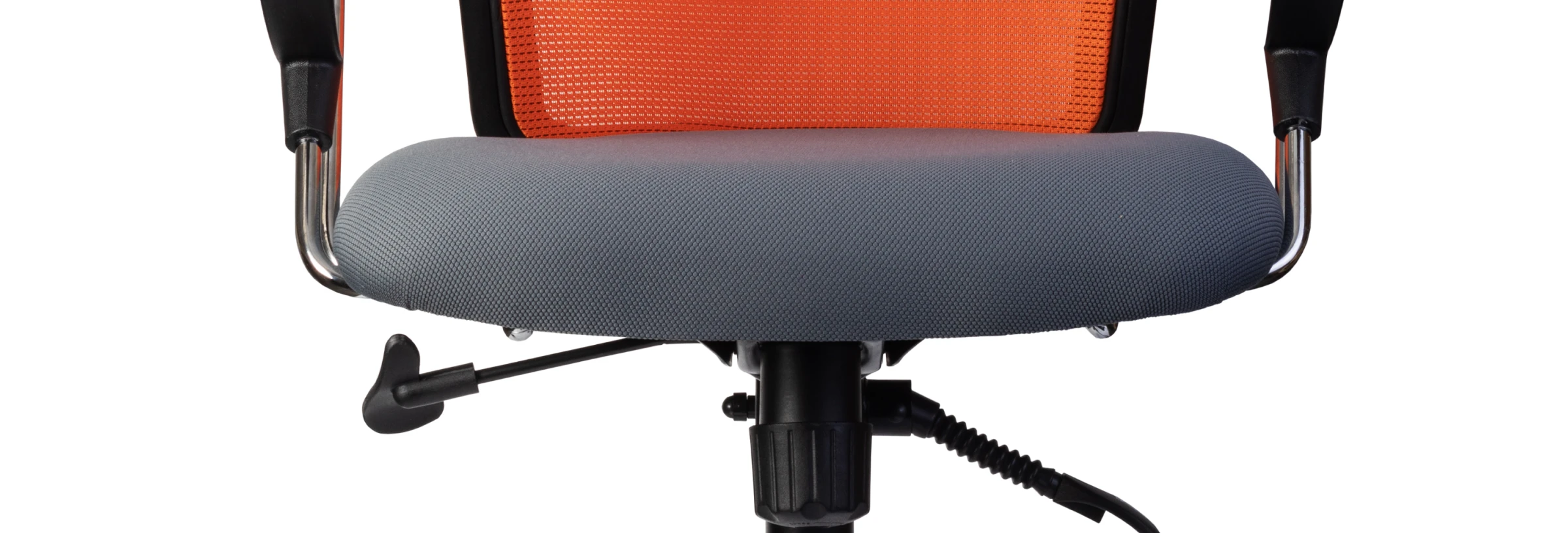
5. Frame, Base, and Caster Specs for High-Capacity Seating
Below the gas lift, the rest of the chair structure has to match the rating. A Class 4 gas lift on a budget nylon base doesn't make a heavy duty chair — it makes a chair that fails at the base instead of the cylinder.
Base material and size
| Base Type | Typical Diameter | Load Rating | Where Used |
| Nylon (PA) | 300–340 mm | ≤ 110 kg | Budget office chairs |
| Nylon + glass fiber | 320–360 mm | 120–150 kg | Standard commercial |
| Aluminum (cast) | 350–400 mm | 150–230 kg | Premium commercial, big & tall |
| Steel (welded) | 350–450 mm | 180–270 kg | Heavy duty, 24/7, bariatric |
Heavy duty chairs need a minimum 350 mm base diameter — anything smaller compromises tip stability when a heavier user shifts weight forward in the seat. Aston's heavy duty mesh chair line uses a 350 mm galvanized square steel tube base, which exceeds the typical aluminum cast spec for stability.
Caster specifications
Casters take the entire chair load through five small contact points. The specs that matter:
• Diameter — 60–75 mm for heavy duty (vs 50 mm standard). Larger casters roll more smoothly under load and reduce concentrated floor pressure.
• Material — PU (polyurethane) for hard floors; nylon for carpet. Dual-material casters (PU outer, nylon inner) work on both.
• Bearing type — Sealed precision bearings for 24/7 use. Plain bushings work fine for standard chairs but wear out quickly under continuous rolling.
• Load rating — Each caster should be rated for ⅕ of the chair's max user load plus chair weight. A 230 kg-rated chair needs casters individually rated for 50+ kg.
Steel frame gauge for arms and back support
Standard office chair arms use 1.0–1.2 mm wall steel tube. Heavy duty arms should be 1.5–2.0 mm wall. The difference shows up after 18 months of users using the armrest to push themselves up from the chair — thinner gauge starts to flex and eventually crack at the weld points.
All Aston commercial chairs are tested per the protocols outlined on our quality testing protocols page, including BIFMA-compliant base stability and arm strength tests.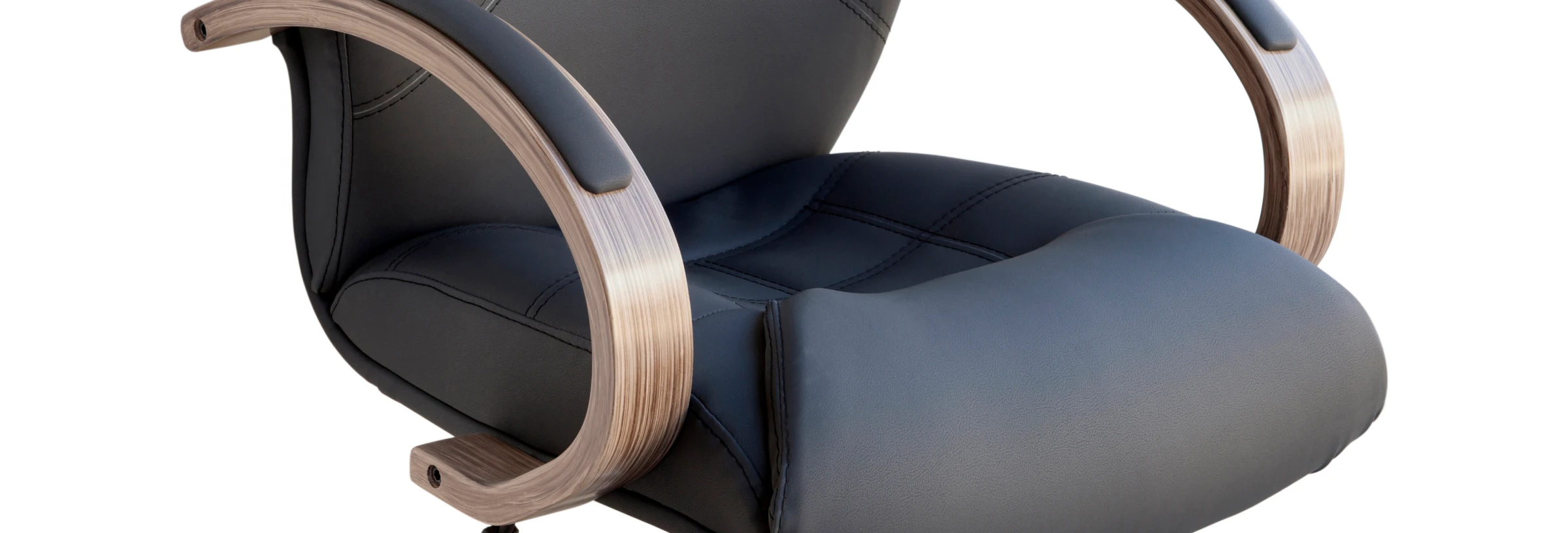
6. Upholstery Choices for Heavy Duty and 24/7 Office Chair Use
Upholstery on a heavy duty chair has to do two things at once: handle higher concentrated load without compressing, and survive cleaning protocols appropriate to the use environment. Different applications need different materials.
Mesh — for breathability and big & tall use
Heavy duty mesh requires higher tensile strength than standard commercial mesh. Look for mesh with documented tensile testing at 200,000+ load cycles at the chair's rated capacity. Standard mesh tested for 130 kg loads will sag noticeably within 12–18 months if used by a 180+ kg user. Big-and-tall mesh chairs use a denser weave with thicker individual fibers.
Fabric — for general heavy duty office use
Fabric durability is measured in double rubs (Wyzenbeek US, Martindale EU). Quick reference:
| Use Intensity | Wyzenbeek Double Rubs | Martindale Equivalent |
| Light residential | 15,000 | 20,000 |
| Standard commercial | 30,000–50,000 | 40,000–60,000 |
| Heavy commercial | 50,000–100,000 | 60,000–100,000 |
| 24/7 / intensive use | 200,000+ | 100,000+ |
Vinyl and antimicrobial materials — for healthcare and dispatch
For environments where chairs are used by many people across shifts — hospitals, dispatch centers, healthcare — vinyl or antimicrobial-treated fabric becomes the default. The cleaning frequency would degrade fabric in months. Vinyl wipes down with sanitizing wipes between shifts and resists biological contamination.
Leather — for executive heavy duty
Heavy duty leather executive chairs exist but are a smaller category. The relevant spec is foam density behind the leather: 50+ kg/m³ high-resilience foam is required to handle higher user weight without compression. Standard 35 kg/m³ foam under leather flattens within a year under a 180 kg user.
Fire retardancy
US-side, two flame retardancy standards matter:
• CAL TB 117 — California Technical Bulletin 117. Baseline for residential and most commercial furniture.
• CAL TB 133 — Stricter standard required for high-occupancy public spaces — airports, hospitals, university dorms, hospitality. Required in many tender specifications. The foam and upholstery must pass a full-chair burn test, not just material-level testing.
Heavy duty leather executive chair configurations are listed under our leather executive chair lineup, including options with 50+ kg/m³ foam and top-grain leather.
7. Industry Standards and Certifications for Commercial-Grade Chairs
Certifications matter at procurement because they're how buyers verify what the manufacturer says. For heavy duty seating, especially in government, healthcare, and institutional tenders, third-party certification is often a hard requirement.
Key standards by region
| Standard | Region | What It Covers |
| ANSI/BIFMA X5.1 | US | General office chair durability baseline |
| ANSI/BIFMA X5.11 | US | Large occupant (big & tall) chairs |
| ANSI/BIFMA X5.4 | US | Lounge and public seating durability |
| BIFMA X7.1 / e3 | US | Emissions and sustainability |
| EN 1335 | EU | Office work chair safety and dimensions |
| BS 5459-2:2000 | UK | 24-hour office chair standard |
| DIN 4550 | Germany | Gas lift cylinder classification |
| GREENGUARD Gold | Global | Indoor air quality / VOC emissions |
| SGS Class 3/4 | Global | Third-party gas lift safety testing |
| CAL TB 133 | US | Fire performance for institutional seating |
"Compliant" vs "Certified"
Vocabulary matters in tender submissions. "BIFMA-compliant" can mean the manufacturer tested in-house and believes the chair meets the standard. "BIFMA-certified" means a third-party lab tested and certified it. The first is the manufacturer's claim; the second is independently verified. For government tenders, certified is usually required; for private commercial procurement, compliant with documented internal testing is often acceptable.
What to ask suppliers
• Which BIFMA standard does this chair test against?
• Compliant or certified — and which lab issued the certification?
• Can I see the test report?
• Does the certification cover the specific configuration I'm ordering, or a similar one?
• What's the gas lift Class certification?
• Any fire retardancy or GREENGUARD certification on the upholstery?
Reputable manufacturers can produce test reports on request. Suppliers who can't or won't share documentation should be treated cautiously for any application that ranks safety highly.
8. How to Specify Big & Tall Office Chairs for Project Procurement
Procurement for heavy duty seating runs differently than standard office chair sourcing. The categories are smaller, the suppliers fewer, and the verification needs higher. Here's the working checklist.
Define the use case first
• Big-and-tall for individual users — order chairs for specific staff (typically 5–10% of headcount in standard offices)
• Big-and-tall universal — entire office spec'd to accommodate larger users (common in healthcare, government inclusive workplace initiatives)
• 24/7 multi-shift — dispatch, control room, healthcare; users rotate through same chairs continuously
• Heavy-traffic commercial — high-occupancy open offices, education, public sector; standard sizing but reinforced components
Spec sheet checklist
• Rated load capacity in kg/lbs, with BIFMA standard reference
• Seat dimensions (width and depth) — big & tall is typically 50+ cm wide
• Backrest height and lumbar adjustment range
• Gas lift class (3 or 4) with third-party certification
• Base material, diameter, and load rating
• Caster size, material, and bearing type
• Tilt mechanism cycle rating
• Upholstery type, double rub count or tensile strength data
• Fire retardancy compliance (CAL TB 117 or 133)
• Warranty term — heavy duty chairs should carry 3-year minimum on mechanism, 5+ year on frame
Procurement strategy
• Always request samples for heavy duty orders. Visual inspection of frame welds, base materials, and gas lift markings reveals more than spec sheets.
• For 24/7 environments, request a sample with full third-party test documentation. Vet the lab name — SGS, TÜV, Intertek, and BIFMA-listed labs carry weight; unfamiliar lab names should be researched.
• MOQ flexibility — most manufacturers will produce small big-and-tall runs (20–50 units) alongside larger standard-chair orders without forcing separate POs
• Lead time runs 30–45 days for standard configurations, 45–60 days for OEM customization with custom upholstery or fire retardancy specifications
• Plan for replacement parts at order time — sourcing matching parts 3 years later is harder than buying spares with the original PO
Aston's wholesale program supports mixed orders combining standard, big-and-tall, and 24/7 specifications in single consolidated shipments.
Specify Heavy Duty Office Chairs for Your Project — Direct from Factory
Aston produces heavy duty office chair configurations including big-and-tall (up to 230 kg), 24/7 multi-shift specifications, and high-traffic commercial-grade chairs across our mesh, fabric, and leather product lines. We work with government contractors, healthcare procurement, dispatch and control room buyers, and corporate facility teams in 50+ countries.
What we deliver:
• BIFMA X5.11 testing protocol on big & tall configurations
• Class 4 gas lift cylinders with SGS or TÜV certification on heavy duty specs
• 350 mm steel or aluminum base, 60+ mm casters with sealed bearings
• CAL TB 133 fire retardancy available on OEM orders
• 3–5 year warranty depending on configuration
• Sample units in 10–14 days for evaluation before bulk PO
• Mixed-spec orders (standard + big & tall + 24/7) consolidated in single shipment
Tell us your application, user load profile, and certification requirements — Send your project specs and we'll respond within one working day with a configured quotation and lead time confirmation.
Frequently Asked Questions
What's the difference between heavy duty and 24/7 office chairs?
Heavy duty refers to load capacity — chairs rated for users above the 130 kg commercial baseline, typically 150–230 kg. 24/7 refers to continuous occupancy — chairs engineered for multi-shift use where the chair is in active service around the clock. A chair can be both, but the categories solve different problems. Heavy duty addresses size; 24/7 addresses time.
Can a regular office chair be used 24/7?
Not for long. Standard BIFMA X5.1 testing assumes 8 hours of daily use. Under 24/7 occupancy, that same chair hits its tested cycle counts in roughly 3.3 years instead of 10. Components fail prematurely — typically the tilt mechanism, gas lift seal, or castor bearings first. For genuinely 24/7 applications, spec a 24/7-rated chair with third-party test documentation.
What weight capacity should I order for general office staff?
Standard commercial chairs rated 130–150 kg (290–330 lb) cover the median user. For broader inclusion, 180 kg (400 lb) rated chairs offer headroom without significantly increasing unit cost. For environments requiring full population coverage — universities, public-sector workplaces — 230 kg (500 lb) BIFMA X5.11 chairs are the safer baseline.
What's a Class 4 gas lift cylinder?
Per DIN 4550, Class 4 gas lifts are rated for ≤ 400 kg with a 3.0 mm tube wall thickness. They're required for heavy duty chairs (180+ kg rated users) and 24/7 multi-shift use. Class 3 is the standard commercial baseline at 2.5 mm wall and 300 kg rated capacity. For any chair sold as "heavy duty," Class 4 should be the minimum specification with third-party certification.
Are big & tall chairs always rated for 24/7 use?
No. They're separate ratings. A chair can be big & tall (BIFMA X5.11 rated for 180+ kg users) but only engineered for standard 8-hour daily use. For 24/7 environments with larger users, you need both ratings — verify BIFMA X5.11 plus 24/7 cycle testing documentation.
What is CAL TB 133?
California Technical Bulletin 133 is a fire-performance standard for upholstered seating in high-occupancy public spaces — airports, hospitals, university residence halls, hospitality facilities. Unlike TB 117 which tests materials individually, TB 133 tests the assembled chair as a unit. Many institutional tenders require TB 133 compliance for occupied seating.
Do mesh chairs come in big & tall versions?
Yes. Big & tall mesh chairs use denser weave with higher tensile strength fibers, wider seat pans (50–55 cm vs 45–48 cm standard), reinforced lumbar zones, and Class 4 gas lifts. Aston supplies big & tall variants across our mesh chair line, rated up to 180–200 kg with BIFMA X5.11 testing protocols.
How long do heavy duty office chairs last?
Realistic service life depends on use intensity. Big & tall chairs in standard 8-hour office use: 8–12 years. 24/7 multi-shift chairs: 5–8 years (replacing components like upholstery and casters along the way). Heavy-traffic commercial chairs: 6–10 years. The longest-lived component is typically the steel frame; the first to fail under heavy use is usually upholstery, then gas lift seals, then tilt mechanism.
What's the typical warranty on heavy duty office chairs?
Quality manufacturers offer 3-year minimum on the mechanism and gas lift, 5-year or longer on the frame. 24/7 multi-shift chairs from specialized brands carry lifetime warranties on the frame and pneumatic lift, with shorter coverage on foam and upholstery (2–3 years). Aston provides 3-year warranty on all heavy duty configurations, with 5-year frame coverage on Class 4 cylinder variants.
How do I verify a supplier's heavy duty claims?
Request three documents: the BIFMA test report (specifically the standard version like X5.1, X5.11, or X5.4), the gas lift Class certification from a recognized third party (SGS, TÜV, Intertek), and the upholstery durability data (Wyzenbeek or Martindale double rub count). A supplier who can produce all three is operating at commercial-spec level. A supplier who can't is selling claims, not engineered products. Our bulk buying guide covers the full procurement verification workflow.
