
There's no universal winner in the mesh vs leather office chair debate, but there's a right answer for every specific room. A mesh-back ergonomic in a call center isn't going to look right at the CEO's desk. A deep-padded leather executive chair in the boardroom would slowly cook a junior developer in a glass-walled meeting room in July. Both products exist because both solve real problems. What changes is which one solves yours.
This guide walks through the comparison from a factory's perspective — the actual material specs, foam densities, lifecycle data, and procurement realities that determine which chair ships into which room. We make both, ship both globally, and have logged enough returns and re-orders to know where each one wins and where each one quietly fails.
1. Mesh vs Leather Office Chair: What Each Type Actually Is
Both are office chairs. The difference is structural — they support the body in completely different ways.
A mesh office chair uses a tension-stretched fabric across a rigid frame to carry the user's weight. The mesh is typically a high-strength elastomeric polyester or nylon weave, sometimes reinforced with polypropylene fibers. There's no padding under it — your body weight is held by the tensile properties of the fabric itself. Lumbar support comes from the curvature of the frame and any movable lumbar pad attached to it.
A leather office chair is a traditional padded chair upholstered with leather (genuine, top grain, bonded, or PU). Body weight is held by a foam cushion sitting on a plywood or steel deck. The leather is a cover material; the structural work is done by the foam density and the deck underneath.
These are not interchangeable products. They generate different pressure profiles, age differently, suit different climates, and project different aesthetics. Comparing them only on price misses everything that actually matters.
Quick reference for the rest of this article:
| Feature | Mesh Office Chair | Leather Office Chair |
| Load-bearing | Tensioned mesh fabric on frame | Foam cushion on plywood/steel deck |
| Cover material | Elastomeric polyester/nylon weave | Genuine, top grain, bonded, or PU leather |
| Foam used | Seat cushion only (back is mesh) | Both seat and back fully padded |
| Aesthetic | Modern, technical, breathable | Traditional, executive, premium |
| Typical use | Task chairs, call centers, dev floors | Executive offices, boardrooms, lobbies |
2. Breathability and Climate: Where Mesh Back Chairs Pull Ahead
This is the single biggest functional difference. Mesh is open-weave fabric with measurable air permeability — typically 60–90% open area for a quality task-chair mesh. Leather, even perforated, sits in the 5–15% range at best. The two materials behave very differently against body heat.
Under prolonged seated use, body temperature rises and humidity builds at the seat–chair contact surface. With mesh, that heat dissipates through the back of the chair into the surrounding air. With leather, it sits against the user's clothing and traps until they stand up. In a 25°C office that's a minor annoyance. In a 32°C call center floor with weak AC, it becomes the reason your staff start swapping chairs informally with whoever sits in the cool corner.
A few climate scenarios where mesh wins decisively:
• Tropical or subtropical regions (Southeast Asia, Middle East, Latin America) where buildings can't always hold consistent temperature
• Open-plan offices with 8+ hour daily occupancy
• Call centers and customer-service floors where staff turnover means chairs run continuous shifts
• Server rooms and IT operations where ambient temperatures are intentionally cooler but localized heat at workstations still builds
• Any environment where users wear synthetic fabrics that trap heat against the chair surface
Leather's edge appears in the opposite scenarios — cold or dry climates, where the slight thermal insulation of a leather seat is welcome, and executive environments where the user spends limited continuous time in the chair anyway.
Aston's mesh chair range uses high-strength elastic polyester mesh tested for tension retention across 200,000 sitting cycles. Browse the full mesh office chair catalog for variants including high-back, mid-back, and big-and-tall configurations.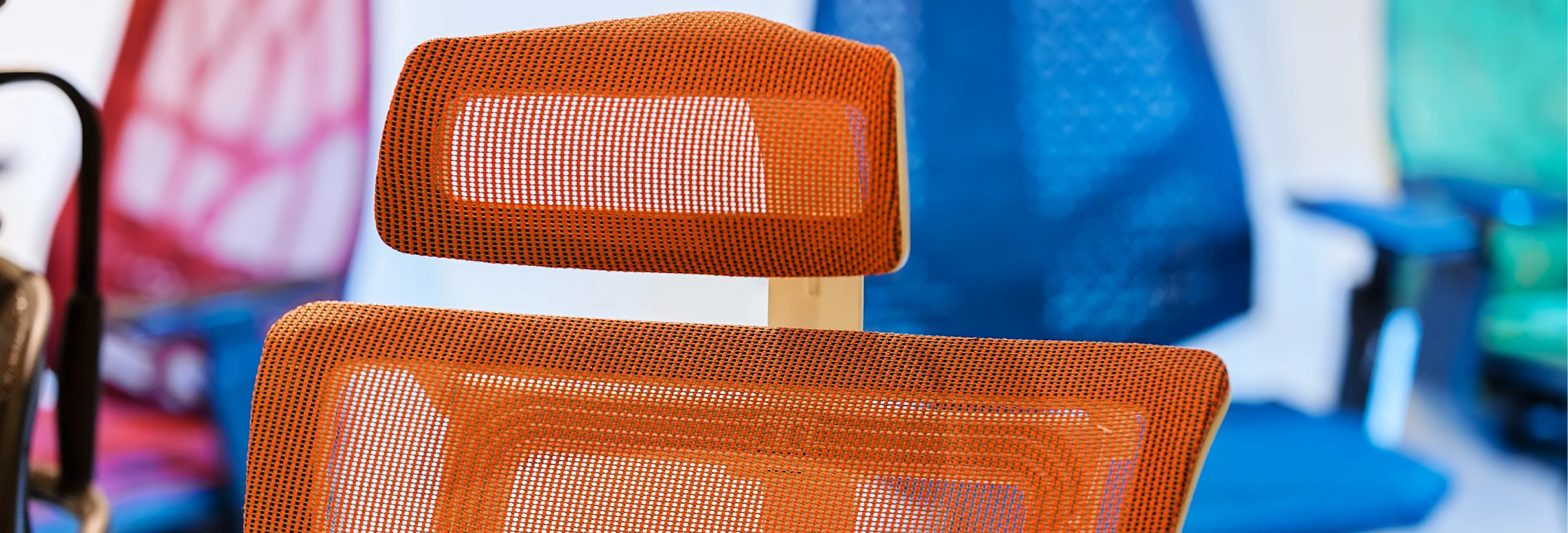
3. Comfort and Plushness: The Case for Leather Executive Chairs
Mesh wins on breathability. Leather wins on perceived comfort during shorter, higher-status seated periods. The difference is foam density and how it interacts with leather.
A serious leather executive chair sits on high-resilience foam with a density of 45–55 kg/m³ (about 2.8–3.4 lb/ft³) under the seat. Anything softer than 40 kg/m³ will deform inside 18 months of daily use, leaving you with a leather-covered chair that looks fine and sits awful. Foam this dense doesn't "give" under initial sitting — it compresses slowly, distributing pressure, then recovers when you stand.
The leather cover then adds a layer of perception. Real leather has a hand-feel and visual depth that no synthetic fully replicates. Even good PU leather (which is what most "leather" budget chairs actually use) looks plausible in photos but feels different under repeated contact. Top-grain and full-grain leather develop a patina over years; bonded and PU don't — they just deteriorate.
Where leather genuinely fits:
• Executive private offices, where the chair signals status and the user spends 2–4 hours seated continuously
• Boardroom seating, where 12–18 chairs cluster around a single table for episodic high-stakes meetings
• Reception areas and visitor seating, where first impression carries weight
• Hotel suites and serviced office environments
• Law firms, finance, and traditional industries with strong visual brand expectations
What buyers should watch for: the leather grade matters more than the chair shape. A correctly-shelled bonded leather chair will peel and crack within 18–24 months of daily use, regardless of how the brochure photographs. PU leather on a high-density foam base will outperform bonded leather over 5 years. Full-grain or top-grain leather on the same foam will outperform both, at roughly 2.5–3× the unit cost.
For full-grain and PU leather executive chair specifications, see our leather office chair lineup with detailed material grade options.
4. Ergonomics and Posture Support — Mesh and Leather Compared
Both can be ergonomic. Both can be terrible for posture. The difference sits in how each material distributes load and how the supporting hardware is engineered around it.
Mesh chairs typically integrate dynamic lumbar support — a separate lumbar pad that floats independently of the back frame, adjusting up and down to track the user's lower spine curve. Because the mesh itself is taut, it conforms to micro-movements of the spine without needing to compress like foam. A quality mesh task chair will offer 3D or 4D lumbar adjustment (height, depth, and sometimes lateral), 6D armrest adjustment (height, width, depth, pivot, swivel, and tilt), and a recline range up to 160° with synchronous tilt that keeps thighs parallel to the floor as the back reclines.
Leather chairs rely on the chair's contour and the foam's response. The lumbar curve is built into the seat-back shape and doesn't adjust dynamically. Recline ranges are narrower — typically 100–135° on executive chairs because the deep-padded silhouette doesn't engineer well for high recline angles. Armrests on leather executives are often fixed or 2D adjustable, not the 6D range you find on serious ergonomic mesh.
In practical terms:
| Ergonomic Spec | Mesh Chair (Quality Task) | Leather Chair (Executive) |
| Lumbar support | Dynamic 3D/4D, height-adjustable | Built into seat-back contour, fixed |
| Armrest adjustability | 6D typical (up to 4D on budget) | Fixed or 2D (height-only) |
| Recline range | Up to 160° with synchro mechanism | 100–135° typical |
| Seat depth slider | Standard on commercial models | Less common; depth is fixed |
| Headrest | Available on high-back variants | Built into chair on high-back exec |
| Active sitting support | Yes (mesh micro-conforms) | Limited (foam holds shape) |
For workers spending 6+ hours seated daily, the ergonomic advantage tilts strongly toward mesh. For occupants who use the chair for shorter periods at higher status — executives, partners, board members — the ergonomic limits of leather rarely manifest before the chair is replaced for aesthetic reasons anyway.
Users with chronic lower back issues should read our ergonomic chair guide for back pain for specific lumbar adjustment patterns and posture mechanics.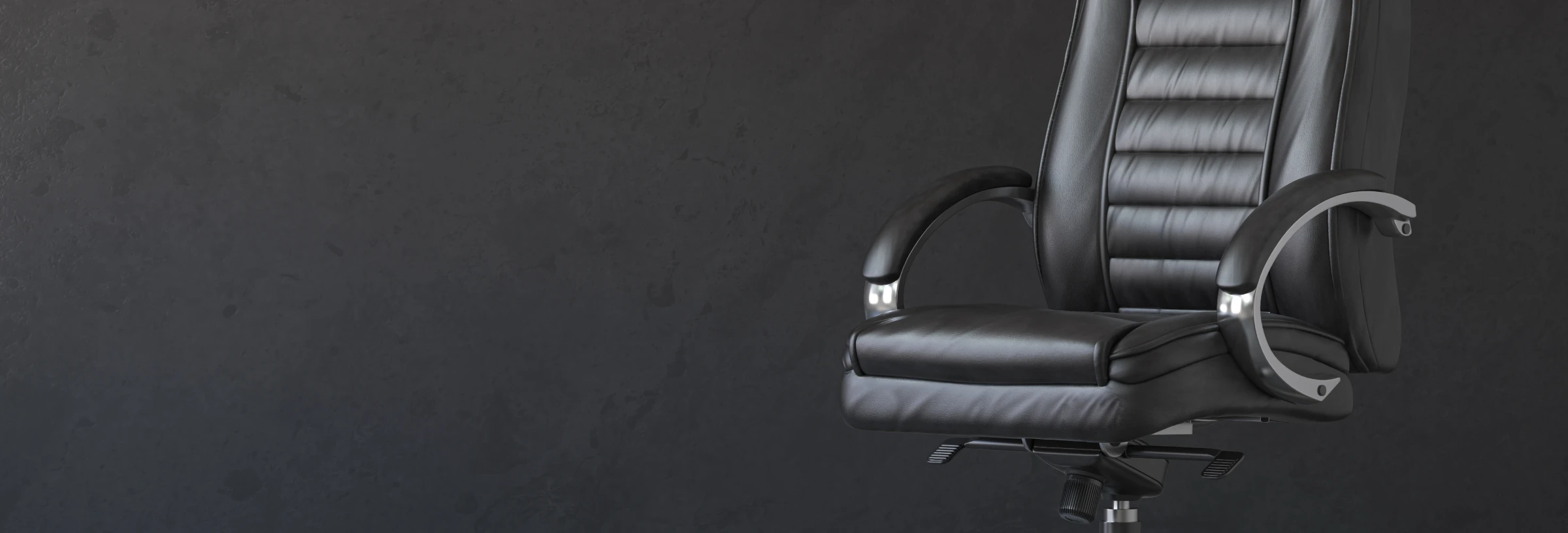
5. Durability, Wear, and Service Life of Mesh and Leather Seating
Both products fail. They fail differently. Knowing the failure modes lets you spec the right one for the right use intensity.
How mesh chairs typically fail
The first thing that degrades on a mesh chair is the mesh itself. Lower-quality elastomeric weaves lose tension after 18–36 months, sagging in the seat or back and shifting lumbar support out of alignment. A high-quality commercial mesh, tested across 200,000+ load cycles before release, will hold tension through 5–8 years of normal commercial use. The frame and mechanism typically outlive the fabric — a worn mesh chair is usually re-mesh-able if the manufacturer supports replacement panels.
Failure modes to watch for:
• Lateral sag in the seat mesh (the user's hips depress more than the front edge)
• Visible weave separation along stress lines near the lumbar curve
• Mesh edge fraying where the fabric meets the frame clamp
• Loss of recovery — the mesh holds an imprint after the user stands up
How leather chairs typically fail
Leather fails from the surface inward. Bonded leather (essentially leather fibers glued to a fabric backing) starts cracking and peeling within 12–24 months of daily use. PU leather holds up better — typically 3–5 years before surface degradation — but starts looking dated as creases form along high-stress zones. Top-grain and full-grain leather develop patina rather than failing visually, though the foam underneath will compress before the cover gives up.
Failure modes:
• Surface cracking and peeling (most common in bonded leather)
• Foam compression — the seat loses its shape and feels harder over time
• Stitching breaks along armrest and seat-edge seams
• Discoloration from sunlight and skin oil contact
Realistic service life ranges:
| Chair Type | Light Use (≤4h/day) | Standard Office (6–8h/day) | Heavy Use (8h+/day) |
| Mesh — commercial grade | 8–12 years | 5–8 years | 3–5 years |
| Mesh — budget | 4–6 years | 2–3 years | Not recommended |
| Leather — full grain | 12–15 years | 7–10 years | 5–7 years |
| Leather — PU | 6–8 years | 3–5 years | 2–3 years |
| Leather — bonded | 3–4 years | 1.5–2 years | Not recommended |
Aston runs full BIFMA-compliant testing on every chair series before production release. Detailed test protocols are documented on our quality testing protocols page.
6. Cost Analysis: Mesh Office Chairs vs Leather Chairs Over 5 Years
Unit cost comparisons mislead. A leather chair at $180 wholesale that's replaced in two years costs more over five years than a mesh chair at $220 wholesale that lasts the full period. The real comparison is total cost of ownership.
Typical wholesale unit cost ranges (FOB China factory, 100+ unit orders):
| Chair Grade | Mesh Wholesale | Leather Wholesale |
| Entry commercial | $60–$110 | $80–$140 (bonded leather) |
| Mid-range commercial | $110–$220 | $160–$280 (PU leather) |
| Premium commercial | $220–$450 | $300–$650 (top-grain) |
| Executive top-tier | $450–$700 | $650–$1,200 (full-grain) |
The five-year picture changes the math. Take an open-plan office of 50 workstations buying mid-range chairs.
| Scenario | Mid-range Mesh | Mid-range PU Leather |
| Unit cost (FOB) | $180 | $220 |
| Expected life (6–8h daily) | 5–7 years | 3–5 years |
| 50-unit initial cost | $9,000 | $11,000 |
| 5-year replacement need | ~10% (5 units) | ~50% (25 units) |
| 5-year TCO | ~$9,900 | ~$16,500 |
| Maintenance complexity | Vacuum, occasional mesh swap | Leather conditioning, foam replacement |
Leather is still the right call when the room demands it visually — executive offices, boardrooms, reception. The point isn't that mesh is universally cheaper. The point is to apply the comparison only within the right category. Don't put bonded leather chairs into a 50-station open office and then act surprised when half of them need replacing inside two years.
For detailed bulk procurement strategies including freight, MOQ, and OEM customization, see our bulk sourcing guide.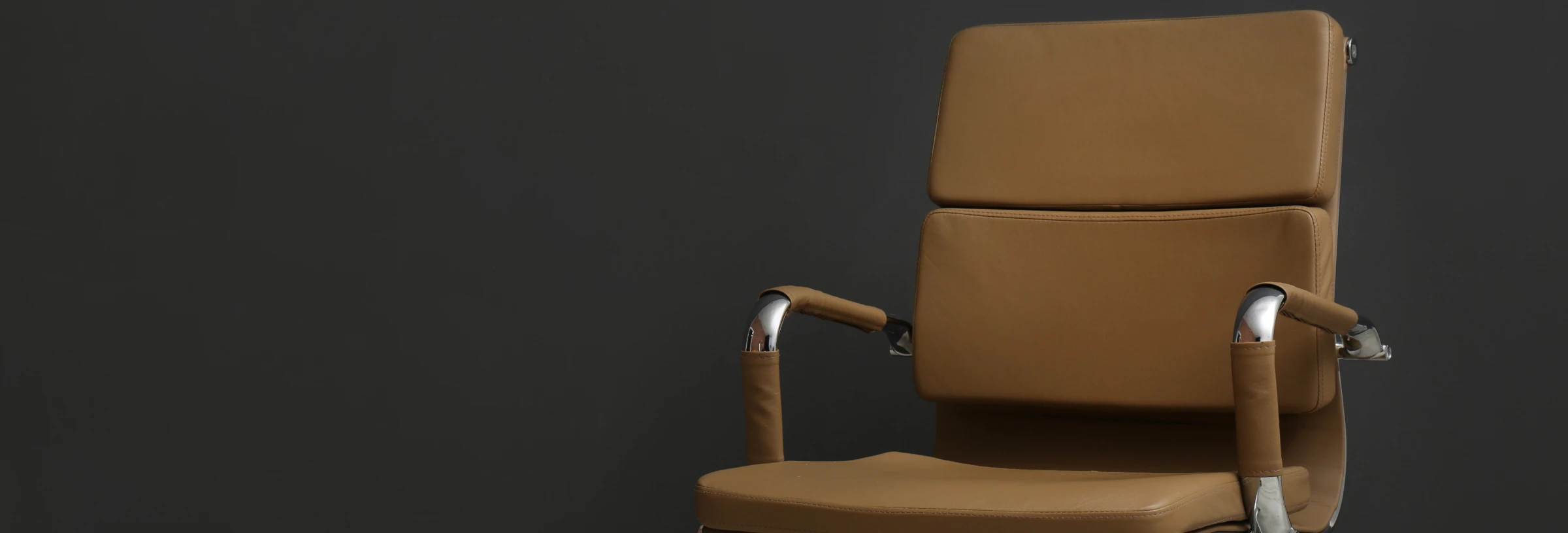
7. Room-by-Room Specification: When to Choose Mesh, When to Pick Leather
The cleanest way to spec across a full office is room by room. Here's how we usually advise distributors and project contractors to map the decision:
| Room Type | Recommended Material | Reasoning |
| Open-plan task area | Mesh | Long seated hours, heat buildup, posture priority |
| Executive private office | Leather (top-grain) | Aesthetic, lower hours, status signaling |
| Boardroom / conference | Leather (high-back exec) | Visual cohesion, episodic use |
| Reception / lobby | Leather or premium PU | First-impression visual weight |
| Call center / customer service | Mesh (heavy-duty) | Continuous occupancy, heat, multi-shift use |
| Training room | PP shell or basic mesh | Stack-and-store, lower hours |
| Creative / dev floor | Mesh (premium ergonomic) | Long seated hours, focus on posture |
| Hot-climate locations | Mesh | Ambient temperature load on user |
| Cool-climate executive suite | Leather | Climate doesn't penalize leather |
| Hotel business center | Leather (PU acceptable) | Aesthetic priority, modest hours |
Two common mixed-room patterns we see most often:
The corporate HQ pattern: mesh task chairs on every working floor (60–80% of the unit count), leather executive chairs in C-suite offices and boardrooms (10–15%), and PP shell chairs or basic mesh in training and breakout areas (10–25%). One factory order, three product lines, consistent brand visual.
The hospitality pattern: leather for guest-facing spaces (reception, business center, suites), mesh for back-of-house staff (admin, reservations, IT). The split mirrors the visible/invisible boundary of the property.
Aston's office chair wholesale range covers all three categories in a single supplier relationship, simplifying procurement for mixed-room projects.
8. Maintenance and Lifecycle: Caring for Mesh and Leather Office Chairs
Both materials need different care. Treating one like the other shortens its life noticeably.
Mesh chair maintenance
• Vacuum the mesh weekly with a soft-brush attachment. Dust embedded in the weave is the main reason mesh discolors over time.
• For spills, blot with a microfiber cloth and warm water. Mild detergent (a drop of dish soap in a cup of water) handles most stains.
• Avoid bleach and ammonia — both degrade the elastomeric fibers and accelerate mesh failure.
• Quarterly, check armrest pivots and lumbar adjuster screws for loosening.
• Mesh panels are typically replaceable on commercial-grade chairs. When tension visibly fails, replacing the panel is usually 30–40% the cost of a new chair.
Leather chair maintenance
• Wipe weekly with a dry microfiber cloth to remove skin oils that otherwise penetrate the leather over time.
• Condition with a pH-neutral leather conditioner every 3–6 months for genuine leather. Bonded and PU leather should not be conditioned — the additives can degrade the surface coating.
• Avoid direct sunlight. UV is the single biggest cause of leather discoloration in office settings near windows.
• Spills: blot, don't rub. Water-based stains usually wipe; oil-based stains may set permanently — clean immediately.
• Foam replacement is possible on serious executive chairs after 5+ years if the leather is still in good condition. Most office chair manufacturers don't stock the foam separately, so confirm replacement availability at the time of ordering.
Common mistakes to avoid on both:
• Don't use furniture polish on either — it leaves residue that attracts more dust.
• Don't power-wash either surface — water under pressure forces past upholstery edges into foam or frame welds.
• Don't store chairs in unheated warehouses long-term — both leather and elastomeric mesh degrade in temperature extremes.
9.Source Both Mesh and Leather Office Chairs from One Factory
Aston produces both mesh and leather office chair lines on the same factory floor, which means mixed-room projects ship as one order with one freight consolidation. Distributors and project contractors in 50+ countries use this dual-line supply to standardize procurement across full corporate fit-outs.
What we offer:
• Mesh: 3D dynamic lumbar, 6D armrests, 160° recline, SGS-certified Class 3 gas lift, BIFMA-compliant
• Leather: PU, top-grain, and full-grain options; 45–55 kg/m³ foam density; metal or wood base
• 3-year warranty on both lines
• MOQ from 10 units on standard configurations, 100+ units for full OEM customization
• Lead time 25–35 days standard, 45–60 days OEM
Tell us your project's room mix and unit counts — visit our wholesale program page or Send your project specs for a same-day quote.
10.Frequently Asked Questions
Which is more durable, a mesh chair or a leather chair?
Both can last 5–10 years if specified correctly. Commercial-grade mesh holds up better against high-use heat and humidity; full-grain leather holds up better against light-use aesthetic wear. The wrong grade of either fails inside two years — bonded leather and budget mesh both fall into this category. Specify by use intensity, not just by material name.
Do mesh office chairs sag over time?
Quality commercial mesh — tested across 200,000+ load cycles before release — holds tension through 5–8 years of normal use. Budget mesh (sub-$80 wholesale) often starts sagging at 18–24 months. The variable is fiber quality and weave density, not the visible appearance at delivery. Ask suppliers for tested cycle counts before bulk PO.
Are leather office chairs hot to sit on?
Yes, relative to mesh. Leather restricts airflow at the seat–body contact surface, trapping body heat. In a 22–24°C climate-controlled office, this is barely noticeable for shorter sessions. Above 26°C or for continuous 6+ hour use, it becomes uncomfortable. Perforated leather helps a little but doesn't close the gap with mesh.
What's the difference between genuine, bonded, and PU leather?
Full-grain and top-grain are real leather (top-grain has a buffed surface). Bonded leather is shredded leather fiber glued to a fabric backing, sold as "genuine leather" in some markets — it cracks and peels in 12–24 months under daily use. PU (polyurethane) leather is synthetic, looks like leather, and outperforms bonded leather over five years. Order grade matters more than chair brand.
Can mesh chairs hold heavy users?
Commercial mesh chairs are typically rated for 130–150 kg (290–330 lbs). Big-and-tall mesh variants go up to 180–230 kg (400–500 lbs). What changes between weight classes isn't the mesh itself — it's the frame steel gauge, the seat plate, and the gas lift class. A 130 kg-rated mesh chair will not safely hold a 160 kg user.
Is a leather chair always better for executives?
Not always. Tech and creative companies increasingly spec high-end mesh in executive offices to project a modern, ergonomic-first culture. Traditional industries (law, finance, hospitality) still default to leather for status signaling. The choice depends on the brand image more than the function. For executives with chronic back issues, mesh is genuinely better ergonomically.
How often should commercial mesh chairs be replaced?
Every 5–8 years for moderate-use offices with commercial-grade mesh. Heavy-use environments (call centers, 24/7 operations) need replacement at 3–5 years. Many manufacturers offer mesh panel replacement at 30–40% of new-chair cost, which extends total chair life if the frame and mechanism are still sound.
Do you supply both mesh and leather chairs in OEM?
Yes. Aston produces both lines in our 10,000 m² Foshan factory, with OEM color matching, branded labeling, and private packaging available on both. Single-PO procurement covers mixed mesh-and-leather orders, with consolidated freight from the same loading dock. MOQ for OEM customization is typically 100 units per configuration.
Which costs more, mesh or leather?
At equivalent quality grades, mid-range mesh and PU leather are similarly priced ($150–$280 wholesale). Premium mesh and top-grain leather both move into the $400–$700+ range. The price difference inside a tier is smaller than the price difference between budget and premium of either material. Don't compare across tiers.
Can mesh be customized with company branding?
Yes. Mesh colors can be customized through OEM dyeing (black, gray, white standard; custom colors available at 300+ unit MOQ). Branded silkscreen on lumbar pads, embroidered logos on headrest covers, and custom plastic component colors are all available. Leather chairs offer similar options including embossed leather logos and custom stitching.
