
When a client walks into your office lobby, the sofa is often the first thing they sit on — and remember. Yet in most commercial procurement processes, sofas get chosen last, budgeted tightest, and replaced soonest. That pattern is expensive.
This guide covers what actually matters when sourcing office sofas for commercial environments: zone-by-zone requirements, structural specifications you should be verifying with suppliers, material performance benchmarks, sizing decisions, and the questions that separate a durable 7-year piece from one that looks tired in 18 months.
We sell and manufacture office sofas at Aston. We've shipped to 50+ countries across the Middle East, Southeast Asia, Central Asia, and Europe. Most of what's in this guide comes from watching what fails in the field — and engineering against it.
1. Why Office Sofas Fail Early (and How to Avoid It)
Most commercial sofa problems trace back to three purchasing mistakes:
Applying residential specs to commercial environments. A sofa rated for home use — typically 10,000–25,000 Wyzenbeek double rubs on fabric — won't hold up in a lobby that sees 80 people a day. Commercial minimum is 30,000 double rubs; heavy-traffic zones warrant 50,000+.
Buying on aesthetics, not frame construction. Industry lifecycle analysis consistently points to frame quality as the primary determinant of sofa lifespan — accounting for roughly 70–80% of total durability. A good-looking piece with a weak frame fails structurally in 2–3 years.
Ignoring foam density. Seat cushions that bottom out quickly are the #1 complaint we hear from facility managers placing replacement orders. For commercial seating, specify foam density of at least 35–40 kg/m³ (HR-grade polyurethane). High-traffic lobby seating should target 40–50 kg/m³.
2. Types of Office Sofas: Matching the Piece to the Zone
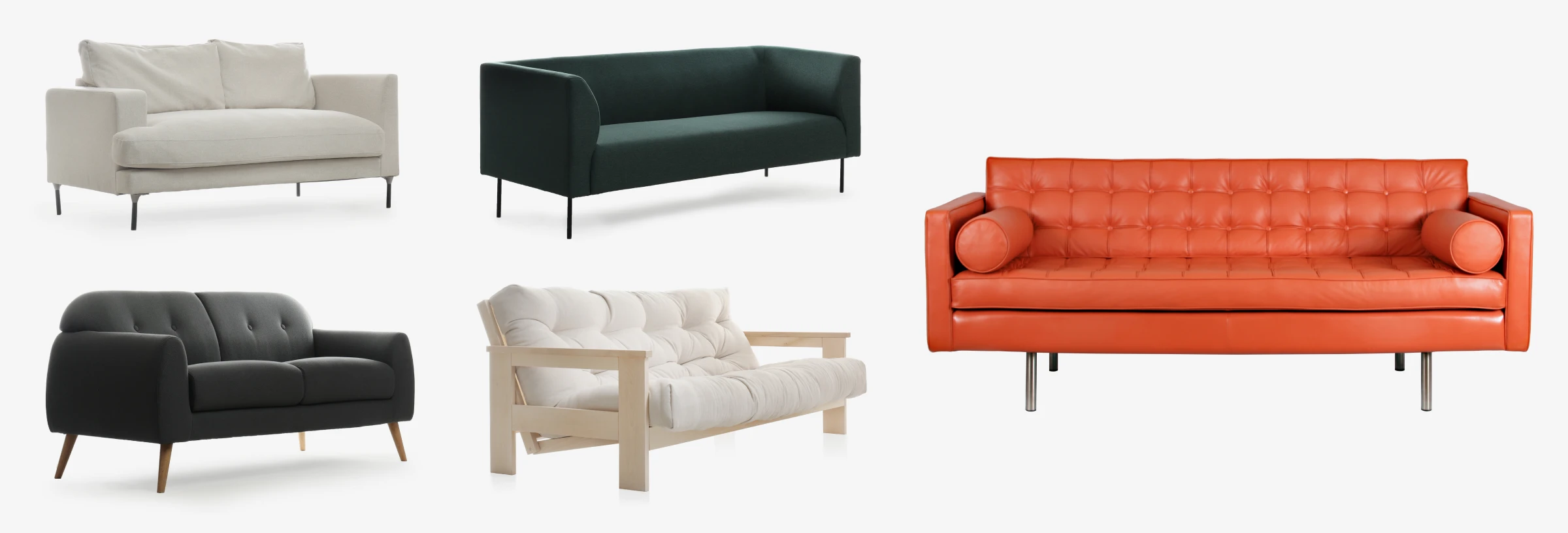
Not all office sofas serve the same function. Here's a practical breakdown:
| Type | Best Zone | Key Spec Priority |
|---|---|---|
| 2-Seater / Loveseat | Private offices, small meeting rooms | Seat depth 50–55 cm, structured back |
| 3-Seater | Reception lobbies, waiting areas | Frame strength, easy-clean upholstery |
| Modular / Sectional | Collaborative zones, open floor plans | Configuration flexibility, consistent module sizing |
| L-Shape | Corner lobbies, large lounges | Rigid corner joint construction |
| Single-Seat Lounge Chair | Executive suites, breakout pods | Lumbar profile, premium upholstery |
| Sofa Set (2+3 or 1+2+3) | Client meeting rooms, formal reception | Visual cohesion, matched foam firmness |
Modular sofas deserve special attention in commercial procurement. They let you reconfigure layouts without buying new furniture — a real advantage in ABW (Activity-Based Working) environments. When evaluating modular systems, check that each module connects securely and that the connector hardware is replaceable, because connections are where modular pieces fail first.
3. Frame Materials: What Holds the Sofa Together Long-Term
The frame is invisible once upholstered, which is why it's often skipped over in buyer evaluations. Don't skip it.
Hardwood frames (typically birch, beech, or rubberwood) offer the best combination of rigidity and screw-holding capacity. Kiln-dried hardwood resists warping from humidity changes — important for buyers in the Middle East and Southeast Asia where climate variation is significant. Joints should be glued, doweled, and corner-blocked, not just screwed.
Steel frames work well for modular and contemporary designs. Steel doesn't warp, and welded steel frames can handle very high load ratings. The downside: steel is heavier and less forgiving to repair if a weld cracks.
MDF / particleboard frames are a cost-reducing shortcut. They're common in low-price-point products and acceptable in very light-use settings. For any commercial application with regular daily use, avoid MDF-framed pieces — screw joints strip out over time, and the frame loses structural integrity.
What to ask your supplier: "What is the frame material and joint construction method? Can you provide a load test certificate?"
4. Upholstery: Leather vs. Fabric for Commercial Use
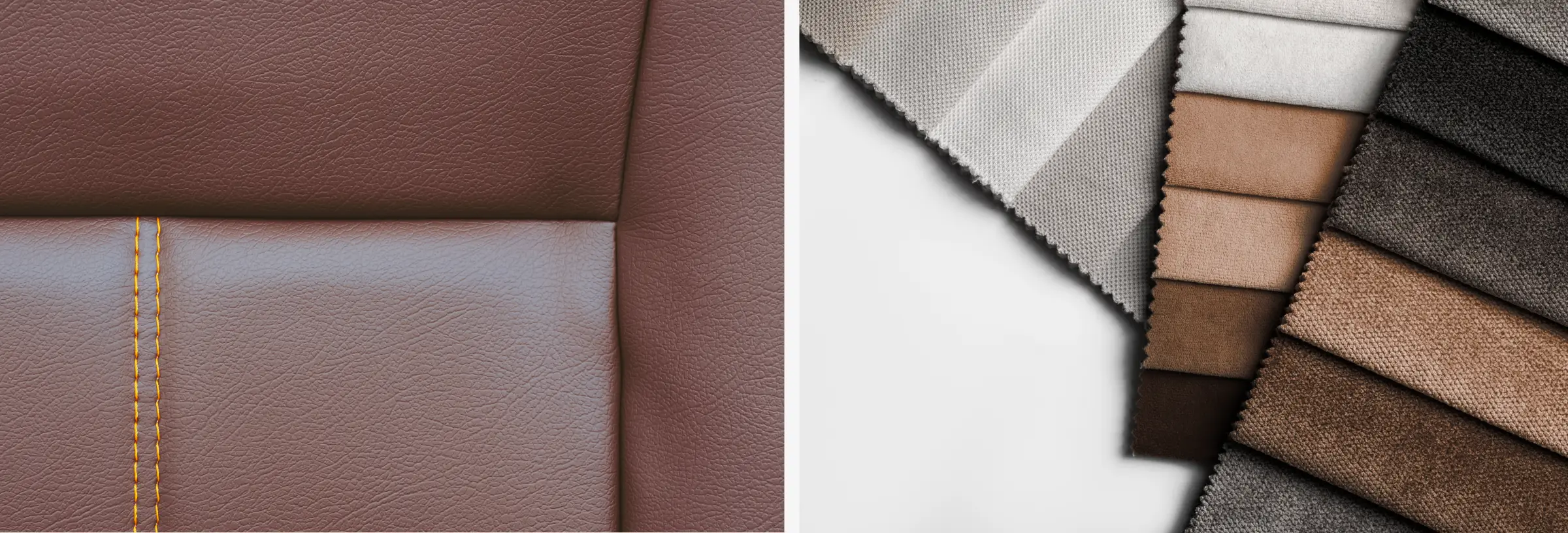
This is the question we get most often from distributors. The honest answer: both work, but for different environments.
Genuine Leather
- Naturally breathable, develops patina over time
- Easier to wipe down for spills and daily cleaning
- Weaker point: susceptibility to scratches and UV fading
- Longevity: 8–12 years with proper conditioning
- Best for: executive offices, formal reception areas, mid-to-low traffic zones
PU / Eco-Leather
- More uniform appearance, lower cost than genuine leather
- Good stain resistance
- Weakness: prone to peeling after 3–5 years if quality is low; check the backing thickness
- What to look for: multi-layer PU with fabric backing ≥ 0.9 mm total thickness
- Best for: waiting areas, co-working spaces, price-sensitive projects
Commercial Fabric (Woven Polyester / Performance Fabric)
- Highest abrasion resistance when properly spec'd
- Wyzenbeek rating should be ≥ 30,000 for general commercial use; 50,000+ for high-traffic lobbies
- Martindale equivalent: 40,000+ cycles for heavy commercial
- Modern performance fabrics often outperform mid-grade leather in stain resistance and durability
- Best for: high-traffic lobbies, tech campuses, healthcare waiting rooms, co-working spaces
A note on rub tests: The Wyzenbeek test (standard in North America) and Martindale test (UK/Europe) measure different friction motions and aren't directly equivalent. When comparing specs across suppliers, confirm which test method was used. Don't accept "durable fabric" without a number.
5. Foam and Cushion Specifications
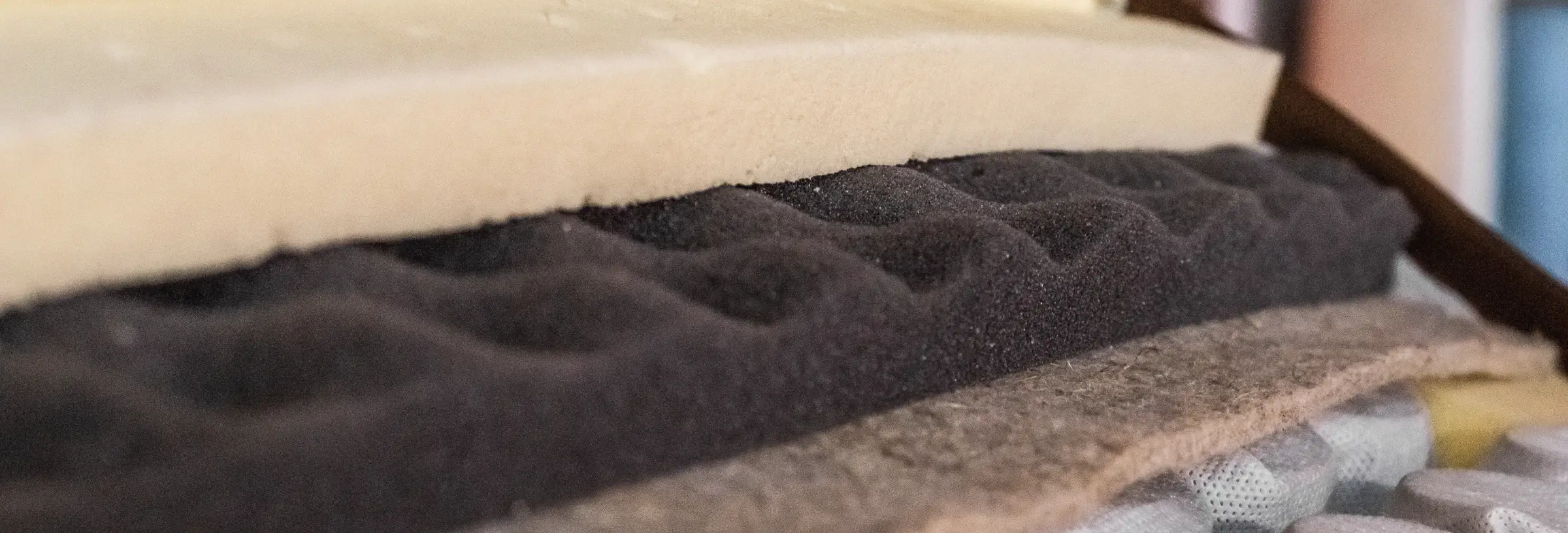
Foam quality is where the budget squeeze hits hardest in commercial furniture manufacturing. Here's what the numbers mean:
Foam density (kg/m³): measures mass per unit volume — a proxy for durability, not firmness.
- 25–30 kg/m³: residential grade, not suitable for commercial use
- 35–40 kg/m³: standard commercial grade, appropriate for typical office reception
- 40–50 kg/m³: high-traffic commercial / hospitality grade
ILD / IFD (Indentation Load Deflection): measures firmness — how much weight is needed to compress the foam by 25%.
- 25–30 ILD: soft; suitable for lounge seating where extended relaxation is the goal
- 30–35 ILD: medium-firm; the standard for office reception sofas
- 35–40 ILD: firm; appropriate for waiting room seating with high turnover
Compression set (ASTM D3574): the foam's ability to recover after sustained compression. A compression set of less than 10% after 22 hours at 50% compression is the benchmark for contract-grade foam. Ask for this test data when evaluating suppliers seriously.
A sofa with high-grade fabric on cheap foam will feel uncomfortable within a year. Cushion collapse is the main reason offices replace sofas ahead of schedule.
6. Sizing Guide for Commercial Spaces
Getting dimensions wrong is a costly mistake — especially for bulk orders. Here are the working ranges for office sofas in commercial environments:
| Configuration | Width | Depth | Seat Height |
|---|---|---|---|
| 2-Seater | 130–160 cm | 78–90 cm | 42–46 cm |
| 3-Seater | 195–230 cm | 78–90 cm | 42–46 cm |
| L-Shape | 220–280 cm per side | 78–90 cm | 42–46 cm |
| Single Lounge Chair | 75–90 cm | 75–85 cm | 40–45 cm |
Seat height matters more in commercial settings than most buyers realize. A seat height of 42–46 cm suits most adults and allows easy standing — critical in high-turnover waiting areas. Lower lounge heights (38–42 cm) are appropriate for executive suites where visitors settle in for longer meetings, but they require more effort to rise from.
Seat depth of 50–55 cm is the sweet spot for commercial seating. Deeper seats (60+ cm) are comfortable for lounging but impractical for upright professional posture in reception areas.
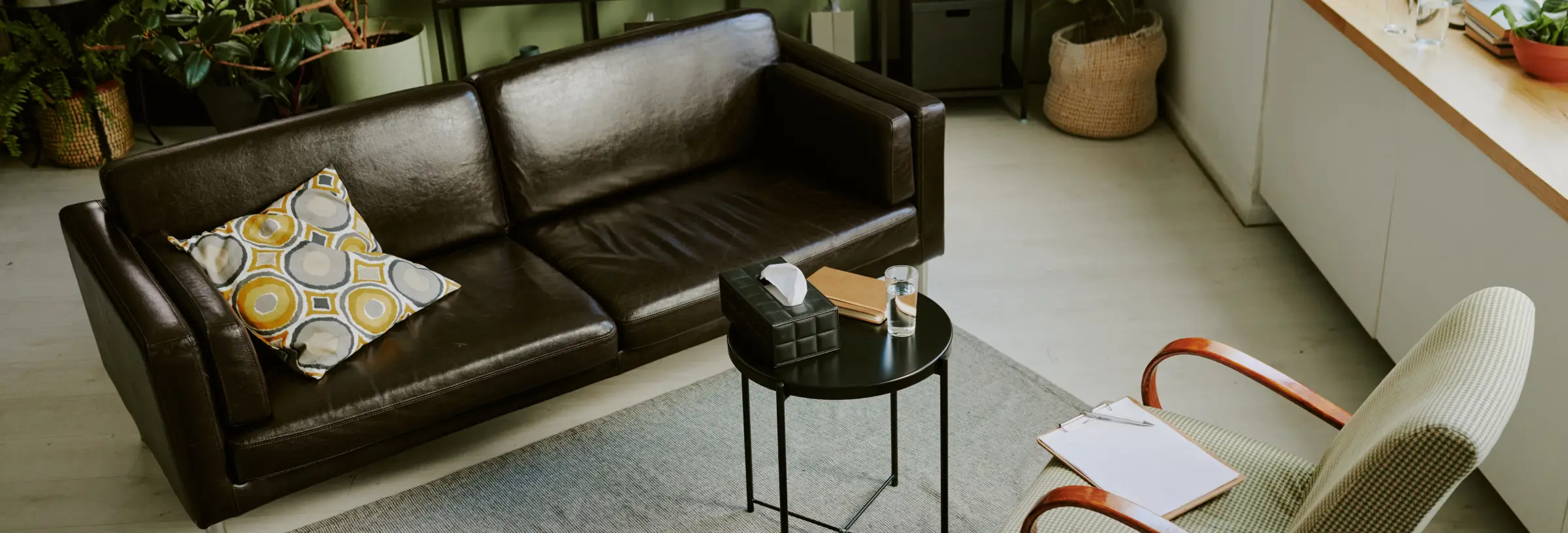
Clearance planning: Leave at least 75–90 cm of walkway clearance around sofas placed in lobby areas. For sofas facing each other across a coffee table, 35–45 cm between the sofa edge and table edge is standard.
7. Zone-by-Zone Selection Guide
Reception and Lobby
This is the highest-traffic, highest-visibility zone. Prioritize:
- Easy-clean upholstery (leather or performance fabric with stain treatment)
- Steel or solid hardwood frame rated for commercial load
- Seat height 44–46 cm for easy ingress/egress
- 2-seaters or 3-seaters matched to expected foot traffic and floor area
- Style should align with brand identity — this is a first impression
Collaborative / Breakout Areas
Here the priorities shift toward configuration flexibility and comfort for 20–60 minute sessions:
- Modular systems that can be reconfigured
- Medium-firm foam (30–35 ILD) for sustained comfort
- Fabric upholstery for durability under frequent, varied use
- Consider adding integrated side tables or power units if your supplier offers them
Executive Offices and Meeting Rooms
Lower traffic, higher aesthetic expectations:
- Genuine leather or premium PU appropriate here
- Sofa sets (matching 2+3 or 1+2+3) for formal client meeting rooms
- Seat depth can be slightly greater (55–60 cm) for comfort in extended meetings
- Attention to leg material and finish — visible hardware matters here
Employee Lounge / Break Room
Comfort-forward, durability secondary priority:
- Fabric upholstery in durable, washable materials
- Slightly deeper seats and lower heights acceptable
- Modular pieces allow reconfiguration as team size changes

8. OEM Customization: What's Actually Possible
If you're a distributor or project contractor sourcing in volume, customization isn't a luxury — it's often a project requirement. At Aston, our standard OEM scope for sofas includes:
- Upholstery material and color (from a standard range or custom swatch matching)
- Leg finish (chrome, matte black, brushed gold, wood-tone)
- Foam firmness and density specification
- Modular configuration dimensions
- Branding / labeling requirements
- Packaging specification for container optimization
Minimum order quantities for customization vary by complexity. Standard color/material changes typically have a lower MOQ than structural dimension changes. If you're specifying for a project, get your requirements in writing early — lead times for custom runs are typically 30–45 days from sample approval.
9. What to Ask Before You Place a Bulk Order
A checklist for procurement managers evaluating office sofa suppliers:
- Frame material and joint construction method?
- Foam density (kg/m³) and ILD rating with test documentation?
- Fabric/leather Wyzenbeek or Martindale rub count?
- Static load capacity per seat (minimum 150 kg recommended for commercial)?
- Compression set test result (ASTM D3574)?
- Warranty coverage — what's included, what's excluded?
- Lead time from order confirmation to FOB?
- Sample availability before bulk production?
- Packaging: what's the CBM per unit for container calculation?
- After-sale: are replacement cushion covers or legs available as spare parts?
Suppliers who can't or won't answer most of these questions are telling you something.
Ready to Source Office Sofas?
Aston manufactures commercial-grade office sofas for reception areas, collaborative zones, and executive spaces — backed by a 3-year warranty and full OEM/ODM support. We ship to 50+ countries with low MOQ and direct factory pricing.
Browse our office sofa collection →
Contact us for wholesale pricing or a custom project quote →
Frequently Asked Questions
What is the difference between an office sofa and a regular sofa?
An office sofa is built to commercial specifications — higher-density foam (35–50 kg/m³ vs. 20–30 kg/m³ residential), upholstery rated at 30,000+ Wyzenbeek double rubs, and frames designed for heavier daily use by multiple users. The aesthetics also tend toward neutral, professional profiles that fit corporate environments. A residential sofa used in an office setting will typically show wear within 1–2 years under commercial foot traffic.
What upholstery material is best for a reception area sofa?
For high-traffic reception areas, commercial-grade fabric (≥50,000 Wyzenbeek) or quality PU leather is usually the most practical choice. Genuine leather works well in moderate-traffic formal reception settings but requires more maintenance. The key spec to request is the abrasion rating — "durable" is a marketing word, not a measurement.
How do I calculate how many sofas I need for a reception area?
Plan for roughly 1.2–1.5 linear meters of seating per person you want to seat simultaneously. For a reception that typically holds 6 people waiting, that's roughly one 3-seater and one 2-seater, or a modular arrangement of equivalent linear length. Account for the room's total footprint and allow 90 cm of clearance on pedestrian paths.
What foam density is appropriate for commercial office sofas?
For standard commercial office environments, specify 35–40 kg/m³ HR-grade polyurethane foam. For lobbies or waiting areas with very high daily turnover, 40–50 kg/m³ is the appropriate range. Always pair density specs with ILD firmness data — density alone doesn't tell you how the cushion will feel.
Can office sofas be customized for OEM or private label orders?
Yes. Most commercial manufacturers — including Aston — offer OEM customization covering upholstery color and material, leg finish, foam specification, dimensions, and branding. Lead times for custom production typically run 30–45 days after sample sign-off, depending on the scope of changes and order volume.
How long should a commercial office sofa last?
A properly specified commercial sofa — solid hardwood or steel frame, HR-grade foam at 40 kg/m³, commercial-grade fabric at 50,000+ double rubs — should last 7–10 years in a standard office environment. The most common cause of early replacement is foam collapse from under-specified density, followed by frame failure at joints. Warranty terms from the manufacturer are a reasonable proxy for expected lifespan.
What is the standard seat height for an office reception sofa?
The standard seat height for commercial reception sofas is 42–46 cm. This range accommodates most adults comfortably and allows easy standing — important in high-turnover waiting areas. Lower lounge-style seats (38–42 cm) are better suited to executive offices and informal collaboration zones where visitors remain seated for extended periods.
