
Corporate training centers, educational seminar rooms, and multi-purpose enterprise facilities operate on a single, uncompromising mandate: spatial agility. A room that hosts a board-level seminar at 9:00 AM must seamlessly reconfigure into an open-floor collaborative workshop by 2:00 PM. For facility managers and procurement officers, achieving this rapid transformation without sacrificing ergonomic support or structural integrity is a persistent engineering challenge.
At Aston Office, our OEM manufacturing and design teams specialize in high-durability commercial seating. This technical guide evaluates the financial and structural metrics of specifying commercial polypropylene (PP) seating, analyzing Total Cost of Ownership (TCO), injection-molding science, BIFMA testing benchmarks, and vertical storage geometry.
The Total Cost of Ownership (TCO) of High-Mobility Seating
When procurement teams evaluate budget allocation for high-traffic training facilities, the purchasing decision frequently defaults to low-cost consumer seating. This is a severe financial miscalculation. In a high-frequency moving environment, residential chairs experience rapid structural fatigue at the joints, resulting in high annual replacement rates.
Calculating accurate TCO requires looking beyond the initial invoice. Specifying commercial-grade polypropylene stackable chairs dramatically reduces lifecycle operational expenditures. Because these units are engineered for rapid deployment, stacking, and cart transport, they eliminate the labor hours and storage footprint required for bulky, non-stackable alternatives. To understand the broader material advantages of this polymer, facility planners can review our technical breakdown on why polypropylene is the professional standard for commercial seating.
Injection-Molding Science and Structural Monoliths
The structural reliability of a plastic training chair is determined on the factory floor during the injection-molding process. Substandard retail chairs utilize hollow-core plastics or cheap ABS blends that warp, crack, and discolor under ultraviolet light and human weight distribution.
Commercial-grade moulded polypropylene chairs are manufactured using high-pressure injection molding with virgin, fire-retardant PP resin infused with glass fiber reinforcement. This technique creates a seamless, monolithic shell with uniform wall thickness and molecular density. The result is a chair that absorbs high kinetic impacts without brittle fracture. For a detailed look at how these commercial seating shells are manufactured from raw polymer pellets, review our inside look at how a plastic chair is made on the factory floor.
BIFMA Testing and Vertical Stacking Geometry
Training room chairs are subjected to unique physical stressors: being dragged across floors, dropped onto hard surfaces, and stacked vertically in high columns on rolling dollies. Standard office task chairs are entirely unsuited for this abuse.
Validating Durability through BIFMA Protocols
Commercial PP seating must pass rigorous ANSI/BIFMA X5.1 performance testing. This includes drop-impact tests on the seat pan and backrest, stability tests to prevent tipping when users lean outward, and static load tests ensuring the frame can safely support 300 lbs repeatedly without structural deflection.
The Physics of Vertical Stacking
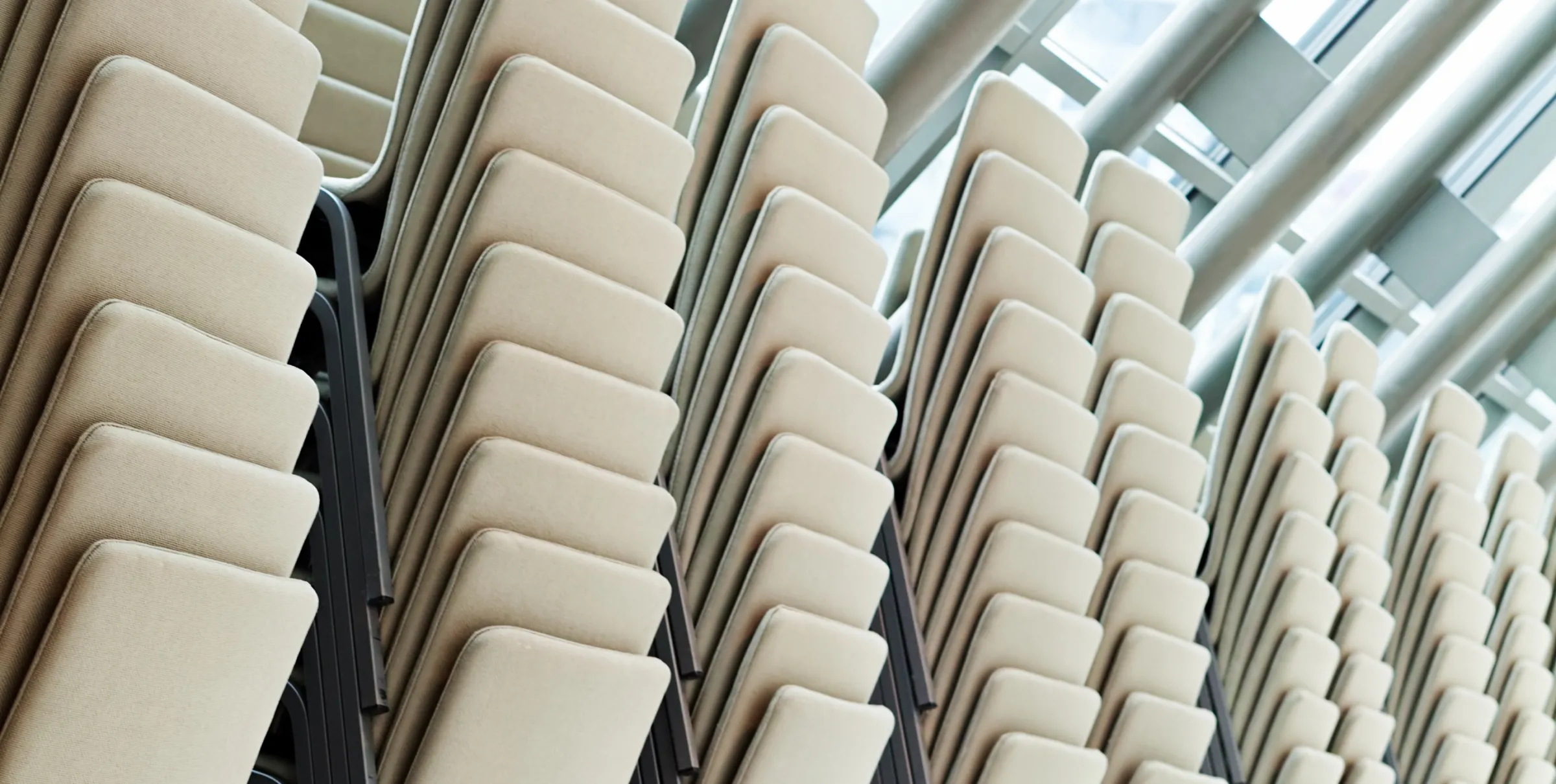
Storage efficiency is dictated by stacking geometry. An unengineered stack of chairs will lean, bind together, or scratch adjacent painted steel frames. Professional stackable seating features built-in polymer stack bumpers and precise taper angles that allow infinite or high-density vertical stacking (often 10 to 20 chairs high on a transport dolly) while maintaining a balanced center of gravity to prevent tipping during transit.
Sanitization, Chemical Resistance, and Anti-Aging
In post-pandemic corporate facilities, daily commercial sanitization is mandatory. Porous fabrics, cheap vinyls, and lower-grade plastics degrade rapidly when exposed to industrial-grade quaternary ammonium disinfectants, alcohol wipes, and bleach solutions, resulting in surface cracking and chemical bleaching.
High-grade polypropylene features a non-porous, chemically inert molecular structure. It resists liquid absorption entirely and withstands aggressive daily sanitization protocols without losing its surface finish or structural elasticity. Furthermore, UV-stabilizers added during the manufacturing process prevent yellowing and polymer degradation, ensuring the chairs maintain their aesthetic appearance even when deployed in sunlit corporate atriums or outdoor training patios.
Strategic Procurement and Enterprise Sourcing
Outfitting a multi-story corporate training center requires massive quantities of identical, perfectly matched furniture. Purchasing these items piecemeal from regional distributors introduces color variances and inconsistent batch tolerances.
When enterprise buyers prepare to scale their facilities, partnering directly with an OEM manufacturer like Aston Office provides complete quality control. As a direct factory supplier of wholesale office furniture, we ensure that every batch of training chairs adheres strictly to international BIFMA standards, offering customizable frame finishes, fire-retardant certifications, and flexible MOQs to protect your project budget.
Frequently Asked Questions
Why is polypropylene preferred over standard plastics for training chairs?
Polypropylene (PP) offers an exceptional strength-to-weight ratio, superior fatigue resistance, and chemical inertness. Unlike cheap plastics that become brittle over time, commercial PP flexes dynamically under human weight and resists cracking even under high-frequency stacking and transport.
How many polypropylene chairs can be safely stacked vertically?
Depending on the frame design (such as a sled base or four-leg tubular frame) and the presence of protective stack bumpers, commercial PP chairs can typically be stacked safely from 8 to 20 units high either freestanding or on a specialized rolling cart without damaging the shells.
How do commercial PP chairs withstand harsh cleaning chemicals?
Polypropylene is a non-porous thermoplastic polymer. Its molecular structure prevents chemical absorption, allowing facility maintenance teams to clean and sanitize the seats daily using hospital-grade disinfectants without causing surface degradation or discoloration.
What is the advantage of sourcing training chairs directly from an OEM factory?
Factory-direct procurement from Aston Office eliminates middleman markups, guarantees strict adherence to BIFMA structural standards, and ensures batch-to-batch color and material consistency for large-scale enterprise deployments.
