
In modern commercial interiors, the office sofa has transcended its role as mere lobby seating, evolving into a critical infrastructure component for collaborative hubs, executive suites, and corporate wellness areas. For facility managers and procurement officers, the challenge lies in the scale of the investment. Sourcing modern office sofas in bulk is a strategic financial decision that impacts long-term operational costs, employee well-being, and brand perception. Improper procurement—specifically the application of residential-grade specifications to high-traffic commercial environments—inevitably leads to premature asset failure, excessive maintenance labor, and budget-draining replacement cycles.
This guide serves as a technical framework for bulk procurement, emphasizing the rigorous engineering and lifecycle analysis required to ensure that high-volume furniture deployments deliver consistent performance over an extended asset lifespan.
Engineering Benchmarks: Defining Commercial-Grade Durability
The primary error in bulk sourcing is the prioritization of unit cost over Total Cost of Ownership (TCO). A commercial office sofa must be engineered to resist the mechanical stressors of a professional environment, which differ substantially from residential use cases.
Structural Integrity and Frame Anatomy
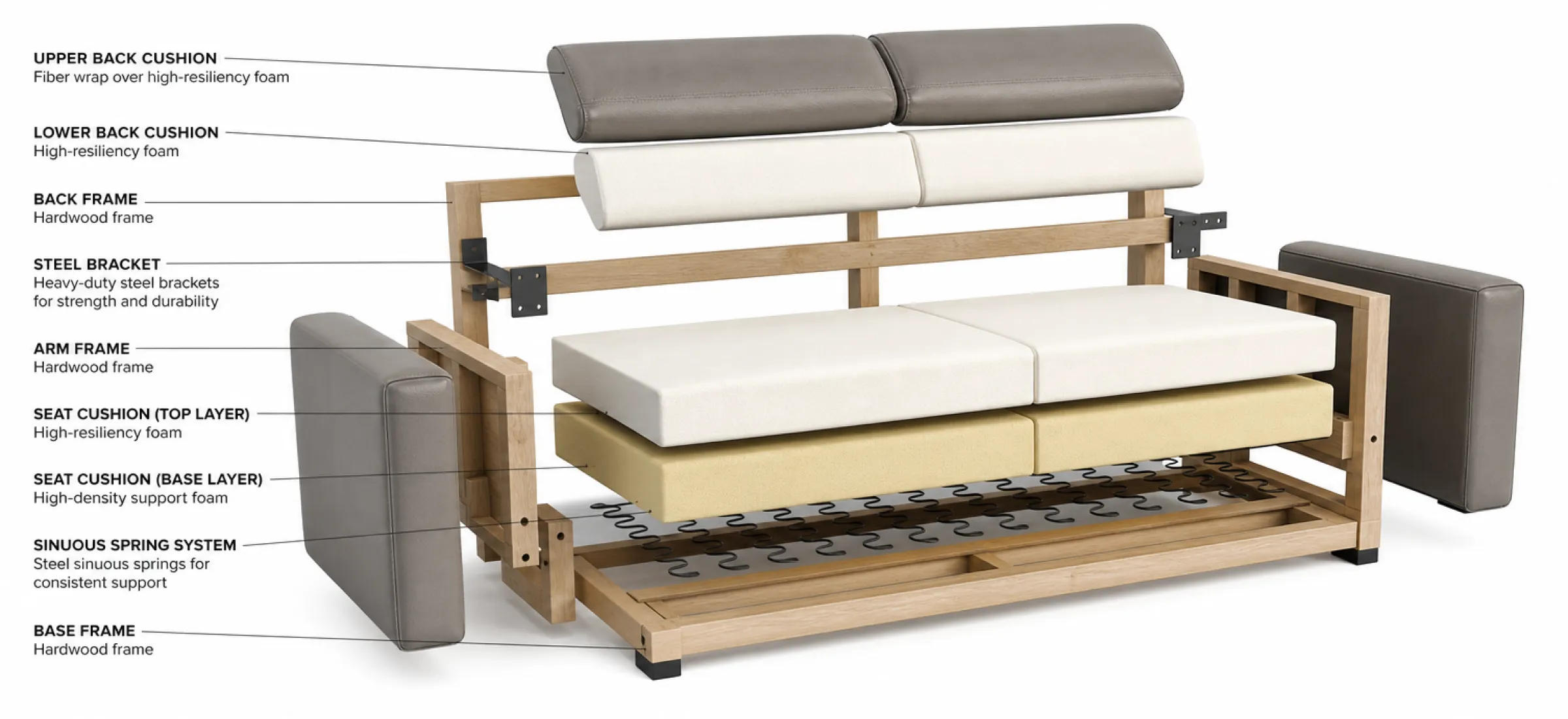
The frame accounts for roughly 70–80% of a sofa's durability. In bulk orders, vendors must provide proof of kiln-dried hardwood or reinforced plywood construction. Engineered wood or MDF frames lack the sheer strength required for high-frequency, daily use and will suffer from structural fatigue at joints within 18 months. Procurement teams should insist on reinforced corner joinery—specifically steel-plated corner blocks—which prevent the lateral racking and sagging often seen in entry-level contract furniture. If your organization is outfitting a high-traffic lobby, the frame must be over-engineered to withstand static loads exceeding 500 lbs without deflection.
Material Science: Rub Tests and Foam Density
Fabric durability is objectively measured by the Wyzenbeek or Martindale double-rub tests. Residential sofas often utilize fabrics rated at 10,000 to 25,000 double rubs; this is insufficient for commercial corridors. For bulk deployments, any specified textile must meet a minimum of 50,000 double rubs. Furthermore, foam specification is critical. Avoid "entry-level" foam, which loses its rebound properties rapidly. Specify High-Resiliency (HR) polyurethane foam with a density rating of at least 2.5 lbs/ft³ (approx. 40 kg/m³). This density ensures that the seating remains supportive, preventing the "puddling" and material fatigue that renders bulk seating sets unsightly within two years of service.
Strategic Configuration: Modular vs. Fixed
Scalability and adaptability are the hallmarks of modern corporate design. When purchasing in bulk, the configuration must allow for future layout pivots.
The Case for Modular Geometry
Fixed sofas are essentially immovable objects. In a dynamic corporate environment, the ability to reconfigure space is a hidden asset. Modular reception sofa systems allow facility managers to break down seating into distinct clusters for temporary privacy or aggregate them into large, U-shaped configurations for town-hall-style collaboration. From a logistical perspective, modularity simplifies the installation process; smaller modules are significantly easier to navigate through elevators, narrow stairwells, and service corridors than monolithic, oversized furniture pieces.
Volume and Spatial Math
When placing a bulk order for 20+ units, procurement must consider the "psychology of the seat." In a waiting or lounge zone, strangers rarely sit directly next to one another. A large, continuous four-seater sofa is often functionally limited to two users. For maximum utilization of square footage, purchasing smaller small office sofa units—or pairing sofas with single guest chairs—is often more space-efficient and cost-effective than deploying massive, single-piece sofa systems. Consult our office sofa buying guide for commercial spaces to calculate the precise spatial requirements for your specific zones.
Procurement Logistics and Lifecycle Management
Bulk sourcing requires more than just a purchase order; it requires an integrated supply chain strategy that addresses everything from color consistency to after-sale support.
Color and Finish Consistency
One of the significant risks in bulk furniture procurement is batch-to-batch variation in dyes. When sourcing 50 identical leather units, ensure the supplier provides a master sample from the specific dye lot used for the entire production run. If the sofas feature office leather sofa upholstery, confirm the hide origin and grain treatment to guarantee that the tactile feel remains uniform across the entire deployment. Inconsistent finishes across a shared space destroy the visual authority of the corporate interior.
Negotiating the Service Level Agreement (SLA)
For bulk orders, the manufacturer’s warranty is a non-negotiable contract. Do not accept summary warranty terms; demand the full documentation. Ensure the contract explicitly covers high-frequency use (24/7 or 16/7 occupancy, if applicable). A professional supplier should be able to guarantee the availability of replacement parts—such as legs, glides, or replacement seat covers—for a minimum of 5–10 years. For organizations seeking deep integration, reach out directly to our wholesale division to discuss custom logistics, bulk volume discounts, and staged delivery schedules to align with project construction milestones.
Manufacturing Quality Assurance
Before the bulk order is released, quality assurance is paramount. Our firm adheres to the strict protocols outlined in our about quality policy, emphasizing rigorous stress testing and component-level audits. Procurement teams should always request physical samples of the frame joinery, foam firmness, and upholstery swatches. If a manufacturer is hesitant to provide a sample, they are likely hiding manufacturing inefficiencies that will manifest as failures in your facility six months post-installation.
For additional strategic insights into how to plan for 2026 and beyond, review our reception sofa buyers guide 2026, which covers the latest in performance textiles and sustainable corporate interiors.
Frequently Asked Questions
Why is residential furniture unsuitable for bulk office procurement?
Residential furniture is designed for occasional use (a few hours a day). Commercial office sofas must withstand continuous use, comply with strict commercial fire safety standards (like Cal TB 117-2013), and use high-density foam and high-rub-count fabrics that resist the rapid abrasion and structural fatigue typical of high-traffic professional settings.
What foam density should I specify for a high-traffic office sofa?
For high-traffic areas such as lobbies and waiting rooms, specify High-Resiliency (HR) polyurethane foam with a density rating of at least 40–50 kg/m³ (approx. 2.5 lbs/ft³). This ensures the seat maintains its structural shape and support over years of daily, heavy utilization.
How does modular sofa design save money in the long run?
Modular design allows for the targeted replacement of damaged sections rather than the entire sofa. If one module’s fabric is damaged or the frame fails, you replace only that piece. Furthermore, modularity allows for spatial reconfiguration as corporate needs change, preventing the need to scrap and repurchase furniture when floor plans shift.
What is a standard "Wyzenbeek double rub" rating for a commercial sofa?
For a standard commercial office sofa, the minimum industry threshold is 30,000 double rubs. However, for high-traffic public areas or bustling lobbies, you should specify fabrics that exceed 50,000 double rubs to ensure longevity and resist early signs of wear.
Should I prioritize frame material or upholstery during bulk purchasing?
Frame material is the primary determinant of sofa lifespan—accounting for 70–80% of durability. While aesthetics (upholstery) are important for brand image, a visually stunning sofa with a weak frame will fail structurally in a commercial setting within 2–3 years, resulting in a poor return on investment.
How can I ensure color consistency across a bulk order?
When ordering 20+ units, require the manufacturer to use a single dye lot for the entire production run. Demand a master sample to verify the color match before the full order goes into mass production. This mitigates the risk of "batch variation," where slight differences in hue become immediately obvious once the sofas are arranged side-by-side in your office.
