
The corporate conference room serves as the epicenter of strategic decision-making, high-stakes client negotiations, and board-level collaboration. Within this environment, furniture transcends basic utility; it functions as critical operational infrastructure. For facility managers and corporate procurement officers, specifying conference room furniture requires a rigorous, mathematical approach to spatial geometry, material science, and technological convergence. A poorly specified boardroom table disrupts architectural flow, creates severe cable management hazards, and undermines the visual authority of the organization.
Procuring a massive, single-piece conference table or a fleet of executive chairs is a complex capital expenditure. This technical guide outlines the precise dimensional tolerances, material durability standards, and seating ergonomics required to successfully source and deploy commercial conference room furniture.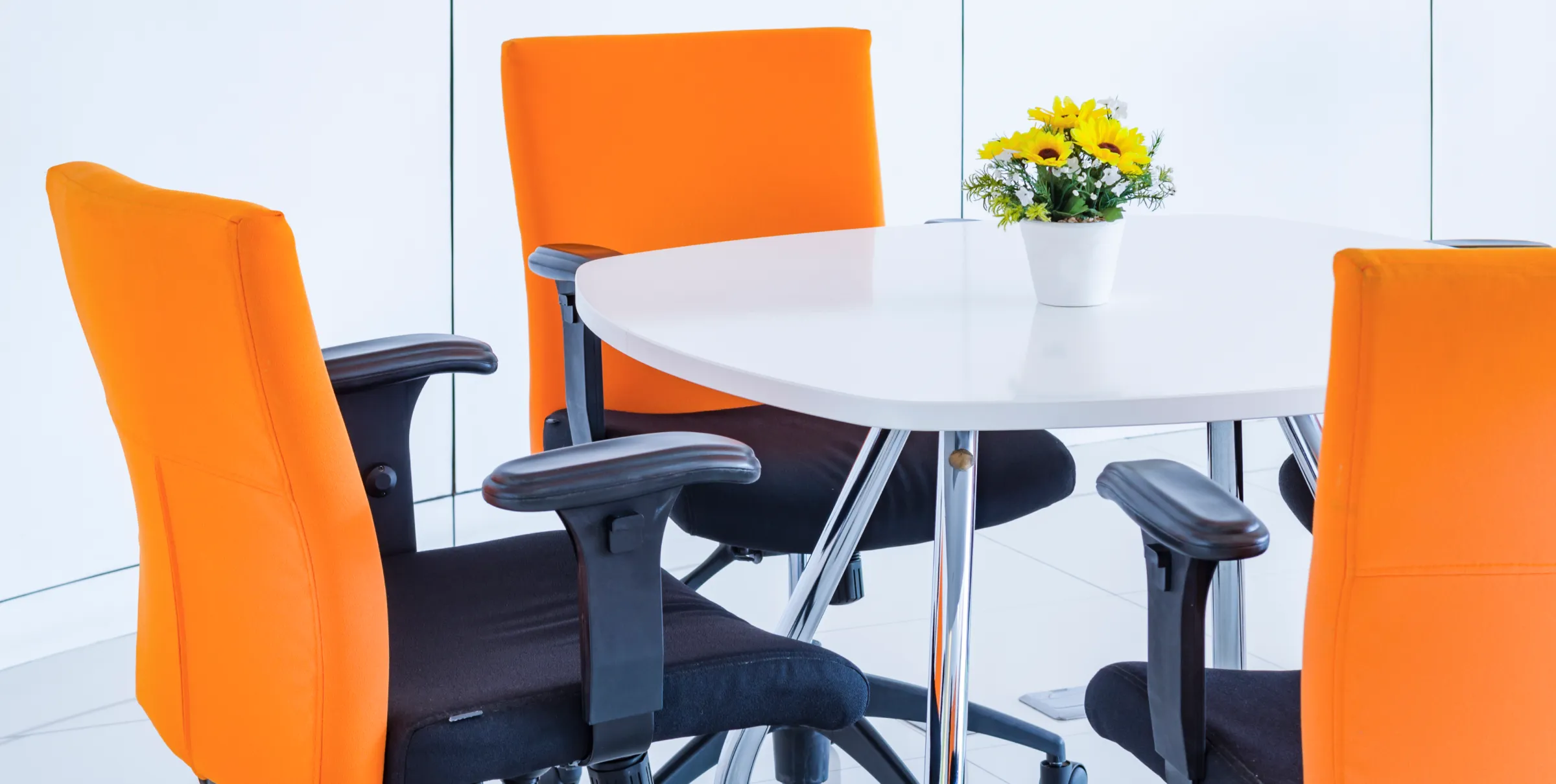
Spatial Geometry: Boardroom Table Dimensions and Room Clearances
The most common failure in conference room procurement is a misalignment between the dimensions of the table and the square footage of the room. A functional layout hinges on maintaining unobstructed primary corridors and sufficient push-out space for seating. Procurement teams must calculate the room's maximum occupancy load before specifying the table size.
Egress, Reach Distance, and Knee Clearance
When placing a large table within a closed room, facility planners must adhere to strict spatial tolerances. The absolute minimum clearance from the edge of the table to the nearest wall or physical obstruction is 48 inches. This allows a standard 36-inch chair push-out distance, plus 12 inches for a secondary user to navigate safely behind the seated participant.
Furthermore, buyers must consider the "reach distance." When specifying a huge office desk or oversized boardroom table wider than 1400mm (55 inches), planners must evaluate how far participants must stretch to pass documents, hand over coffee cups, or reach centralized power modules. Along with chair spacing, British Standard BS9241 dictates that a minimum of 500mm of knee and foot space must be maintained from the table edge inward.
Seating Capacity and Table Sizing Benchmarks
The size of a boardroom table directly depends on the width of the specified chairs and the desired generosity of spacing between executives. Standard boardroom sizing calculations are based on a commercial chair width of approximately 540mm. Based on industry standards, facility managers should utilize the following dimensional starting points when requesting quotes:
- 6 to 8 Seat Table: 200cm x 100cm (approx. 79 x 39 inches).
- 8 Seat Table: 240cm x 120cm (approx. 94 x 47 inches).
- 10 to 12 Seat Table: 300cm x 140cm (approx. 118 x 55 inches).
- 14 to 16 Seat Table: 440cm x 140cm/150cm (approx. 173 x 59 inches).
- 18 to 20 Seat Table: 600cm x 160cm (approx. 236 x 63 inches).
Logistical constraints must also be factored into the purchase. Typically, tables measuring 2.4m, 2.8m, and up to 3.0m in length are manufactured as a single, continuous piece. Any table exceeding 3.0m is engineered in two or more sections to ensure structural stability and facilitate delivery. Facility managers must verify freight elevator dimensions and corridor turning radii before approving a one-piece 3.0m table, as they are notoriously difficult to deliver into high-rise offices.
Material Science and Structural Presence
Corporate hierarchy is communicated visually through the specification of materials. The materials selected for the conference room must align with the company's size, corporate image, and internal culture.
Solid Wood vs. Commercial Panel Construction
For government agencies, Tier-1 law firms, and legacy financial institutions, high-end solid wood conference tables or painted veneer tables remain the standard. The dense, heavy texture of a true wooden office desk or table signals solemnity, permanence, and institutional stability. However, buyers must be aware that authentic solid wood requires a longer production cycle and demands strict environmental HVAC controls to prevent the timber from checking or cracking over time.
For high-growth technology firms, marketing agencies, or mid-range studio environments, panel-type conference tables (utilizing High-Pressure Laminate or Melamine) offer a highly durable, cost-effective alternative. These engineered materials provide immense scratch resistance and can simulate complex wood grains or ultra-modern concrete finishes. If the space is used primarily for rapid, informal collaboration, a heavy solid wood table may feel oppressively formal; a modern steel-framed panel table is much more appropriate. For localized meeting zones within a private executive suite, utilizing a director table with a built-in peninsula offers a flexible micro-conference solution.
Power, Data, and Technological Convergence
A modern conference table is no longer just a flat wooden surface; it is an active technological hub. Procurement teams must treat these tables as integrated IT assets.
Embedded Infrastructure
Corporate users require simultaneous connectivity. During a high-stakes presentation, users rarely need only standard AC power. They demand simultaneous USB-C fast-charging, direct HDMI mirroring to the room's primary display, and Ethernet handoffs for secure data transfer.
When sourcing tables, buyers must specify flush-mounted or motorized pop-up sockets that keep all cables hidden until required. Planners must calculate exactly how many AC and USB-C connections will be utilized simultaneously during peak meetings. Furthermore, structural integration is paramount: the buyer must confirm the table's core thickness and underside clearance to ensure the selected power modules physically fit within the substrate without striking the users' knees.
Specifying Conference Seating: Aesthetics and Ergonomics
The seating deployed around a boardroom table determines the physical endurance and focus of the participants during extensive meetings.
The Executive Boardroom Standard
In a primary executive boardroom, the seating must match the authoritative scale of the table. A high-backed, genuine leather executive chair provides excellent visual weight and postural support for long-duration strategic sessions. Leather offers exceptional abrasion resistance and resists absorbing odors or spills in environments where working lunches are common.
Agile Meetings and Visitor Seating
Not every meeting room requires heavy, rolling executive chairs. For smaller breakout rooms, client negotiation spaces, or training environments, deploying a leather office chair no wheels (such as a cantilever sled-base chair) prevents the room from feeling cluttered. Sled-base chairs keep the seating layout strictly organized, as participants cannot roll them haphazardly across the floor.
Alternatively, for training rooms or highly active collaborative spaces where thermal regulation is necessary, outfitting the table with a mesh office chair with mesh seat ensures maximum breathability. The high-tension elastomeric mesh prevents heat buildup during intensive, multi-hour training seminars.
Strategic Wholesale Sourcing
Outfitting a corporate headquarters with multiple conference rooms requires strategic volume purchasing. Engaging directly with a manufacturer for wholesale procurement allows facility managers to dictate specific material finishes, ensuring that the laminate on the boardroom table perfectly matches the veneer on the surrounding executive desks and credenzas. By standardizing the procurement process, organizations significantly lower their Total Cost of Ownership (TCO), guarantee batch-to-batch color consistency, and secure dedicated after-sales support for technological components like embedded power modules.
Frequently Asked Questions
How much clearance is needed around a conference room table?
A minimum of 48 inches of clearance must be maintained between the table edge and the walls or surrounding furniture. This dimension accommodates a 36-inch chair push-out space and leaves a 12-inch walkway for other participants to navigate behind the seated individuals without disruption.
What are the standard dimensions for an 8-person boardroom table?
Based on commercial standards utilizing a 540mm wide chair, an 8-person boardroom table should measure approximately 240cm in length by 120cm in width (roughly 94 x 47 inches). This provides adequate elbow room and prevents users from encroaching on each other's personal space.
Should I choose a solid wood or a panel-type conference table?
Solid wood tables are ideal for high-end, formal environments (like law firms or government agencies) where a sense of permanence is required. Panel-type tables (laminate or melamine) are highly durable, scratch-resistant, and cost-effective, making them perfect for high-traffic, modern corporate environments or rapid-collaboration zones.
Why is "reach distance" important when specifying a large table?
For tables wider than 1400mm (55 inches), reach distance becomes a critical ergonomic factor. If a table is too wide, participants will struggle to pass physical documents, hand over beverages, or reach centralized power and HDMI modules without standing up and leaning aggressively across the surface.
How should power and data be managed on a commercial conference table?
Power and data must be treated as integrated infrastructure. Tables should be specified with flush-mounted or motorized pop-up modules that provide simultaneous AC power, USB-C fast charging, and HDMI/Ethernet connections, keeping all trailing cables hidden within the table's structural legs or central pedestal.
What type of chair is best for a formal executive boardroom?
A high-backed genuine leather executive chair is the industry standard for formal boardrooms. It matches the massive visual weight of a large conference table, provides excellent postural support for long meetings, and offers high abrasion resistance against the friction of daily use.
