
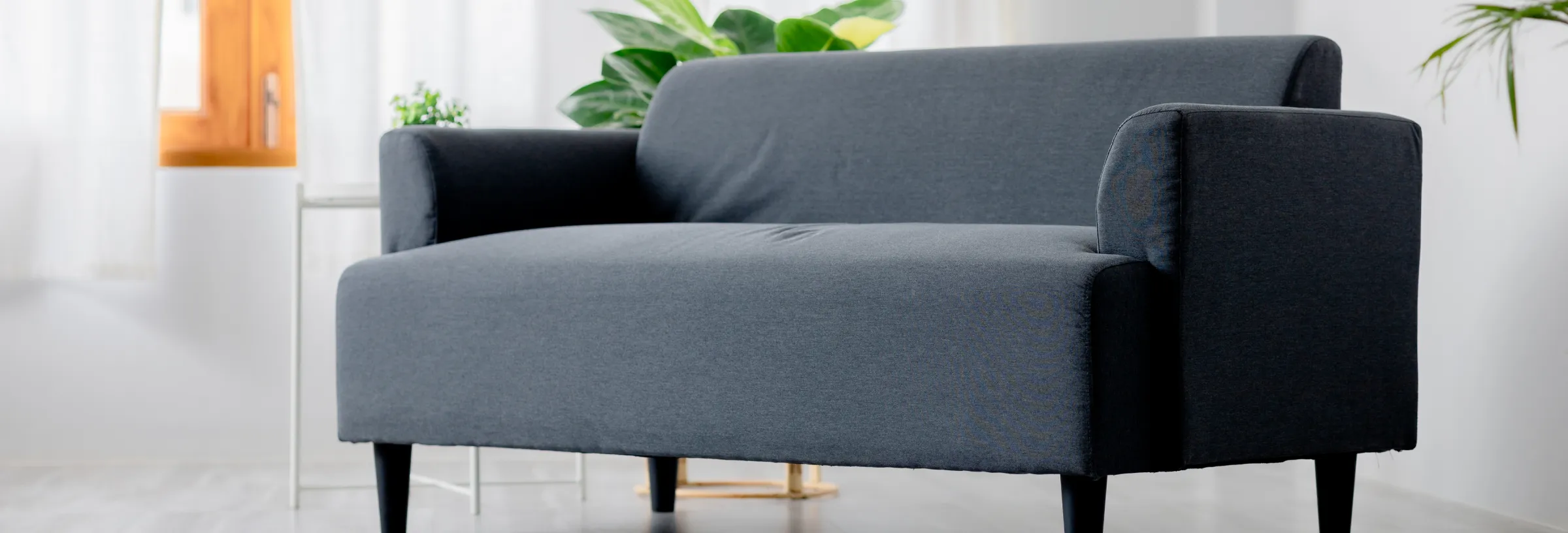
Every time we walk a distributor through a factory tour in Foshan, the same conversation happens at the sofa line. They ask why one 3-seater costs $220 and a nearly identical one costs $680. The answer sits in five specifications that never make it onto a product photo — foam density, frame material, upholstery abrasion rating, fire compliance, and stitching method.
This guide covers those five and everything else you need before signing a PO. Written for distributors, project buyers, and interior contractors who are done losing money on reception sofas that go flat by month eight.
What Counts as a Commercial-Grade Reception Sofa
A reception sofa is upholstered seating built for commercial lobbies, hotel receptions, medical waiting rooms, and corporate lounges. Residential sofas see maybe 1,000 uses in their lifetime. A lobby sofa can see that in a single month. The engineering is a different category.
For a sofa to qualify as commercial-grade for reception use, it should meet four baselines:
Foam density ≥ 1.8 lb/ft³ (about 29 kg/m³) for seat cushions
Kiln-dried hardwood or reinforced steel frame — not particleboard
Upholstery abrasion resistance ≥ 30,000 Martindale cycles
Fire compliance to California TB 117-2013 for US, BS 5852 for UK/EU export
Anything below these numbers is residential furniture being sold into a commercial channel. Aston's reception sofa collection is built to exceed these baselines by default — we use ≥45 kg/m³ HR foam (about 2.8 lb/ft³) as the standard fill for seat cushions, paired with hardwood frames and BIFMA-tested joinery.
Materials: What We're Actually Producing for 2026 Orders
The order book has shifted noticeably in the past 18 months. Here's what buyers are specifying:
Full-grain and top-grain leather
Still the default for executive lobbies, law firms, and 4-star-and-above hospitality. Ivory and black lead the color rankings — the 3-piece ivory leather set is the single highest-search configuration for reception furniture this year, which matches what we see in project orders from the Middle East and Southeast Asia. Aston uses first-layer leather on premium builds; the wear behavior is fundamentally different from bonded or split leather.
PU and bonded leather
Mid-market corporate. Delivers 80% of the leather look at 30–40% of the cost. The catch: cheap PU peels within 18 months under commercial abrasion. Specify PU rated for at least 30,000 Martindale cycles and ask for a wear test report. Our commercial office sofa range uses stain-resistant treated PU on entry-tier configurations for buyers who need visual consistency without the leather budget.
Performance fabric (Crypton, Como, similar grades)
Growing fastest in the past year. Residential feel, commercial durability. Liquid beads off, stains lift with a damp cloth. Good fit for creative-industry offices, healthcare, and boutique hotels going for a "warm" aesthetic. Watch abrasion ratings — the label "performance fabric" is not regulated.
Commercial vinyl
Best for healthcare, education, high-abuse environments. Modern vinyls replicate leather grain closely enough that most guests do not notice, and they survive quaternary cleaning agents that would destroy leather.
Boucle and textured fabric
Trending in hospitality and design-forward corporate. Pretty on Pinterest, brutal in a lobby if you specify the wrong grade. Only order boucle rated at 40,000+ Martindale. Below that, it pills within 6 months.
Foam, Frame, and Fire — The Technical Specs
This is the section that separates buyers who get called back to their client in year two from those who don't.
Foam density is the single most-cheated spec
Density measures foam mass per volume. It is the primary predictor of long-term shape retention. Foam firmness (ILD/IFD) is separate — density is what tells you whether the sofa will still look new in year three.
| Use case | Minimum density | Recommended | Foam type |
|---|---|---|---|
| Residential | 1.2 lb/ft³ (19 kg/m³) | 1.5 lb/ft³ | Standard PU |
| Light commercial (small waiting room) | 1.8 lb/ft³ (29 kg/m³) | 2.2 lb/ft³ | HR foam |
| Corporate reception (moderate traffic) | 2.2 lb/ft³ (35 kg/m³) | 2.5 lb/ft³ | HR foam |
| Hotel lobby / high-traffic public | 2.5 lb/ft³ (40 kg/m³) | 3.1 lb/ft³ | HR or CMHR foam |
| Back cushions (all uses) | — | 1.8–2.0 lb/ft³ | Softer HR |
Suppliers quoting foam density in "kg" without specifying "per cubic meter" are hiding something. Ask for a certificate showing the test method — ISO 845 or ASTM D3574 are the standards.
Frames: three tiers
Kiln-dried hardwood (beech, ash) — Best. Resists warping in humid climates. Aston uses this on all reception sofa builds.
Softwood or engineered wood with reinforcement — Acceptable for mid-tier if joints are dowelled and glued, not just stapled.
Metal frame — Excellent for modular seating. Powder-coated steel with welded joints is the durable version.
Particleboard — Not acceptable for commercial reception use, regardless of what the catalog claims.
Fire compliance
US market: California TB 117-2013 is federal law under 16 CFR part 1640 for all upholstered furniture sold in the 50 states. No exceptions.
UK / EU market: BS 5852 (Crib 5 for high-hazard) and BS 7176 (Medium Hazard for public buildings).
BIFMA X5.4 covers seating structural durability for public seating specifically. Ask for the actual test report, not a compliance claim.
Sizing: Space Per Person and Sofa Dimensions
The most-referenced planning number in the industry, per Gensler and BIFMA space guidelines:
20 sq ft per person — small chairs / bench seating
30–35 sq ft per person — lounge sofa / armchair seating
80 sq ft — minimum total footprint for any dedicated reception area
Standard commercial reception sofa dimensions:
| Configuration | Typical width | Depth | Seat height | Common use |
|---|---|---|---|---|
| Loveseat (2-seater) | 55"–65" | 32"–36" | 17"–18" | Small offices, medical waiting |
| 3-seater standard | 75"–85" | 32"–36" | 17"–18" | Corporate reception, hotel |
| Sectional (modular) | Sold per seat unit | 32"–38" | 17"–18" | Coworking, large lobbies |
| Bariatric (heavy-duty) | 30" / 36" / 42" per seat | 34"–38" | 18"–19" | Healthcare, inclusive design |
Seat height matters more than most buyers realize. 17"–18" is the ADA-friendly range that works for the widest range of body types. Anything above 19" becomes hard for shorter guests to sit down and get up from.
Weight capacity should be 250 lb minimum per seat, 500 lb for bariatric configurations, 700 lb for oversized commercial builds.
Layout Templates by Reception Size
Compact reception (under 120 sq ft) — 1 loveseat (2-seater) + 1 lounge chair + coffee table. Position the loveseat against the longest wall, lounge chair at 45° to open the sight line to the reception desk.
Standard corporate reception (120–300 sq ft) — 1 three-seater + 2 lounge chairs facing each other with coffee table between. Or 2 loveseats facing each other with coffee table between. Either layout supports 4–6 waiting guests comfortably.
Large lobby (300+ sq ft) — Modular sectional or 2 sofas + 4 chairs. Split into two conversation clusters at least 6 feet apart for acoustic privacy. Anchor each cluster with a coffee table and floor lamp.
Hotel lobby (400+ sq ft) — Multiple conversation clusters of 4–6 seats. Use high-back sofas or semi-enclosed configurations if you want acoustic privacy without walls.
Color and Style Direction
The cool gray / stark white era is ending. Warmth is back. What we're upholstering the most this year:
Warm neutrals — Caramel, clay, antique cream, soft browns
Deep greens and burgundy in executive segments
Ivory and black leather — Still the two safest choices for corporate lobbies; they photograph well in any interior scheme, which is why they consistently rank as the highest-search reception sofa colors
Leg finishes have shifted too. Natural wood (walnut, oak) and brushed brass have overtaken chrome and black metal. If you are stocking for distribution, ivory leather with walnut legs and black leather with brushed brass legs are the two SKUs that turn over fastest across corporate and hospitality channels.
Bulk Pricing for Distributors and Project Buyers
Indicative FOB Foshan port pricing for wholesale volumes. Freight, duty, and last-mile install are additional.
| Tier | Configuration | Bulk unit price |
|---|---|---|
| Value | 3-seater, PU leather, standard foam, softwood frame | $180–$350 |
| Mid | 3-seater, top-grain leather or performance fabric, HR foam ≥2.2 lb/ft³, hardwood frame | $350–$700 |
| Premium | 3-seater, full-grain leather, HR foam ≥2.5 lb/ft³, kiln-dried hardwood, BIFMA tested | $700–$1,500 |
| Luxury / OEM | Custom sectional, contract-grade leather, custom brass hardware | $1,500–$4,000+ |
Reception sofa sets (sofa + 2 lounge chairs + coffee table) usually price 30–40% below the sum of the individual pieces when ordered together — the upholstery batch is dyed and cut in one run, and the coordinated shipment consolidates freight.
Our standard MOQ is 2 sets for a first-time OEM order, which is unusual for the industry. Most factories start at 20 or 50. If you are testing a new product line in your market, this makes the risk manageable.
Sourcing Checklist Before You Send the Deposit
Get these from any supplier before wiring money:
Foam density certificate — Test method (ISO 845 or ASTM D3574) must be listed on the report
Upholstery abrasion report — Martindale or Wyzenbeek, with cycle count
Fire compliance certificate — TB 117-2013 for US-bound, BS 5852 for UK/EU
Frame photo before upholstery — kiln-dried hardwood shows visible grain and moisture-content stamp
Business license — verify the registered scope includes furniture manufacturing, not just trading
Live video factory tour — 5 minutes on WhatsApp video is enough to spot a trading company posing as a factory
Approved upholstery swatch — signed off before bulk production, not after
Warranty terms — 3 years on frame and mechanism is the commercial standard
If a supplier can't produce these within 3 business days, they don't have them. Move on.
Coordinated Reception Fit-Out: Why It Matters
The finish-mismatch problem is the most common complaint we hear from project buyers. The desk arrives from Factory A, the sofa from Factory B, the chairs from Factory C, and the walnut on each is a slightly different shade. On site, it looks off. There is no fix short of re-ordering.
Sourcing the desk, sofa, and lounge chairs from a single manufacturer solves this in one PO. Aston's reception sofa lineup is designed to coordinate finishes with our executive office desk line and leather office chair series, so a full lobby package ships from one factory with matched wood tones, matched leather batches, and one warranty.
For distributors building a private-label reception furniture range, the same logic applies. Our wholesale office chair program runs alongside the sofa program with unified branding, packaging, and shipping documentation.
The Bottom Line
Reception sofa procurement in 2026 is a technical decision, not a soft-furnishing one. Foam density, upholstery abrasion, and fire compliance are the three specs that separate a sofa that still looks new after four years from one showing seat set and worn armrests by month eighteen.
Buyers who ask for actual test reports, verify factories with video calls, and coordinate their reception package with one supplier get better outcomes and lower total cost of ownership. The math works out over a 5–7 year fit-out cycle.
FAQ
Q: How much space should I allocate per person in a reception area?
Plan 20 square feet per person for small-chair seating and 30–35 square feet for lounge or sofa seating. Total reception area should be at least 80 square feet regardless of visitor count, to leave room for a coffee table, side tables, and clear traffic paths.
Q: What foam density should a commercial reception sofa have?
Minimum 1.8 lb/ft³ (29 kg/m³) for light commercial use. For corporate reception and hotel lobbies, specify 2.5 lb/ft³ (40 kg/m³) or higher, and require high-resilience (HR) foam. Anything below 1.8 lb/ft³ is residential-grade and will develop permanent indentations within months under commercial use.
Q: How long should a commercial reception sofa last?
A properly specified commercial reception sofa lasts 5–10 years under daily use. Premium builds with full-grain leather and hardwood frames often reach 12–15 years. Cheap PU sofas with low-density foam typically show visible wear at 18 months and need replacement by year 3.
Q: What is the difference between a residential and commercial reception sofa?
Commercial reception sofas are built to survive 5–20 times the daily use of a residential sofa. They have denser foam (1.8+ lb/ft³ vs 1.2), sturdier frames (kiln-dried hardwood vs particleboard), higher-abrasion upholstery (30,000+ Martindale vs 15,000), and mandatory fire compliance (TB 117-2013). Warranty language must explicitly cover commercial use — residential warranties void the moment the sofa is placed in a public space.
Q: What size sofa is best for a small office reception?
A 2-seater loveseat (55"–65" wide) paired with one lounge chair works for reception areas under 120 square feet. It seats 2–3 people comfortably and leaves room for a coffee table and clear traffic path. Modular units also work well because they can be reconfigured as needs change.
Q: What weight capacity should a reception sofa support?
Standard commercial reception sofas should support at least 250 lb per seat. Heavy-duty configurations rate 500 lb per seat. Bariatric options rate 700 lb+ per seat. Weight capacity is set by frame strength and joinery, not by upholstery — always verify this against the actual test report, not the marketing sheet.
Q: Do I need to buy the sofa, desk, and chairs from the same manufacturer?
Not required, but strongly recommended for a coordinated finish. Wood tones, leather batches, and metal finishes vary between factories, and the differences show up on site. Ordering the full reception package from one manufacturer solves this in one PO and consolidates the warranty. This is why coordinated fit-outs are the fastest-growing segment of our OEM business.
