
When outfitting a commercial workspace, corporate facility managers naturally prioritize ergonomic support, lumbar mechanics, and visual aesthetics. However, one of the most critical components of an office chair is also the most frequently overlooked: the casters. Specifying the wrong type of wheel for your corporate flooring is not merely a design oversight; it is a rapid catalyst for severe infrastructure damage.
At Aston Office, our OEM engineering teams emphasize that seating procurement must align with the architectural substrate of the building. This technical guide examines the physics of point-load friction, decodes the application differences between hard Nylon and soft Polyurethane (PU) casters, and demonstrates why evaluating chair wheels is vital to protecting your commercial flooring and lowering your Total Cost of Ownership (TCO).
The Physics of Friction and Point Load Distribution
An office chair does not distribute weight evenly across the floor. The entire kinetic load of the chair, plus the human occupant, is concentrated into the tiny contact patches where the five casters meet the ground. When a user rolls, pivots, or pushes back from their desk, this concentrated mass creates immense shear force and friction.
If the material density of the caster is incompatible with the hardness of the flooring, abrasion is inevitable. When reviewing what to look for when buying an office chair, facility managers must audit their floor plan first. Are you deploying seating on high-pile carpet, polished concrete, or luxury vinyl tile (LVT)? The answer dictates the required caster polymer.
Hard Nylon Casters: The Mandate for Commercial Carpeting
Nylon is a rigid, high-density thermoplastic. The vast majority of standard office chairs ship with hard nylon twin-wheel casters by default. This is because standard nylon is highly cost-effective and structurally robust.
Nylon casters are strictly engineered for soft flooring surfaces, primarily commercial loop-pile carpets or carpet tiles. Because the wheel is harder than the carpet, it glides smoothly across the fibers without sinking or bogging down. However, deploying hard nylon casters on hard surfaces is catastrophic. On hardwood, laminate, or polished concrete, nylon acts like sandpaper. It traps microscopic dirt and grit against its rigid surface, dragging those abrasive particles across the floor and permanently stripping the protective polyurethane clear coat from the wood or vinyl.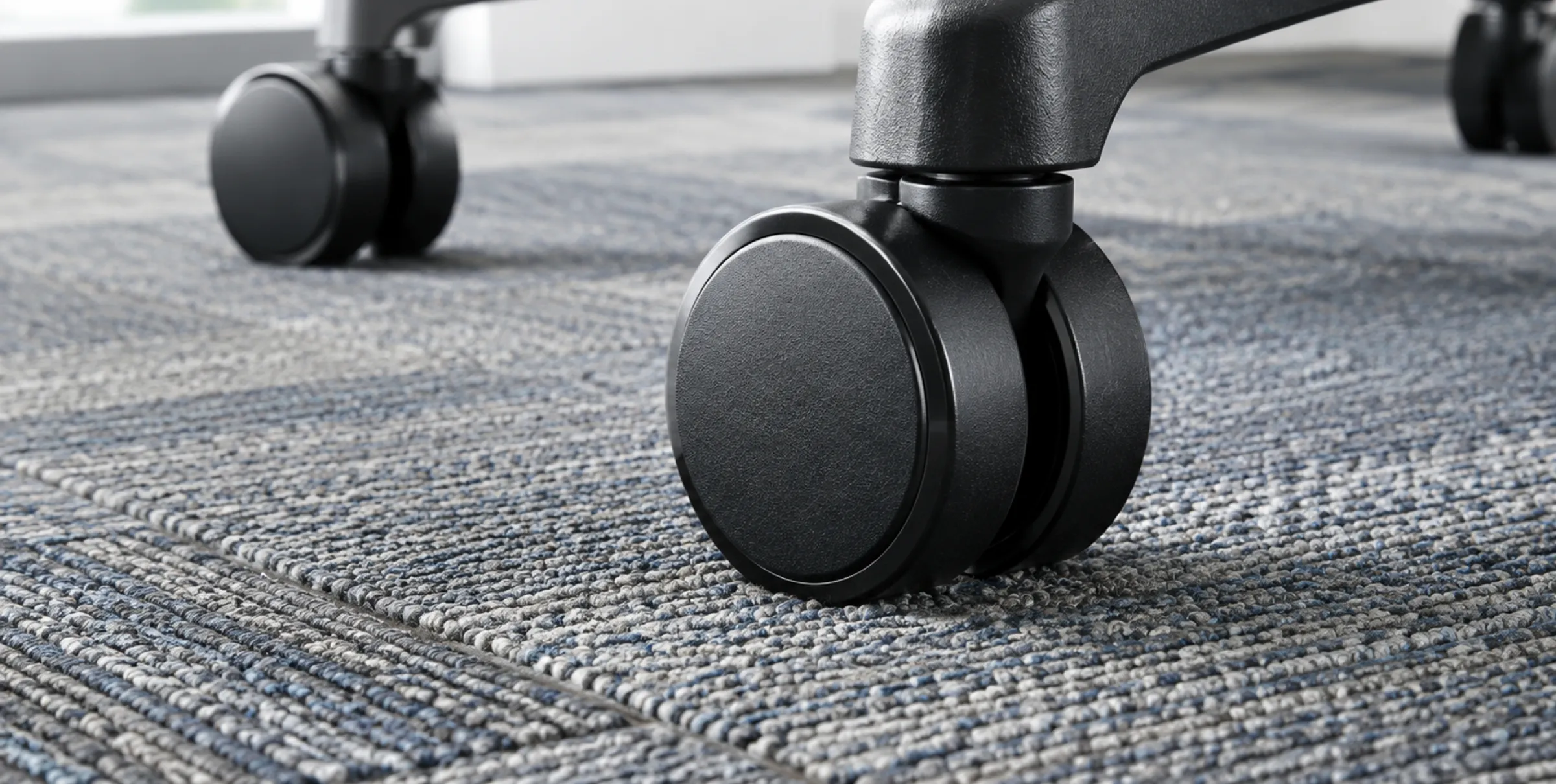
Soft PU (Polyurethane) Casters: Protecting Hard Surfaces
For modern commercial interiors featuring hardwood, luxury vinyl plank, or polished concrete, facility managers must specify Polyurethane (PU) casters. Often referred to as "soft casters," these wheels feature a rigid internal core surrounded by a softer, rubberized polyurethane tread.
The engineering advantage of PU is shock absorption and elasticity. When an office chair black mesh equipped with PU casters rolls over a tiny piece of grit on a hardwood floor, the soft polyurethane tread depresses, absorbing the particle into the wheel momentarily rather than grinding it against the floor. This eliminates the scratching, scoring, and acoustic "clacking" associated with hard wheels on hard floors.
Calculating Total Cost of Ownership (TCO) and Flooring Degradation
The financial argument for specifying the correct caster is irrefutable. Upgrading a fleet of task chairs or heavy duty office chairs to premium PU casters at the factory level may add a nominal fractional cost per unit. Conversely, the cost of resurfacing or completely replacing 5,000 square feet of commercial hardwood or LVT due to caster gouging can easily exceed tens of thousands of dollars.
When calculating how often should office chairs be replaced, proactive facility managers must also calculate how often their flooring will need replacement if subjected to the wrong kinetic friction. Specifying PU casters is an insurance policy for your architectural assets.
Alternative Topologies: When to Eliminate Mobility Entirely
Not every zone within a corporate suite requires dynamic mobility. In executive boardrooms, reception areas, and private client consultation rooms, the constant rolling of chairs can actually be a distraction and an unnecessary risk to high-end rugs or premium flooring.
In these specific acoustic and architectural zones, facility planners should consider eliminating casters entirely. Sourcing a leather office chair no wheels featuring a cantilever sled base or static architectural glides ensures absolute floor protection. These models utilize broad, flat nylon or felt glides that distribute weight across a much larger surface area, completely nullifying the point-load threat.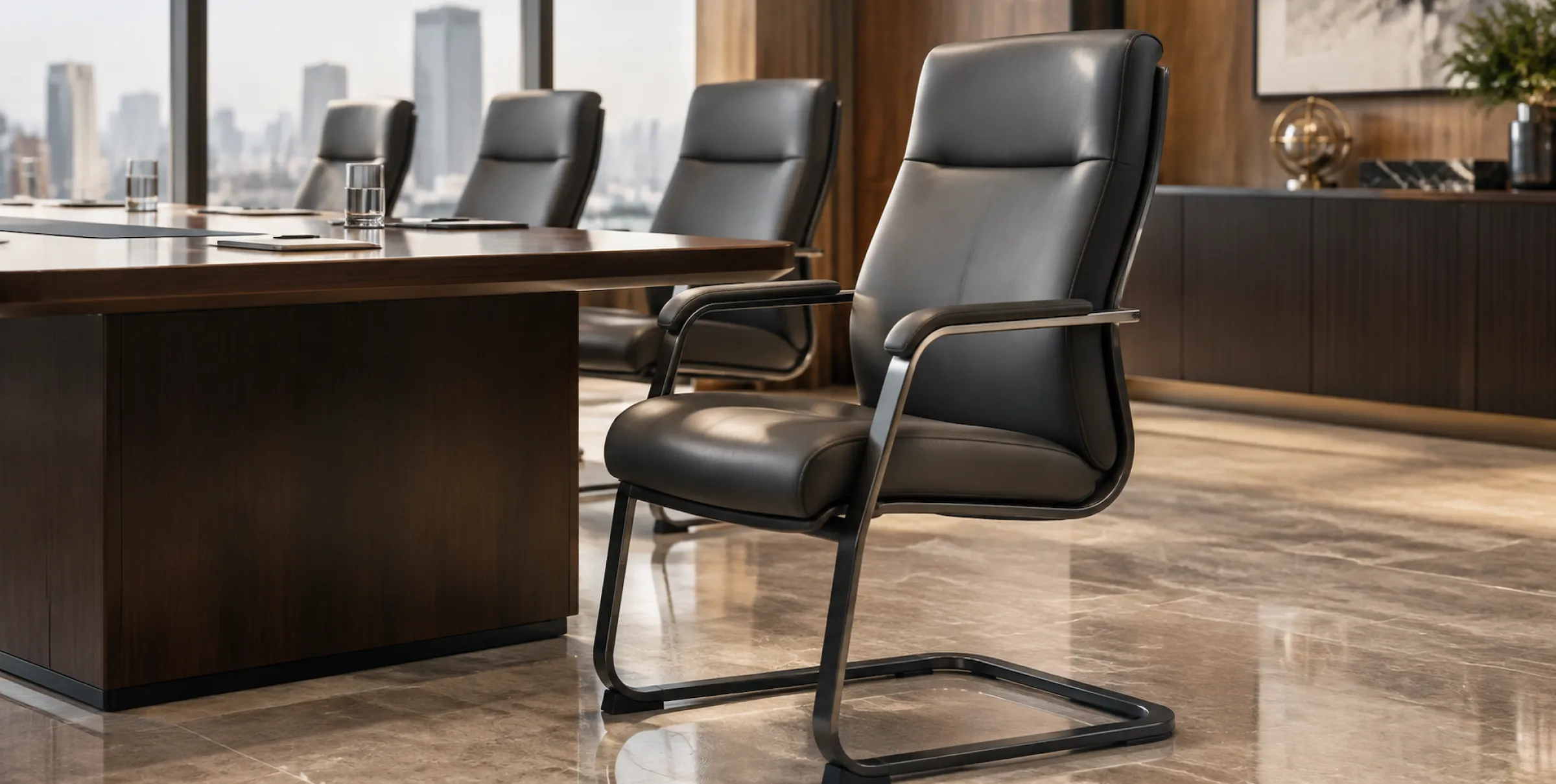
Strategic Bulk Procurement and OEM Customization
Purchasing prefabricated chairs from retail distributors often means settling for whatever standard nylon caster is currently in the box, leaving the facility manager to bear the risk of floor damage.
By partnering directly with an OEM manufacturer like Aston Office for your wholesale office furniture procurement, you gain control over component-level specifications. Before your bulk order hits the production line, our engineers review your facility's flooring schedule. Whether you require standard nylon for carpeted open-plan zones or soft PU casters for your luxury vinyl executive suites, we customize the chassis configuration at the factory, ensuring your furniture arrives ready to protect your investment.
Frequently Asked Questions
What is the difference between Nylon and PU casters?
Nylon casters are made from a hard, rigid plastic designed specifically to glide over soft surfaces like commercial carpeting. PU (Polyurethane) casters feature a soft, rubber-like outer tread designed to grip hard surfaces (wood, tile, concrete) without scratching or causing acoustic noise.
Can I use hard Nylon casters on hardwood floors?
It is highly discouraged. Hard nylon wheels will trap dust, sand, and grit, dragging it across the hardwood and acting like sandpaper. This will permanently gouge the wood and strip its protective finish in a matter of months.
Do PU casters wear out faster than Nylon?
While polyurethane is a softer material, commercial-grade PU casters are highly durable and resilient to abrasion. However, they may attract and hold more dust than slick nylon, meaning facility maintenance teams should occasionally wipe the casters to maintain smooth rolling.
Can I specify the caster type when ordering chairs in bulk?
Yes. When sourcing directly from an OEM manufacturer like Aston Office, procurement managers can explicitly specify whether they need hard casters for carpet or soft PU casters for hard floors before the manufacturing run begins.
