
The 2026 news cycle has been loud about return-to-office mandates. Amazon, JPMorgan Chase, AT&T, Novo Nordisk, Paramount Skydance — the list of five-day RTO announcements keeps growing. Read only the headlines and you'd assume hybrid work is finished.
The data says something different.
Fresh 2026 numbers from Gallup, Stanford, Pew Research, and Robert Half show hybrid work holding firm. In several sectors it's still edging up. For anyone furnishing or refitting an office right now, the gap between the RTO headlines and the actual workplace reality matters. It changes what to buy, how much of it, and where to put it.
Here's what the current hybrid work news is telling procurement teams — and what it means if you're speccing out an office this year.
Where Hybrid Work Actually Stands in 2026
The short answer: hybrid won.
Among U.S. remote-capable employees, 52% work hybrid, 27% are fully remote, and 21% are fully on-site (Gallup, 2026). That makes hybrid the single largest category. It hasn't moved much in almost three years.
A few other 2026 figures worth knowing:
| Metric | 2026 Figure | Source |
|---|---|---|
| U.S. hybrid workers (remote-capable) | 52% | Gallup |
| Hybrid workers' avg days in office/week | 2.3 – 2.5 | Gallup / Flex Index |
| Companies fully in-person | 27% | Resume Templates |
| Companies with hybrid policies | ~67% | Resume Templates |
| Q1 2026 job postings that are hybrid | 19% | Robert Half |
| Workers who prefer hybrid | 83% | Global workforce survey |
| Companies using structured hybrid schedules | ~75% | Flex Index |
The most common hybrid work schedule? Three days in-office, two days remote. Roughly 40–44% of hybrid companies use this pattern (Flex Index, Q1 2026).
Stanford's Survey of Business Uncertainty adds one more useful data point: even after every currently planned RTO mandate takes effect, the U.S. work-from-home share will drop by just 0.4 percentage points, from 21.2% to 20.8%. The RTO wave is real for a specific slice of large employers. It is not an industry-wide reset.
Which Industries Still Run Hybrid
Not every sector looks the same. Robert Half's Q1 2026 job posting data shows a clear split by field:
- Marketing & creative — 21% hybrid, 9% fully remote
- Legal — 23% hybrid, 5% fully remote
- Technology — 18% hybrid, 8% fully remote
- Finance & accounting — 19% hybrid, 5% fully remote
- HR — 21% hybrid, 3% fully remote
- Healthcare — 6% hybrid, 9% fully remote
- Admin & customer support — 8% hybrid, 5% fully remote
If you sell into or furnish offices in tech, legal, marketing, or finance, hybrid isn't a recovery-period arrangement. It's the operating model. Procurement decisions need to reflect that.
The Furniture Impact: Fewer Desks, More of Everything Else
Here's the part most trend reports skip. Hybrid work isn't just an HR policy. It reshapes the desk-to-person ratio, and that ratio drives every furniture purchase downstream.
A company running a 3-2 hybrid schedule with staggered in-office days usually sees peak desk occupancy around 60–70% of headcount. That has three consequences for procurement:
- Fewer dedicated workstations. More hot desks, touchdown spots, and shared benches.
- More collaboration seating. Sofas, lounge chairs, and huddle furniture fill the floor space freed up by removed desks.
- Higher use per chair. Shared seating gets hit harder than assigned seating. Durability specs need to go up, not down.
Multiple 2026 workplace reports call this the "experience hub" model. The office stops being a container for individual work and becomes a venue for the things people can't do at home: face-to-face meetings, mentoring, whiteboarding, quick decisions.
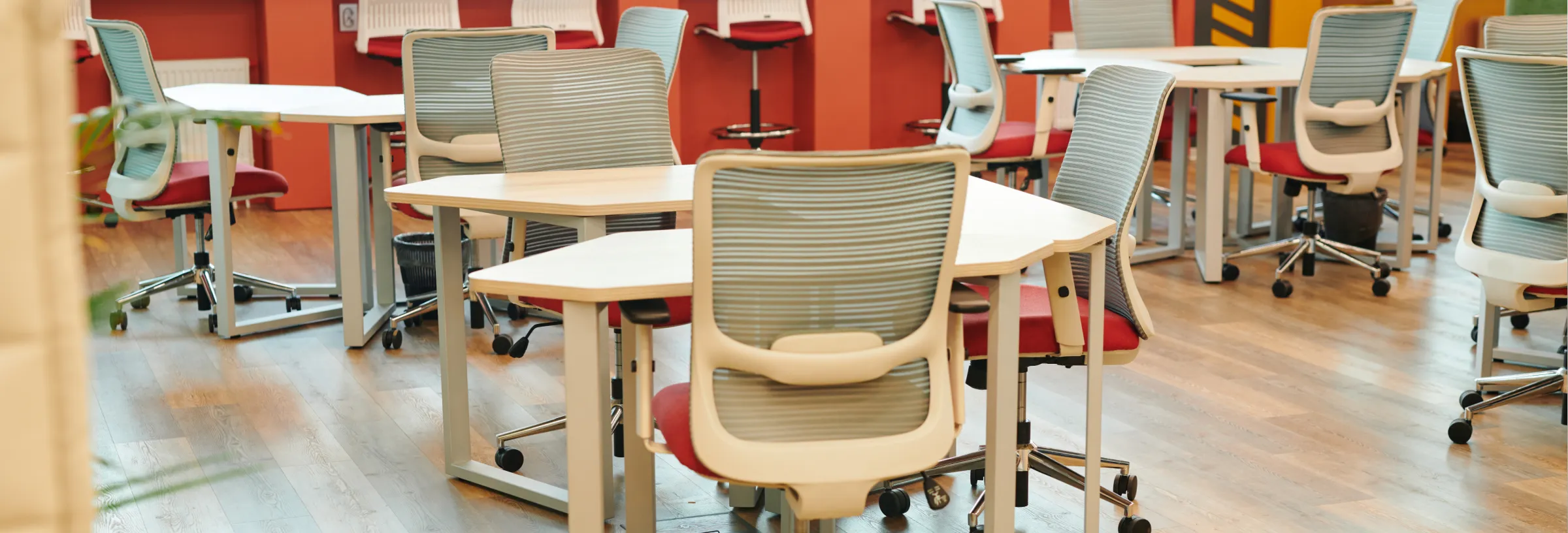
That shift is why buying patterns have changed. Modular desks that reconfigure. Stackable chairs that come out on team days and store when the floor is half-empty. Reception and lounge seating for zones that now function as informal meeting space. If you're planning a hybrid office layout, our complete office layout guide walks through the numbers.
What Hybrid Work Solutions Actually Need in 2026
Based on current procurement data, a hybrid-ready office needs five things:
- Task chairs that hold up to shared use. In a hot-desk environment, chairs get 1.5–2x more use than assigned seating. Budget task chairs fail fast under that load. Spec ergonomic mesh chairs rated for 8+ hours of continuous use, with BIFMA-compliant weight ratings and Class 4 gas lifts.
- Reception and lounge furniture that doubles as informal meeting space. When 40% of office visits are casual drop-ins from hybrid colleagues, the front area handles double duty. A well-chosen reception sofa becomes a huddle spot, not just a waiting bench.
- Stackable or mobile chairs for peak days. On anchor days or team days, headcount spikes. Static furniture can't handle the swing.
- Acoustic-friendly soft seating. Video calls happen in every corner of a hybrid office. High-back sofas and lounge chairs with upholstered surfaces cut echo without requiring construction.
- Contract-grade finishes. Higher rotation means more spills, more scuffs, more wear. Look for textiles rated 30,000+ Martindale cycles and PU or bonded leather finishes designed for commercial use.
For B2B buyers spec'ing a full hybrid fit-out, most of these categories are covered in our office furniture catalog. Mesh task chairs and reception sofas tend to be the two highest-volume line items in a hybrid conversion — they replace both removed desks (reception and lounge take the freed space) and cheap legacy chairs (which don't survive shared use).
Hybrid Work Schedule Trends: What Procurement Should Track
The three-days-in-office pattern isn't the only shift showing up in Q1 2026 data. A few smaller trends are worth watching:
- Structured hybrid is beating open hybrid. 75% of hybrid companies now mandate specific days rather than letting employees choose. That means predictable peaks, which changes how you size a space.
- Attendance tracking has jumped. 69% of employers now measure office attendance, up from 45% a year earlier. Companies now know exactly how full their offices get — which means procurement can size furniture orders against real occupancy data.
- Four-day schedules are creeping in. Canadian banks (RBC, Scotiabank, BMO), Starbucks corporate, and NBCUniversal moved to four in-office days in late 2025 or early 2026. Not a majority trend, but a signal.
- Fully remote postings are shrinking. Only 4% of Q1 2026 U.S. postings are fully remote, versus 19% hybrid. Hybrid is absorbing what used to be fully remote roles.
Hybrid Work Model Examples: Three Setups Buyers Are Requesting
Three hybrid office models are running most of the current B2B procurement requests:
1. The 3-2 Standard
Three days in, two days out. Peak occupancy around 65%. Common in finance, legal, mid-size tech. Requires: reduced desk count, roughly one shared chair per 1.3 employees, expanded meeting rooms.
2. The Anchor-Day Model
Two or three fixed "anchor days" where the full team comes in; rest of the week is flexible. Peak occupancy hits 90–100% on anchor days. Requires: chairs for full headcount (often with stackable overflow), heavy meeting-room investment, larger reception and waiting areas for cross-team traffic.
3. Remote-First With Optional Office
Small permanent office used mainly for client meetings and quarterly gatherings. Occupancy varies wildly week to week. Requires: heavy investment in reception and lounge furniture, minimal dedicated desks, higher-end executive furniture for client-facing rooms.
Each model has a different bill of materials. Getting the model right before ordering saves both money and rework. For B2B and bulk procurement across these setups, our wholesale program handles container-scale configurations directly.
What the RTO Push Actually Means (and Doesn't)
The RTO trend is real for a specific slice of the market: very large employers, finance, parts of federal government. For most mid-market firms in tech, marketing, legal, and professional services, the schedule that got locked in around 2023 is still the schedule. Hybrid held its ground.
Stanford's forward-looking data: only 12% of executives at hybrid or remote-capable companies plan a full RTO in the next year. The other 88% are staying put or loosening.
There's also a cost picture behind this. Employers save roughly $11,000 per year for every employee working half-time remotely. Companies enforcing strict RTO have seen turnover rise 14% and hiring cycles stretch 23% longer (Ding, Ma et al., SSRN, 2024). The financial math on hybrid still works, which is why most companies aren't reversing it.
For office furniture buyers in 2026, this means the biggest procurement risk isn't over-investing in hybrid-friendly furniture. It's assuming an RTO reversal that most companies won't execute — and then over-buying desks that sit empty three days a week.
