
An executive office desk is more than a work surface. It is the visual centerpiece of any private office, boardroom, or managerial workspace — a piece of furniture that communicates authority, professionalism, and organizational culture before a single word is spoken. It is also the functional hub where critical business decisions are made, documents are reviewed, and meetings are conducted every working day.
Yet despite its importance, most executive desk purchasing decisions are made on appearance alone — a quick scroll through product photos, a color preference, and a rough size estimate. This approach works for a decorative side table. It does not work for a desk that will be used 8 hours a day, 250 days a year, for the next decade. The wrong size creates ergonomic problems. The wrong material degrades within years. The wrong layout disrupts workflow and wastes expensive floor space.
This guide provides a systematic framework for choosing an executive office desk that fits the user, the space, and the professional environment. Whether you are a facility manager furnishing a new office, a project contractor specifying furniture for a commercial fit-out, or a distributor sourcing desks for resale, every recommendation here is grounded in dimensional standards, material science, and real-world commercial use requirements.
1. Standard Office Desk Dimensions: Height, Width, and Depth That Actually Support Productivity
Before considering style, material, or brand, the first question to answer is whether the desk's physical dimensions match the user and the workspace. Getting this wrong creates daily discomfort that no amount of aesthetic appeal can compensate for.
The standard desk height across the global furniture industry is 28 to 30 inches (71 to 76 cm) from the floor to the top of the work surface. This range is designed to accommodate most adults between 5'4" and 6'0" when seated in a standard office chair with the seat height set to approximately 17 to 19 inches. At the correct desk height, the user's forearms rest naturally on the surface with elbows bent at approximately 90 degrees, shoulders relaxed, and wrists in a neutral position. According to OSHA's ergonomic guidelines, a workstation that forces the user to raise their shoulders or bend their wrists creates a significant risk for repetitive strain injuries over time.
For users outside the standard height range, or for workspaces that prioritize wellness and flexibility, height-adjustable desks with electric lift systems offer the ability to switch between seated and standing positions throughout the day. Dual-motor electric lifting systems — the type used in commercial-grade sit-stand desks — provide smooth, quiet height adjustment from approximately 27 inches to 47 inches, accommodating both seated and standing work for users from 5'0" to 6'5". Aston's executive office desk collection includes electric height-adjustable models with dual-motor systems designed specifically for commercial environments where durability and daily reliability are essential.
Desk width (the left-to-right measurement) determines how much workspace and equipment the desk can accommodate. Standard executive desk widths range from 48 to 72 inches (120 to 180 cm). A 48-inch desk provides adequate space for a single monitor, keyboard, and minimal accessories — suitable for focused individual work. A 60-inch desk is the most common commercial specification, offering room for a dual-monitor setup, phone, document tray, and comfortable elbow space. A 72-inch desk is the standard executive specification, providing ample surface for meetings conducted across the desk, large monitor arrays, and the visual presence expected in senior leadership offices.
Desk depth (the front-to-back measurement) controls the distance between the user and the monitor, the amount of usable workspace in front of the user, and the legroom underneath. Standard executive desk depths range from 24 to 36 inches (60 to 90 cm). A depth of 24 inches is the minimum for comfortable computer use — it positions a standard monitor at approximately 20 inches from the user's eyes, which is the lower end of the recommended 20 to 30 inch viewing distance. A depth of 30 inches is the most common commercial specification, providing comfortable monitor distance and adequate workspace. Depths exceeding 30 inches are used for executive desks where the desk doubles as a meeting surface, requiring space on both sides for documents and devices.
2. Office Table Shapes and Configurations: Rectangular, L-Shaped, and U-Shaped Layouts
The shape of the desk determines how it fits within the office layout and how the user interacts with their workspace. Each shape offers distinct advantages depending on the room dimensions, the user's workflow, and the role's requirements.
Rectangular desks are the traditional executive standard. They project formality and authority, position the user facing visitors or the office entrance, and work well in offices where the desk is placed against a wall or floated in the center of the room. A rectangular executive desk with a front modesty panel (the panel that conceals the user's legs from visitors) is the standard specification for private offices, boardroom head positions, and reception areas. The clean, symmetrical lines of a rectangular desk also make it the easiest shape to integrate with credenzas, bookcases, and return units for additional storage.
L-shaped desks combine a primary work surface with a perpendicular return, creating a larger total workspace within a compact footprint. The primary surface typically faces the office door or window, while the return provides space for a secondary monitor, printer, reference materials, or a small meeting area. L-shaped configurations are ideal for managers and executives who need to switch frequently between computer work and document review or who hold informal one-on-one meetings at their desk. The return can be positioned on either the left or right side depending on the user's preference and the room layout. For commercial projects where floor space optimization is critical, modern executive desks with integrated L-shaped returns provide the functionality of two separate pieces in a single, cohesive unit.
U-shaped desks surround the user on three sides, providing the maximum possible work surface. These configurations are reserved for senior executives with large private offices (typically 150 square feet or more) who manage high volumes of physical and digital work simultaneously. The U-shape includes a primary desk, a bridge connecting to a credenza behind the user, creating a continuous work surface that allows the user to swivel between tasks without standing. While U-shaped configurations offer unmatched workspace, they require careful space planning to ensure adequate clearance for the user's chair (minimum 30 inches between the desk and any wall or furniture behind the chair).
Corner desks are a variation of the L-shape, specifically designed to fit into room corners. They maximize usable floor space in smaller offices by utilizing wall space that would otherwise go unused. Corner desks are a practical choice for co-working spaces, home offices, and satellite offices where square footage is limited but a full-size work surface is still needed.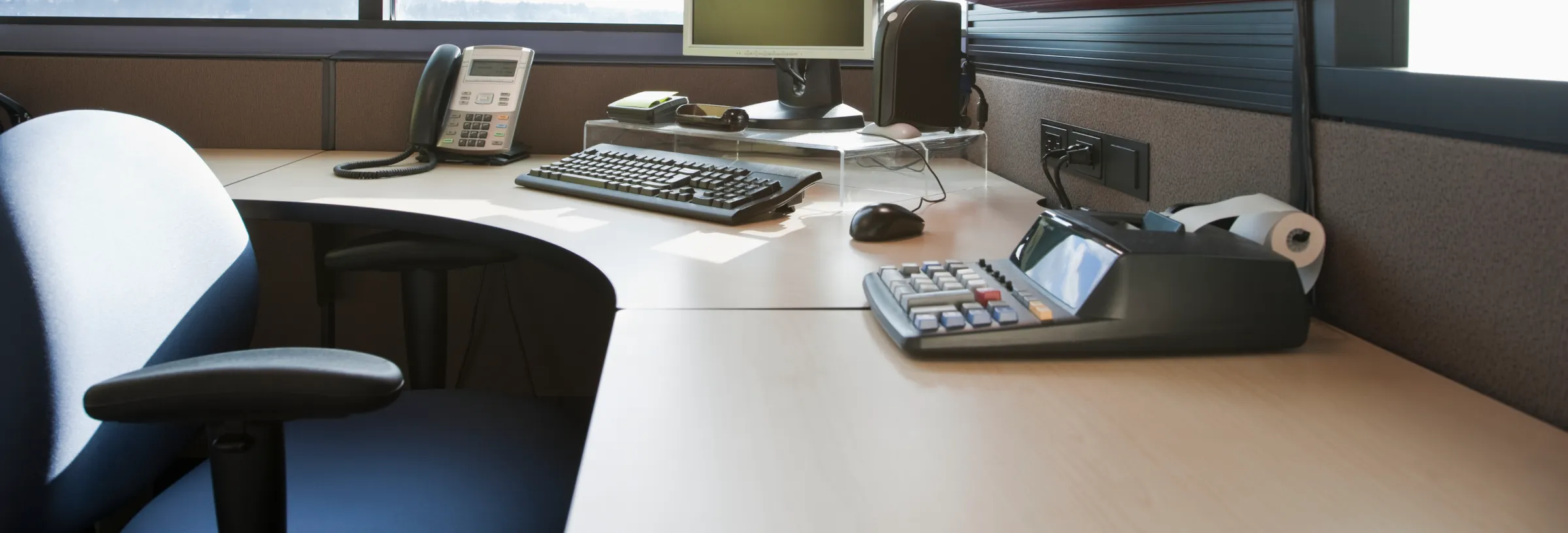
3. Desk Materials and Surface Finishes: What Determines Durability, Appearance, and Cost
The desk surface material is the single largest factor in both the desk's appearance and its long-term durability. In commercial environments where desks are used daily for 5 to 15 years, the material choice has a direct impact on maintenance costs, replacement frequency, and the professional image of the workspace.
Melamine-faced particleboard (MFC) is the most common material in commercial office desks. It consists of a particleboard or MDF (medium-density fiberboard) core with a melamine resin-impregnated decorative paper surface. MFC offers a wide range of color and woodgrain finishes at a competitive price point, and the melamine surface provides good resistance to scratches, stains, and moderate heat. For most commercial applications — general offices, training rooms, open-plan workstations — MFC desks deliver the best balance of appearance, durability, and cost. The standard thickness for commercial desk surfaces is 25mm, which provides adequate rigidity for spans up to 1600mm without noticeable flexing.
PVC edge banding and ABS edge banding are used to seal the exposed edges of MFC panels. PVC banding is the more common and cost-effective option. ABS banding is more environmentally friendly (it does not release chlorine compounds during production or disposal) and offers slightly higher impact resistance. Both materials prevent moisture from penetrating the particleboard core, which would cause swelling and delamination. The quality of the edge banding application — specifically, the bond strength and the precision of the trimming — is one of the most reliable indicators of overall desk construction quality. Poorly applied banding peels within months; properly bonded banding lasts the full service life of the desk.
Solid wood desks represent the premium end of the executive desk market. Materials like walnut, oak, cherry, and mahogany offer natural grain patterns, a warm tactile quality, and an aesthetic that communicates permanence and prestige. Solid wood develops a patina over time that many users consider an enhancement rather than a defect. However, solid wood is significantly more expensive than MFC, heavier (which affects shipping costs), and more sensitive to humidity and temperature fluctuations. In commercial environments with climate control (air conditioning and heating), solid wood performs well. In environments with wide humidity swings, MFC is the more practical choice.
Tempered glass surfaces are used primarily for modern-aesthetic reception desks and small executive desks. Glass creates a visually light, contemporary appearance and is easy to clean. However, glass surfaces show fingerprints and dust readily, require more frequent cleaning than MFC or wood, and can feel cold to the touch in air-conditioned environments. For custom reception desks, glass panels are often combined with MFC or wood bases to achieve a modern aesthetic while maintaining structural practicality.
4. Cable Management and Power Integration: The Feature Most Buyers Forget Until It Is Too Late
In a modern office, every desk serves as a node in the building's power and data infrastructure. A typical executive workstation connects to 4 to 8 cables: monitor power, monitor data (HDMI or DisplayPort), laptop charger, phone charger, desk lamp, and potentially a docking station, external keyboard, and secondary monitor. Without integrated cable management, these cables create visual clutter, accumulate dust, create tripping hazards, and make the desk difficult to clean around and underneath.
Effective cable management is not an afterthought — it is a design feature that should be specified during desk selection. There are several common approaches used in commercial executive desks.
Cable grommets are circular or rectangular cutouts in the desk surface, fitted with a plastic or metal cover, that allow cables to pass from the desktop through to the underside. Standard grommet positions are at the rear of the desk (for monitor and power cables) and at one or both sides (for phone and peripheral cables). The grommet diameter should be at least 60mm to accommodate multiple cable passes with connectors attached.
Cable trays are horizontal channels mounted under the desk surface that hold cables, power strips, and adapters off the floor. A well-designed cable tray runs the full width of the desk, is easily accessible for adding or removing cables, and has sufficient depth (at least 80mm) to accommodate power adapters and surge protectors. Cable trays keep cables organized, prevent them from dangling to the floor, and make it easy to vacuum or mop under the desk.
Integrated power modules are built-in power outlets and USB charging ports mounted directly into the desk surface. These modules provide convenient access to power without requiring users to reach under the desk or behind furniture to find an outlet. For executive desks used in meeting contexts — where visitors frequently need to charge devices — surface-mounted power modules with pop-up or flip-top designs are particularly practical.
When sourcing desks for a commercial project, always verify the cable management provisions before placing an order. A desk that looks perfect in a product photo but arrives without grommets or cable trays creates immediate frustration for users and additional cost for retrofit solutions.
5. Office Desk Durability Testing: How Commercial Furniture Is Built to Last
Commercial office desks are subjected to forces that residential furniture never experiences. Multiple users across shifts, heavy equipment loads, frequent relocations during office reconfigurations, daily cleaning, and the cumulative impact of thousands of small collisions from chairs, bags, and equipment. A desk built to residential standards will not survive this environment.
Commercial-grade desk construction includes several engineering features that distinguish it from consumer furniture.
The desk frame — the steel or metal structure that supports the tabletop — is the primary load-bearing component. Commercial desk frames use steel tubing or steel plate construction with minimum wall thickness of 1.2mm for light-duty applications and 1.5mm or more for executive and heavy-duty desks. The frame joints are welded or bolted with grade 8.8 or higher fasteners, not held together by cam locks or wooden dowels (which are adequate for residential furniture but insufficient for commercial use). Frame cross-members prevent lateral sway and distribute weight evenly across all legs.
Surface durability testing evaluates the desktop's resistance to the hazards of daily office use. Standard tests include scratch resistance (a weighted stylus is drawn across the surface under controlled force), stain resistance (common office substances — coffee, ink, marker, hand sanitizer — are applied and removed after a set period), heat resistance (a heated object is placed on the surface to simulate hot coffee cups and laptop bases), and impact resistance (a steel ball is dropped onto the surface from a calibrated height to simulate objects falling on the desk).
| Test Category | What Is Tested | Commercial Standard |
|---|---|---|
| Static load capacity | Maximum weight the desk surface supports without deflection | 80–150 kg distributed load |
| Surface scratch resistance | Resistance to scratching from office equipment and daily use | ≥ Grade 3 (EN 438 standard) |
| Stain resistance | Resistance to coffee, ink, marker, cleaning agents | No permanent marking after 24-hour exposure |
| Heat resistance | Surface integrity after contact with heated objects | No damage at 70°C for 20 minutes |
| Edge impact resistance | Edge banding adhesion under repeated impact | No delamination after 10 impacts at standard force |
| Structural stability | Resistance to lateral sway and racking forces | ≤ 5mm lateral displacement under 100N horizontal force |
Desks that pass these tests are rated for commercial use and can be expected to maintain their structural integrity and surface appearance for 8 to 15 years under normal office conditions. Desks that have not been tested to these standards — which includes most consumer-grade furniture — may show visible wear, edge damage, and structural looseness within 2 to 3 years of commercial use.
6. Matching the Right Desk to the Right Workspace: A Room-by-Room Specification Guide
Different office environments have different desk requirements. A desk that works perfectly in an executive private office may be entirely wrong for an open-plan workstation or a reception area. Matching the desk specification to the specific room function ensures both ergonomic correctness and visual appropriateness.
Executive private offices require desks that convey authority and professionalism while supporting intensive daily work. The standard specification is a 60- to 72-inch wide rectangular or L-shaped desk in a premium finish (walnut woodgrain, dark oak, or matte black), with a full modesty panel, integrated cable management, and matching return or credenza. Desk height should be standard 29 to 30 inches, with an optional electric lift for executives who prefer sit-stand working. The desk should be positioned to face the office door, with the user's back toward the window or a wall-mounted display. A pair of office guest chairs placed in front of the desk completes the executive meeting configuration.
Open-plan workstations use compact, modular desks — typically 48 to 55 inches wide and 24 inches deep — arranged in clusters or rows. Surface material is almost always MFC in neutral tones (white, light oak, grey) to maintain a clean, unified appearance across the floor. Cable management is critical in open-plan environments because power and data cables run between desks, under raised floors, or through desk-mounted power modules. Desks for open-plan use must include privacy screens or desk dividers that can be added without modifying the desk structure.
Reception and front desk areas require desks with a strong visual impact — they are the first piece of furniture visitors see when entering the building. Reception desks are typically taller than standard desks (36 to 42 inches at the counter height) to accommodate standing interaction with visitors, with a lower work surface behind the counter for the receptionist's computer and equipment. Materials often include glass panels, curved MFC elements, and backlit surfaces for a contemporary, branded appearance.
Conference and boardroom tables are the largest desk category, ranging from 8-seat rectangular tables (approximately 96 inches long) to 20-seat modular configurations. The key specifications are surface durability (conference tables endure constant use of laptops, water bottles, notebooks, and sometimes meals), integrated power modules (every seated position should have convenient access to power and USB charging), and cable management (AV equipment, conference phones, and presentation systems require dedicated routing).
Training room desks — often called flip-top tables or folding desks — are designed for spaces that frequently reconfigure between classroom-style, U-shape, and group-work layouts. These desks feature folding tabletops that allow the tables to be stacked vertically for storage, locking casters for easy repositioning, and front modesty panels that can double as privacy screens. Training room desks pair naturally with PP stacking chairs for a complete flexible-use furniture solution that stores compactly and deploys quickly.
7. Procurement Considerations: How to Source Commercial Office Desks at Scale
For procurement professionals, facility managers, and furniture distributors sourcing office desks for commercial projects, the purchasing process involves considerations beyond simply choosing a model from a catalog.
Lead times for commercial desk orders are typically longer than for chairs because desks involve more material variety (different surface colors, edge finishes, frame configurations) and larger packaging. Standard catalog desk models generally ship within 15 to 25 days of order confirmation. Custom configurations — specific surface colors, non-standard dimensions, integrated power modules, or branded elements — require 30 to 45 days. For large project orders (50 desks or more), an additional 1 to 2 weeks may be needed for production scheduling.
Shipping logistics for desks differ from chairs in important ways. Desks are heavier, larger, and more fragile than chairs — the surface panels are particularly vulnerable to edge damage and scratching during transit. Knock-down (KD) packaging is standard for international shipments, with the tabletop, frame, and accessories packed separately in protective cartons. A 40-foot shipping container typically holds 80 to 120 standard office desks in KD packaging, depending on the desk size and packaging configuration.
Assembly at the destination is a critical planning item for desk orders. Unlike chairs — which can often be assembled by end users in 10 to 15 minutes — executive desks with returns, credenzas, and cable management systems require 30 to 60 minutes of assembly per unit by experienced installers. For large project deployments, budget for professional assembly services or ensure that your delivery team has the capacity and skill to handle the volume.
When evaluating desk manufacturers for bulk commercial orders, apply the same quality criteria used for chair procurement: verify material certifications, request physical samples, check surface durability test reports, review warranty terms, and assess the manufacturer's production capacity and export experience. A manufacturer that offers a coordinated product line — desks, chairs, storage, and accessories in matching finishes and design language — simplifies procurement and ensures visual consistency across the entire workspace. Aston's executive desk range is designed as part of a complete office furniture system, with matching finishes available across desks, chairs, sofas, and reception furniture for unified commercial projects.
Conclusion
Choosing the right executive office desk is an investment in productivity, professional image, and long-term workspace functionality. The decision should be driven by dimensional fit (height, width, depth matched to the user and the room), material durability (surface and edge resistance appropriate for commercial daily use), layout integration (desk shape and configuration optimized for the specific room function), and infrastructure support (cable management, power integration, and compatibility with the broader furniture system).
For facility managers and project contractors, the stakes are amplified at scale — a wrong specification repeated across 50 or 100 desks becomes an expensive problem to correct. The framework in this guide provides the technical foundation to specify desks with confidence, evaluate manufacturers objectively, and deliver workspaces that perform as well as they look for years to come.
